A connected aircraft profile

Avro Lancaster

Bringing a heavy bomb to northern Norway required more than lifting it off the runway. Fuel, weight, weather and visibility shaped the attack.

Profile · Evidence and limits

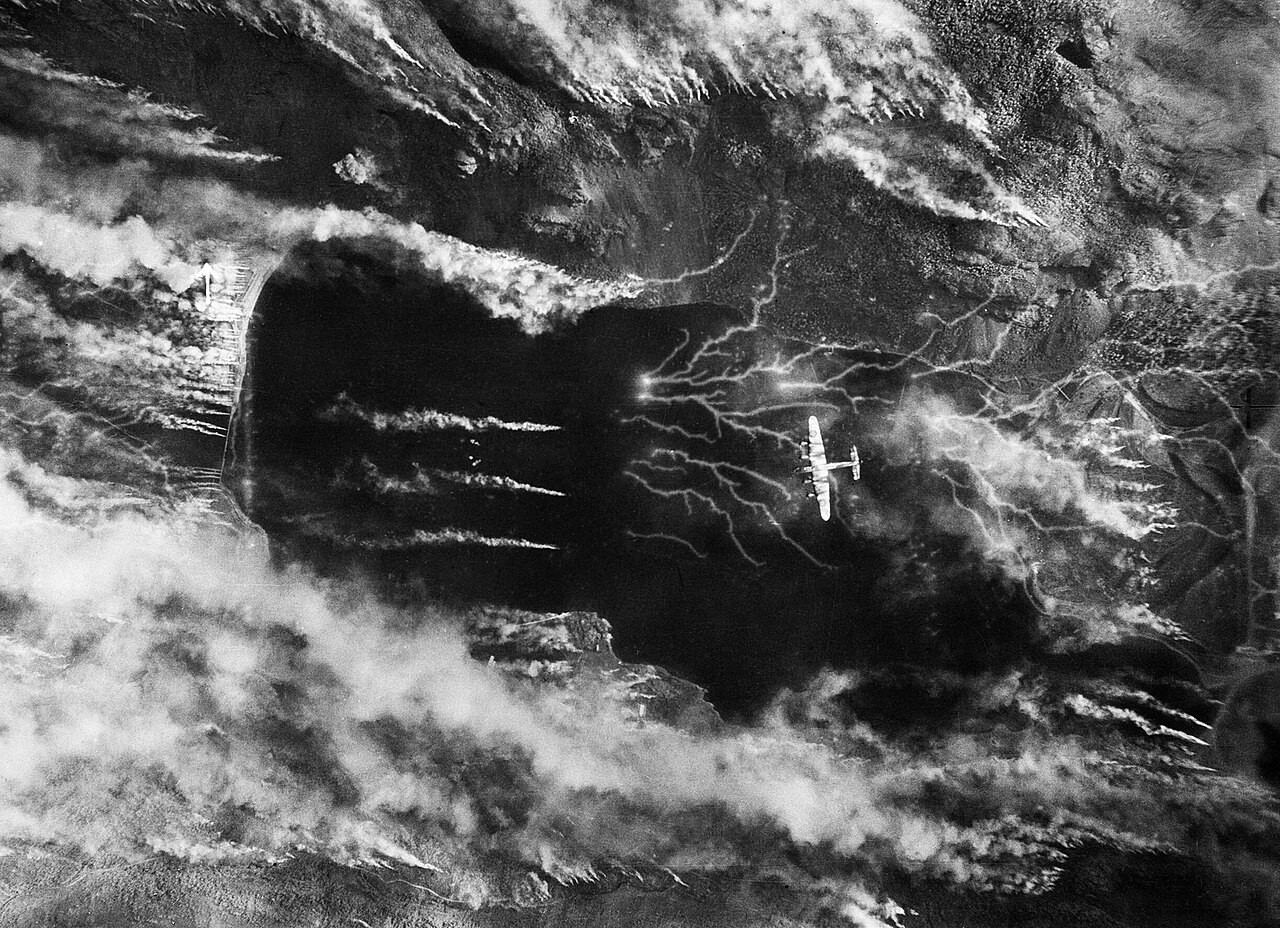
A Lancaster seen from above over a mountainous Norwegian fjord and cloud.

Operation Paravane · September 1944

A Lancaster over Kåfjord during Operation Paravane, the September 1944 attack on Tirpitz.

No. 5 Group RAF / Imperial War Museums, C 4873 · Source · Public domain (source statement)

The Commons date field says 1943, contradicting its identification of Paravane. The date here follows the documented September 1944 operation. Original annotation is retained.

Carrying the load far enough

No.5 Group’s contemporary newsletter describes modified Lancasters with extra fuel tanks and unnecessary equipment removed, including the mid-upper turrets. These changes made the aircraft suitable for the northern mission; they were not the standard configuration of every Lancaster. The account identifies Nos.9 and 617 Squadrons as delivering the final attack. YT-T06

Those choices illustrate the trade between range, bomb load and defensive equipment. A bomber’s headline payload alone cannot explain whether it could reach a particular target.

A target that had to be seen

The newsletter describes a route intended to reduce early detection and the crews’ relief at finding the anchorage clear of cloud and smoke on arrival. Smoke from the attack then made results harder to distinguish. It reports twenty-nine aircraft delivering the attack, separately from the larger force assembled for the operation. YT-T06

The article is valuable operational testimony, but some of its earlier-raid chronology is faulty. It is not a substitute for individual squadron operations record books.

A small entry in a flying log

The RAF Museum reproduces a detail of Wing Commander Tait’s logbook identifying the Tirpitz operation at Tromsø and recording the ship sunk. This is a participant’s contemporary record of the operation’s outcome. The published crop does not establish which aircraft’s bomb caused which damage. YT-T20

The later naval technical investigation asks the separate question of how Tirpitz capsized, drawing on reports and information of uneven completeness. YT-T02

Continue with The Last Anchorage and the Tallboy profile.

Evidence within reach

Sources for this page

Open a note for the passage, inspection status and limits. Source records link to the available documents.

YT-T06V Group News: The End of the Tirpitz

Contemporary service publication through archive transcription

Passage: The End of the Tirpitz: modifications, route, visibility and attacking-force count

Final RAF attack, participating squadrons and observation limits.

Checked: Tirpitz article read through IBCC catalogue/transcription.

Limits: Not squadron operations record books. Some earlier-attack chronology conflicts; exact hits and casualties not certified. Archive images have not been reused.

View full source record →
YT-T20Tait flying logbook: Tirpitz operation

Published image detail of a contemporary flying logbook

Passage: Published detail of Tait logbook, RAF Museum M10395: Tirpitz / Tromsø entry

Participant record of the operation and its reported outcome.

Checked: Museum-published image downloaded and visually inspected on 20 October 2026.

Limits: Partial, low-resolution crop, not full logbook inspection. The asset filename incorrectly contains 1942; museum context dates the entry to 12 November 1944. Aircraft serial and full timing columns are not transcribed. Does not allocate hits. Image retained only for research, not reproduced on this site.

View full source record →
YT-T02Technical investigation of Tirpitz’s final loss

Postwar technical report through modern transcription

Passage: Narrative and introduction: final attack, damage and evidence used

Reconstruction of damage, flooding and loss of stability.

Checked: Selected narrative, source list, analysis and appendices read through the transcription.

Limits: No full scan comparison. Chief engineer absent from final sinking; confirmed and probable hits distinguished. Earlier damage descriptions contain inconsistencies; casualty totals not certified.

View full source record →

Photograph

Enlarged historical photograph

Web copy resized and compressed; original framing retained. Open image file ↗