A connected aircraft profile

Fairey Barracuda

On 3 April 1944, the Barracudas reached Tirpitz in favourable flying weather. What their bombs damaged mattered as much as how many appeared to hit.

Profile · Evidence and limits

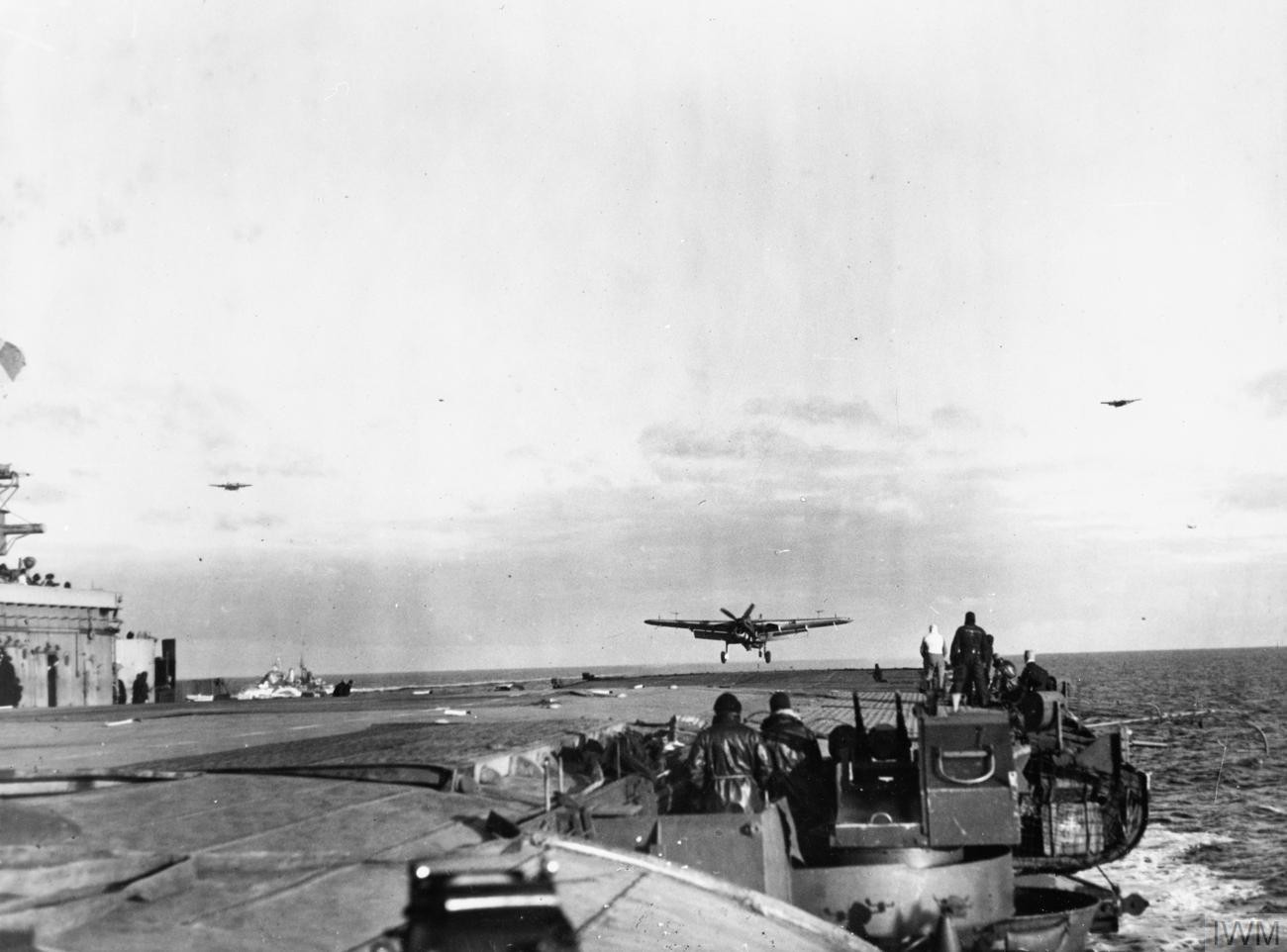
A Barracuda approaches the flight deck of Victorious, watched by deck personnel.

Operation Tungsten · April 1944

A Barracuda approaches Victorious during Operation Tungsten. The catalogue identifies Belfast off the carrier’s starboard quarter.

F. A. Hudson, Royal Navy official photographer / Imperial War Museums, A 22644 · Source · Public domain (source statement)

The archive identifies the operation; it does not identify the individual aircraft or crew.

Rehearsal before the fjord

The Home Fleet diary describes a practice target at Loch Eriboll representing Tirpitz’s anchorage, followed by a dress rehearsal on 28 March. The carrier crews were preparing for a particular approach and target, not simply taking bombs north and looking for an opportunity. YT-T17

Its April summary records forty Barracudas and eighty-one fighters in two strikes. Fighters attacked the defences while the bombers pressed their attacks. These are the summary’s participating-force figures, distinct from aircraft reserved to defend the fleet.

The Admiralty battle summary explains the difference between the planned forty-two bombers and the forty that set out for Tirpitz. During the second strike’s departure, one Barracuda failed to start and another crashed after take-off, killing its crew. Nineteen continued in that strike, following the twenty-one of the first. A planned aircraft total conceals both mechanical failure and human loss. YT-T22

The aircraft and its load

The summary’s aircraft table identifies the Barracuda II with a crew of three. It lists alternative loads, including one 1,600-pound armour-piercing bomb, three 500-pound bombs, or two 600-pound anti-submarine bombs. The Tungsten weapons profile explains why those loads were selected and how release height affected the expected result. YT-T22

An attack against a recovering ship

The German account places the raid amid preparations for trials. Its damage categories distinguish deck hits, an underwater hit and a near miss. That is more informative than combining them into a single number of direct hits. YT-T05

The later American technical report describes extensive damage in the superstructure and upper spaces. Its reported hit total differs from the German account; this profile does not reconcile those figures by selecting the larger one. YT-T02

Damage without sinking

The immediate British assessment claimed more hits than expected but acknowledged that damage was not yet fully assessable. A further attack the next day was considered and abandoned, with aircrew fatigue and reported damage among the reasons. YT-T17

Tirpitz survived, but survival did not mean that the raid had failed to affect her usefulness. Follow Tungsten and the Return to Repair for what happened to her readiness.

Evidence within reach

Sources for this page

Open a note for the passage, inspection status and limits. Source records link to the available documents.

YT-T22Admiralty Battle Summary No. 27: Operation Tungsten

Official wartime operational synthesis · scan of printed edition

Passage: Printed pp.2–3, 7 and 14 / PDF pp.8–9, 13 and 20: planned force, actual departures, bomb loads and aircraft table

Shared Victorious/Furious strike organisation; squadron exchange; aircraft preparation and fleet protection; planned flying programme; Barracuda II and selected bomb loads; conditional expectations for bomb effects. Reported release heights and the two-aircraft reduction in the second strike.

Checked: Title and source-list pages and the cited printed pages visually inspected on 20 October 2026. Full 40-page scan retained with SHA-256; selected page renders retained. Source list identifies Home Fleet report M.056731/44 and carrier reports dated 5 April 1944. Appendix E read as a programme, not an execution log. Printed p.1 and strike observations on pp.6–7 also visually checked for the gun profiles. Printed pp.2, 7 and 14 / PDF pp.8, 13 and 20 rechecked for Hellcat roles, aircraft particulars and the damaged-hook loss. Printed pp.2, 12, 15, 22 and 24 / PDF pp.8, 18, 21, 28 and 30 visually checked on 20 October 2026 for Emperor’s roster, two fighter groups, Hoare’s loss and the flying programme. Printed pp.7, 12, 14–15 and 24 / PDF pp.13, 18, 20–21 and 30 visually checked on 21 October 2026 for Searcher, Fell’s escort role and the Wildcat variants. Printed pp.4, 6, 12, 15 and 24 / PDF pp.10, 12, 18, 21 and 30 visually checked on 21 October 2026 for Pursuer, Graham, Sleigh, the steering incident and Wilkinson’s return footnote. Printed pp.3, 6, 8, 12 and 24 / PDF pp.9, 12, 14, 18 and 30 visually rechecked on 21 October 2026 for Fencer’s fleet protection, aircraft and flying programme. Printed pp.2–5, 9 and 12 / PDF pp.8–11, 15 and 18 visually rechecked on 21 October 2026 for Royalist, Bisset, Eveleigh, force reorganisation and Sheffield. Printed pp.2, 5, 9 and 12 / PDF pp.8, 11, 15 and 18 visually rechecked on 21 October 2026 for Anson, Moore, McCarthy, guns, Force 7 and the decision to cancel the repeat attack.

Limits: An official synthesis compiled from reports, not the signed original reports of Victorious and Furious. Its source list is evidence of the compiler’s sources, not proof we inspected those manuscripts. Aircraft allocation, actual departures, aircraft attacking and fleet-defence aircraft are distinct counts. The bomb-penetration heights are planning expectations, not confirmed damage results. No exact bomb mark, explosive fill or reconstructed complete flight log is assigned. Its armament footnote is a British assessment, not a dated German final-fit return. Its HA/LA label for the 5.9-inch battery is not adopted; the new profiles do not classify those guns as dual-purpose. Strike descriptions preserve the attackers’ viewpoint. The flying programme is a planned schedule; Emperor’s complete log and squadron records have not been independently compared. The aircraft table lists Wildcat V and VI but does not map them to individual carriers; no mark is assigned to every Searcher aircraft from that table. Pursuer’s steering failure is recorded without a precise mechanical diagnosis; the account describes a narrowly avoided incident, not a collision. The aircrew roster is not a complete flying log. The planned four airborne and four standby Wildcats are not a complete execution log. Twenty-five fleet-defence fighters combine Seafires and Wildcats; nine retained Swordfish do not mean nine continuously airborne. Force 2 and Force 8 are successive operational groupings, not interchangeable labels. Seventeen knots is the mixed force’s stated maximum, not Royalist’s individual maximum. Royalist’s eight 5.25-inch guns are operation-list particulars; no bombardment of Tirpitz or complete fighter-control log is established.

View full source record →
YT-T17Commander-in-Chief Home Fleet war diary: March–April 1944

Modern transcription of a wartime command diary

Passage: April 1944 summary, paragraph 139 (iii) and (viii)–(x): training, aircraft and attack

Training, attack composition, initial assessments and decision against an immediate repeat attack.

Checked: Full paragraph 139 read on 20 October 2026 and retained; compared with German damage reporting. Earlier research inspected the March–April readiness entries.

Limits: Original Admiralty PDF could not be retrieved in this pass. Transcription is not a facsimile; immediate hit claims are not confirmed damage totals. Repeated history entries are not independent evidence.

View full source record →
YT-T05Tirpitz’s report on Operation Tungsten

Contemporary German report through modern transcription

Passage: Opening account and damage categories: postponed trials, 13 deck hits, underwater hit and near miss

Postponed trials, departure preparations, machinery and separate hit categories.

Checked: Opening paragraphs and damage categories read and rechecked on 20 October 2026.

Limits: Not compared with original images or fully translated. Preserve 13/14 April discrepancy. Thirteen deck hits, one underwater hit and one near miss are not fifteen direct hits.

View full source record →
YT-T02Technical investigation of Tirpitz’s final loss

Postwar technical report through modern transcription

Passage: Introduction: assessment of April bomb damage; reported totals differ from German account

Reconstruction of damage, flooding and loss of stability.

Checked: Selected narrative, source list, analysis and appendices read through the transcription.

Limits: No full scan comparison. Chief engineer absent from final sinking; confirmed and probable hits distinguished. Earlier damage descriptions contain inconsistencies; casualty totals not certified.

View full source record →

Photograph

Enlarged historical photograph

Web copy resized and compressed; original framing retained. Open image file ↗