A connected ship profile

X-craft midget submarines

The attack began long before the harbour nets. First the small craft had to reach Norway, with their machinery working and their attack crews ready.

Profile · Evidence and limits

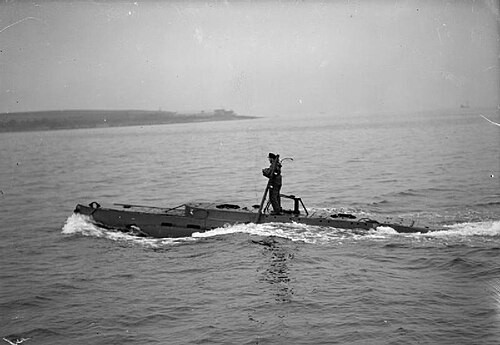
A small X-craft submarine underway with an officer standing on its casing.

Second World War

X25 underway at Loch Striven, with Lieutenant J. E. Smart on deck. The photograph illustrates the small submarine type.

S. J. Beadell, Royal Navy official photographer / Imperial War Museums, A 22903 · Source · Public domain (source statement)

This is X25, not one of the craft that attacked Tirpitz. The catalogue supplies no exact date.

Two crews, two journeys

For the long passage, full-sized submarines towed the X-craft. Passage crews manned the small boats while their operational crews travelled aboard the towing submarines. The official account records X.6 with Truculent, X.5 with Thrasher and X.7 with Stubborn. The arrangement preserved the distinction between delivering a craft and fighting it inside the anchorage. YT-T01

Even under tow, the X-craft had to surface periodically to ventilate. Their small size helped make the final approach possible but did not remove the demands of a sea passage.

Placing the weapon

The craft carried explosive charges that could be released beside or beneath the target. The later official reconstruction describes four charges, each weighing two tons, laid by X.6 and X.7. This is the weight reported for each charge, not a newly verified figure for its explosive filling. YT-T01

Getting them into position required navigating nets, shallow water and the ship’s immediate defences. The account describes X.6’s flooded periscope and disabled compass; X.7 repeatedly became entangled and used air while trying to free herself. The attack was a succession of decisions with damaged equipment.

Escape was another operation

X.6 was scuttled and her four men taken aboard Tirpitz. X.7’s abandonment ended with two men surviving and two missing. The despatch records these outcomes alongside the attack, rather than treating the release of the charges as the end of the crews’ story. YT-T01

The precise contribution of X.5 remains unresolved in the inspected evidence.

Success measured in repair time

Tirpitz remained afloat. Yet the subsequent German record of repair, trials and training shows why sinking was not the only consequential outcome. Disabling machinery and delaying a return to effective service could alter what the ship could threaten for months. YT-T18

Continue with Beneath the Defences and Repairing a Battleship.

Evidence within reach

Sources for this page

Open a note for the passage, inspection status and limits. Source records link to the available documents.

YT-T01Operation Source despatches

Official printed edition of command reports

Passage: Gazette supplement 38204, PDF p.3 / printed p.995; PDF pp.14–15 / printed pp.1006–1007

Development, transport, evolving damage assessment and later witness evidence.

Checked: Previously inspected selected pages; PDF pp.3, 14 and 15 visually rechecked on 20 October 2026 for passage crews, craft allocation, attack and charges. Printed pp.995 and 1000–1002 / PDF pp.3 and 8–10 visually rechecked on 20 October 2026 for Stubborn’s outward tow, search, recovery, crew transfer and scuttling of X.10. Personal account: Gazette p.1007 / PDF p.15 visually rechecked on 24 October 2026, distinguishing Place’s quoted report from the final report’s narrative of escape; p.1005 identifies the July 1945 report layer.

Limits: Not the signed manuscript or original German diary. Reports have different evidence bases and time conventions. X.5’s exact contribution remains unresolved. The Stubborn profile uses the published official despatch, not a separately inspected complete submarine patrol report.

View full source record →
YT-T18Naval Staff diary: March 1944

Scanned English translation of wartime diary

Passage: March 1944 diary, PDF pp.255 and 469: restoration, trials and training

Trials, cruising-turbine vibration, staged machinery forecasts and crew training.

Checked: Title page and selected entries visually inspected on 20 October 2026.

Limits: Not German originals. Ambiguous translated readiness terminology and dates need comparison. Forecasts do not certify completion or British knowledge.

View full source record →

Photograph

Enlarged historical photograph

Web copy resized and compressed; original framing retained. Open image file ↗