A connected ship profile

HMS Rodney

Rodney carried nine 16-inch guns. Bringing them into action required the target to bear, the guns to be loaded and the machinery to keep working.

Profile · Evidence and limits

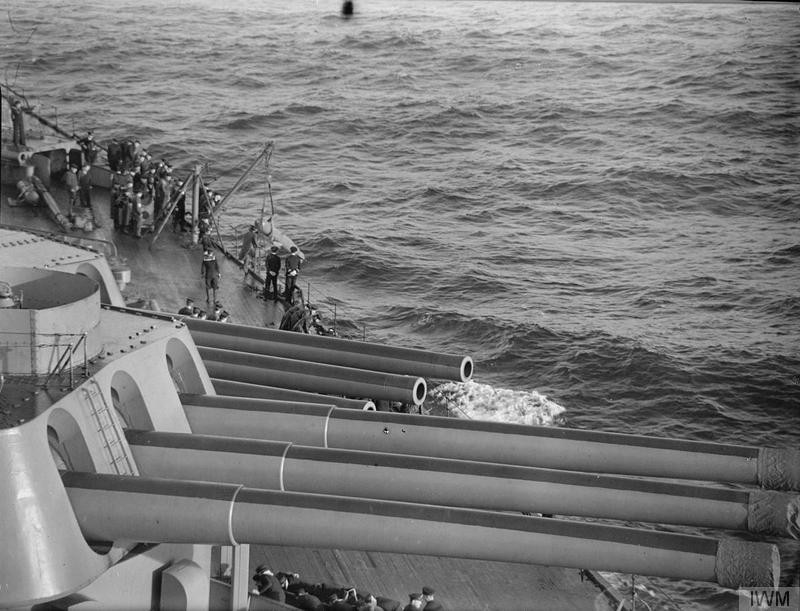
Sailors at work on Rodney’s foredeck beneath the forward guns.

1940

Rodney’s crew prepare to recover paravanes and clear the anchor cable before entering harbour. The view connects the battleship’s machinery with the people who operated it.

R. G. G. Coote / Imperial War Museums, A 2146 · Source · Public domain (source statement)

A concentrated main battery

Rodney’s three triple turrets were grouped forward, with B raised above A. The reproduced gunnery report also lists six twin 6-inch secondary mountings. These smaller guns formed a separate battery; they should not be added to the main-gun count. B09

“Sixteen inch” describes the bore diameter, approximately 406 millimetres. It is not a measure of range or a guarantee that a shell will penetrate any part of another ship. Position, ammunition, impact angle and the target’s protection all matter.

Installed guns and guns bearing

The report states that X turret could bear during only six of the first twenty-five salvos. A turret could be fully functional yet unable to engage the target on the ship’s current heading. Its loading-failure list describes another restriction: guns could temporarily stop firing without having been hit by the enemy. B09

This is why a broadside total is a starting point for understanding a battleship, rather than a count of the weapons she necessarily fired together throughout an engagement.

Closing with Bismarck

Tovey’s despatch places Rodney alongside King George V in the approach to the final action. Rodney opened fire first, followed shortly by the flagship. As the engagement continued, the British ships closed the range and Bismarck’s effective resistance diminished. B11

Rodney was part of a combined attack. Observations of hits from several ships do not permit every visible explosion or damaged turret aboard Bismarck to be assigned confidently to one British gun. The final-battle chapter follows that distinction between the observed collapse of resistance and the less certain internal damage sequence.

Reading the equipment evidence

The gunnery transcription’s ammunition figures contain an arithmetic discrepancy, so this profile does not present a supposedly exact expenditure total. Its introductory armament note also needs comparison with the original enclosure. Those limitations do not erase the practical lesson of restricted arcs and interrupted loading, but they remain attached to the source.

Compare the naval-gunnery profile for how different batteries divided their fire into salvos.

Evidence within reach

Sources for this page

Open a note for the passage, inspection status and limits. Source records link to the available documents.

B09Rodney’s preliminary gunnery report

Contemporary technical reporting · modern web transcription

Passage: Introductory armament note and paragraphs 2–3; modern transcription, original enclosure unchecked

Main-armament arrangement, restricted firing arcs and reported loading failures during the final action.

Checked: Full short transcription reread on 18 October 2026. Original page images not inspected. Full short transcription rechecked for the Rodney and naval-gunnery profiles; no exact ammunition total adopted.

Limits: The reproduced ammunition figures contain an arithmetic discrepancy; no exact expenditure total is adopted. A reported loading failure is not evidence of an enemy shell hit. The original enclosure and editorial provenance of the introductory note remain to be compared.

View full source record →
B11Tovey’s despatch

Contemporary command report · later official printed edition

Passage: PDF pp.12–13 / Gazette pp.4858–4859, paragraphs 77–84: opening and course of the final action

Discovery, the decision to shadow after Hood’s loss, fuel and interception constraints, Victorious’s attack and later operational pressures. Loss of radar contact, search choices and the misleading radio-bearing plot aboard King George V. Rescue and the reported reason for breaking it off.

Checked: Selected official printed pages inspected. Paragraphs 3–15 on pp.4847–4849 visually checked for chapter 4 on 18 October 2026; earlier checks include pp.4855–4857. For The Pursuit, PDF pp.4–8 / printed pp.4850–4854 visually checked, including paragraphs 19–44 and Admiralty footnotes. For Contact Lost, PDF pp.8–9 / printed pp.4854–4855 visually checked, paragraphs 44–54 and the Prinz Eugen footnote. For Contact Regained, PDF p.10 / Gazette p.4856 visually checked, especially paragraphs 59–63. For The Final Battle, PDF pp.11–13 / Gazette pp.4857–4859 visually checked, paragraphs 70–87. Paragraph 87 on PDF p.13 rechecked for Rescue and Remembrance. Ship-profile expansion: PDF pp.4–5 and 12–13 visually rechecked for Prince of Wales and King George V. Supporting-ship update: PDF p.13 / Gazette p.4859 visually rechecked for Dorsetshire’s gunfire, torpedo attack and rescue, paragraphs 84–87. Cruiser-profile review, 18–19 October 2026: PDF pp.3, 5, 8 and 13 / Gazette pp.4849, 4851, 4854 and 4859 visually rechecked for Suffolk and Norfolk.

Limits: A retrospective commander’s account, not the signed manuscript or a complete inventory of British naval strength. Disagreements with the web transcription remain recorded in the research audit. Later Admiralty footnotes correct the interception forecast and qualify Tovey’s assessment of the first torpedo hit; these are distinct editorial voices. Overconfidence is Tovey’s retrospective judgement. The Admiralty footnote corrects his inference that Prinz Eugen remained present; a possible Walrus sighting is a counterfactual, not a certainty. Position-error estimates are Tovey’s retrospective assessment; finding Bismarck did not itself secure an interception. Night torpedo-hit claims are not independently confirmed. External observations of gun suppression and sinking do not establish the internal damage sequence or settle the contribution of scuttling. The submarine sighting is explicitly uncertain. Rescue totals differ from B24 and the later B26 roll; the speculative Canarias rescue is not adopted. Suffolk’s initial discovery was visual; radar sustained contact. Norfolk’s report reached Tovey first. Norfolk’s limited forward radar coverage is not treated as equivalent to Suffolk’s; no radar model or full dated fit is assigned.

View full source record →

Photograph

Enlarged historical photograph

Web copy resized and compressed; original framing retained. Open image file ↗