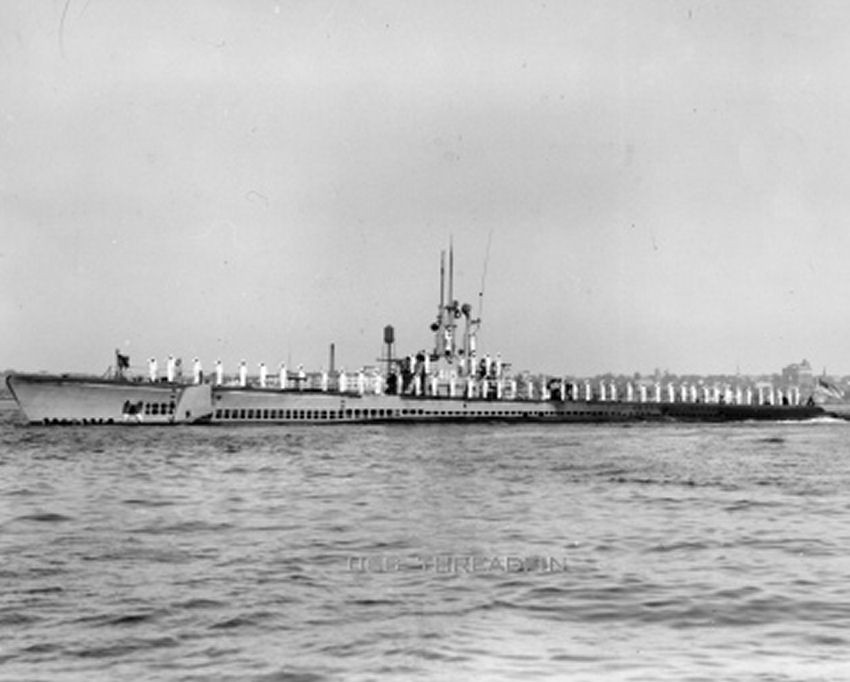


Watching the approaches
Threadfin’s second patrol brought her to the approaches to the Bungo Suido, the passage between Kyushu and Shikoku. On 6 April, her report records aircraft, minesweepers and vessels conducting anti-submarine searches. The submarine watched from near Fuka Shima as activity increased around the route out to sea. YT-Y24
The report was submitted on 4 May by J. J. Foote. Its dated entries preserve the crew’s sequence of observations, but they remain an account written up after the events. The distinction matters when the men were trying to identify ships in darkness.
Large ships in the dark
At 1944, Threadfin picked out four ship echoes among the radar returns from land and islands. Two minutes later, the display showed two large ships and at least four smaller ones. Nearby vessels looked like destroyers. Foote judged that he had a favourable position for an attack, but the ships’ speed and his orders made it difficult to use. These times follow the report’s stated ITEM time convention. YT-Y24
At about 2000, the two large ships were visible roughly 10,000 yards away. The crew thought that one might be an aircraft carrier, although it was too dark to be certain. A footnote explains that they subsequently learned this was Yamato: her long, flat hull had contributed to the mistake. The later identification should not be placed in the mouths of the men at the moment of first contact.
The message before the shot
Foote records written orders requiring the initial contact report to be transmitted before attacking. To stay on the approaching destroyers’ tracks while doing so risked being forced underwater. Threadfin worked away from those tracks and tried to keep pace. At about nineteen knots, she was still losing position. YT-Y24
The initial report went out at 2020. At 2027, Threadfin opened the stern tube doors and prepared to fire Mark 14 torpedoes at a nearby destroyer. Another Japanese course change then took the target beyond range. The record describes a missed opportunity shaped by reporting priority, speed and manoeuvre; it does not describe a torpedo fired at Yamato.
Threadfin sent four further reports as the enemy changed course. At 2300, she deciphered a message cancelling the instruction that contact reports take priority over attacks. By then the promising position had gone. Contact was lost at 2348, and the submarine returned towards her patrol area.
Hearing the outcome
On the evening of 7 April, the crew heard that Task Force 58 had devastated the force they had followed. They had supplied information and attempted to gain an attack position, but had not witnessed the air battle or Yamato’s sinking. YT-Y24
The patrol report establishes Threadfin’s own contribution. It does not, by itself, reconstruct when every American commander received her signals or how each message influenced the carrier decision. Nor does an advantageous torpedo position prove that an attack would have succeeded. Those questions need other records alongside Foote’s account.
Read Hackleback’s separate account for the other submarine’s tracking and radio difficulties.
Return to The Last Sortie for the Japanese departure, then Under Carrier Attack for the battle the following day.