A connected ship profile

USS Vireo

Vireo had no flight deck and could not restore Yorktown’s machinery. What she could offer was a tow: a slow attempt to move a surviving carrier towards safety.

Profile · Evidence and limits

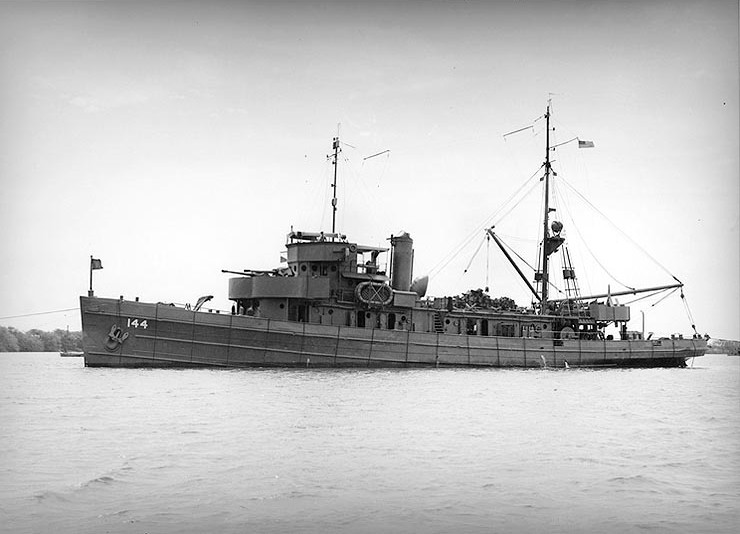
USS Vireo at Pearl Harbor, viewed from the side.

20 August 1942

Vireo at Pearl Harbor after repairs and overhaul. By this photograph she was designated AT-144; at Midway she had still been AM-52.

U.S. Navy / NHHC, 19-N-34748 · Source · Public domain (source statement)

This photograph postdates the Midway towing and rescue work.

A working ship with a new designation

Vireo had served as a minesweeper before being redesignated an ocean-going tug, AT-144, on 1 June 1942. The later official ship history supplies that administrative date. It helps distinguish the vessel’s identity at Midway from photographs and accounts using her earlier AM-52 number or later ATO-144 designation. M61

Moving a carrier without engines

Yorktown’s technical report records Vireo joining on 5 June and taking the carrier in tow at about two knots. The damaged carrier yawed badly and appeared lower by the bow. Starting a tow therefore did not mean that the ship was stable or close to safety. M18

Nimitz’s report lists other vessels dispatched to assist. Their being ordered towards Yorktown should not be mistaken for all of them having arrived and begun work. For the immediate tow, the record identifies Vireo. The same command account distinguishes the tug’s work from the destroyers’ screening and the salvage party’s efforts aboard the carrier. M01

Towing and salvage were different jobs

Vireo could provide movement while men aboard Yorktown worked on flooding, fire and the distribution of weight. Hammann supplied assistance alongside. These tasks depended on one another: towing alone could not restore buoyancy, while a repair party could not make a powerless carrier steam home. M18

The submarine attack on 6 June interrupted this effort. Yorktown remained afloat through another night before capsizing on 7 June. Her eventual loss does not make the preceding salvage attempt imaginary or its outcome inevitable from the moment she was abandoned. M18

From towing to rescue

The later official history describes Vireo cutting the tow and returning to recover men, sustaining damage while working close to Yorktown. That account extends the tug’s story beyond the tow; it remains a later narrative pending comparison with Vireo’s own original operational records. M61

Follow Beyond the Carrier Battle for the wider sequence. The two-knot figure describes this particular tow, not Vireo’s maximum speed or a general measure of tug capability.

Evidence within reach

Sources for this page

Open a note for the passage, inspection status and limits. Source records link to the available documents.

M18Yorktown’s damage report

Technical report · third-party scan extract

Passage: PDF p.6 / printed p.3, paragraphs 13–16: towing, salvage and loss

The sequence of damage, recovery, interrupted salvage and loss of Yorktown. Fuel precautions, flight-deck repair, boiler recovery, loss of power and abandonment.

Checked: PDF pages 4 and 17 visually inspected; other text selectively examined. PDF pp.4–5 rendered and visually rechecked on 18 October 2026 for Hiryū Fights Back. PDF p.6 / printed p.3 visually inspected for towing, salvage, the submarine attack and final loss. Supporting-ship update: PDF p.6 visually rechecked for Vireo’s tow and Hammann’s salvage assistance.

Limits: Relies on officers’ reconstructed recollections after records were lost. Cover publication date and complete plate set are absent from the retained extract. Draws on the captain’s submissions, so is not independent corroboration of M04. Its 1645 torpedo-hit time differs from M04’s approximately 1620, and its 23-degree abandonment list differs from M04’s 26 degrees. The paragraph 10 elapsed-time arithmetic is inconsistent; no exact repair duration is inferred from it. The post-Hammann underwater explosion is tentatively attributed to depth charges, whereas M44 leaves the cause unresolved. The smaller list after the later attack did not mean improved overall buoyancy.

View full source record →
M01Nimitz’s Midway action report

Contemporary command report · selected scan pages checked; earlier passages read in transcription

Passage: PDF / printed pp.21–22, paragraphs 62–65: assistance dispatched, tow and interrupted salvage

The broad course of the battle and the report’s explicit clock convention. Later pursuit, cruiser attacks and rescue from Yorktown.

Checked: Earlier preparation, timing and attack passages read in modern transcriptions; paragraphs 13–18, 19–25 and 27–36 rechecked on 18 October 2026. For the aftermath chapters, a 28-page scan of serial 01849 was retained and PDF / printed pp.1 and 17–21 rendered and visually inspected. Earlier chapter passages have not all been compared with these images. The report date is taken from the transcription; it is not legible on the inspected first-page image. PDF / printed p.25 visually inspected for fighter assessment, replacement groups and training. Aircraft expansion: PDF / printed pp.6–12, 23 and 25 visually inspected on 18 October 2026; night attack, scout reports, TBF/TBD operations, fighter allocations and equipment assessments. Supporting-ship update: PDF/printed pp.21–22 visually inspected for paragraphs 62–65, including the continuation of paragraph 63. Cruiser-profile review, 18–19 October 2026: PDF / printed pp.20–21 visually rechecked for 6 June attacks and the erroneous two-cruiser sinking claim.

Limits: Preliminary enemy identifications and loss estimates are not final accounting. The report uses Zone plus 12; task-force reports can use a different clock. Both web copies transmit the same report. The apparent 126 B-17 transcription error is not adopted. Early hit claims and a possible fifth carrier are not accepted as established facts. Early warning times differ from M31. The statement implying deliberately spared runways is not adopted; M32 records actual runway damage and repairs. Torpedo hits, early Sōryū damage, additional ships claimed hit and precise deck conditions are not adopted as confirmed facts. Aircraft losses are distinct from personnel losses. Its retrospective sacrifice explanation is not treated as a deliberate attack plan. Its claim that both Mogami and Mikuma sank is rejected; its preliminary personnel total is not a final casualty roll. The scan does not include the separately listed enclosures. Paragraph 74’s claimed fighter exchange ratio is not treated as a verified loss total or controlled performance comparison. Early damage and hit claims on these pages are not adopted as confirmed results. The retrospective sacrifice explanation is not an order for a planned diversion. The reported two hits on Hammann differ from the captain’s account; post-sinking explosion explanations remain tentative. Ships dispatched to assist are not all treated as having arrived.

View full source record →
M61Vireo I — official ship history

Retrospective official history · HyperWar reproduction

Passage: May–June 1942 passages: redesignation, towing and rescue; later official ship history in web transcription

Change from AM-52 to AT-144 on 1 June 1942; later account of cutting the tow and rescuing men after the submarine attack.

Checked: Relevant May–June 1942 passages read on 18 October 2026 through the HyperWar transcription. The current NHHC page could not be opened directly; no original Vireo log or classification order inspected.

Limits: Later history, not Vireo’s contemporary action report. Undated opening particulars are not adopted as a Midway fit. ATO-144 belongs to 1944, not Midway. Its assertion that Hammann’s depth charges caused the explosion is not adopted as certain. Precise clocks and compressed carrier-loss chronology are not adopted; M18 supplies the inspected wartime salvage account.

View full source record →

Photograph

Enlarged historical photograph

Web copy resized and compressed; original framing retained. Open image file ↗