A connected ship profile

USS Hammann

Hammann protected Yorktown, recovered survivors and returned with a salvage party. On 6 June, the destroyer was herself lost alongside the carrier she was helping to save.

Profile · Evidence and limits

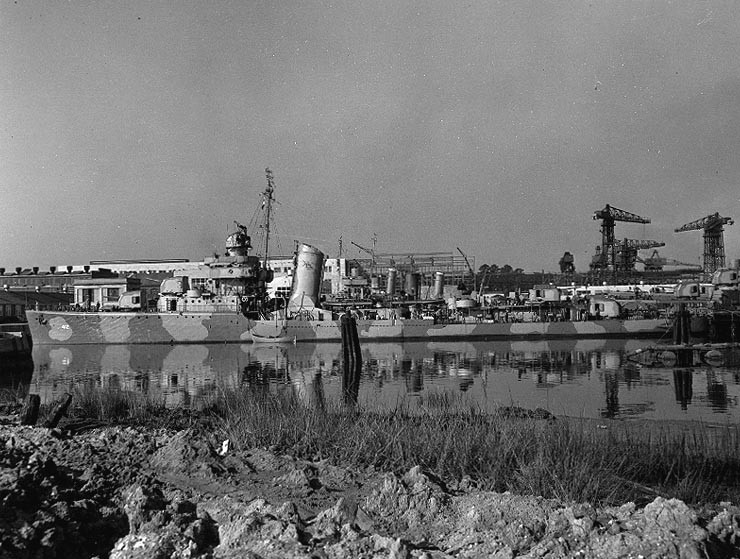
USS Hammann seen alongside a navy-yard pier.

January 1942

Hammann at Charleston Navy Yard before transferring to the Pacific. This earlier view introduces the destroyer later lost alongside Yorktown.

U.S. Navy / National Archives; NHHC Hammann ship history · Source · Public domain (source statement)

The date and location were checked against the NHHC ship-history photograph caption.

A carrier’s protection

Hammann’s report describes firing 5-inch and 20 mm guns during the attacks on Yorktown, then recovering aircrew and carrier survivors. These entries establish weapons used in the action, rather than a complete armament return or independently confirmed aircraft kills. M44

An escort’s duties competed for attention. Remaining close enough to protect the carrier could delay a rescue elsewhere; recovering men could require leaving the screen. The report makes those choices visible without giving the destroyer’s crew knowledge of the battle’s eventual result.

Alongside the damaged ship

Hammann returned with Yorktown’s captain and salvage personnel. Holding a useful position clear of the carrier proved impractical, so she secured alongside. Her report describes firefighting hoses, assistance with removing oil and counterflooding, and food for the working party. M44

Yorktown’s technical report describes the arrangement from the damaged carrier’s perspective: salvage work used power from Hammann while awaiting salvage tugs. The reduction in list represented progress, but the operation remained exposed to attack. M18

Rescuers in the water

Submarine torpedoes struck during that work on 6 June. Hammann sank rapidly. A powerful underwater explosion followed, killing and injuring men who had escaped into the sea. Her captain did not establish whether a depth charge or torpedo caused it. His report was reconstructed from memory because the ship’s records had been lost. M44

Nimitz’s command report also preserves uncertainty about the explosions. It differs from the captain’s account over the number of hits on Hammann; neither is used here to fix an exact weapon-by-weapon sequence. Yorktown’s later technical analysis tentatively attributed the underwater blast to depth charges. M01 M18

Read Beyond the Carrier Battle for the salvage attempt, and The People Left Behind for the care of survivors. Original Hammann report images and a reconciled casualty roll remain outstanding.

Evidence within reach

Sources for this page

Open a note for the passage, inspection status and limits. Source records link to the available documents.

M44Hammann’s loss and the care of survivors

Contemporary ship report reconstructed from memory · modern transcription

Passage: Captain’s paragraphs 1, 3–9 and Hartigan’s statement: defence, rescue, salvage and loss; modern transcription

Salvage assistance, the destroyer’s sinking and Crawford’s care of wounded survivors. Antiaircraft weapons reported used, rescue duties and practical assistance alongside Yorktown.

Checked: Relevant passages and the opening memory caveat read on 18 October 2026. Original page images not inspected. Supporting-ship update: captain’s paragraphs 1 and 3–9 and appended statement reread; official NHHC page was unavailable and no original scan retrieved.

Limits: Records were lost; times and early casualty counts are provisional. The underwater explosion’s cause remains unresolved. No final death total is adopted from this report. The captain and Hartigan differ on the apparent torpedo-hit sequence; Nimitz also reports two hits on Hammann. No exact hit reconstruction or confirmed aircraft-kill total is inferred.

View full source record →
M18Yorktown’s damage report

Technical report · third-party scan extract

Passage: PDF p.6 / printed p.3, paragraphs 14–16: salvage assistance and the attack

The sequence of damage, recovery, interrupted salvage and loss of Yorktown. Fuel precautions, flight-deck repair, boiler recovery, loss of power and abandonment.

Checked: PDF pages 4 and 17 visually inspected; other text selectively examined. PDF pp.4–5 rendered and visually rechecked on 18 October 2026 for Hiryū Fights Back. PDF p.6 / printed p.3 visually inspected for towing, salvage, the submarine attack and final loss. Supporting-ship update: PDF p.6 visually rechecked for Vireo’s tow and Hammann’s salvage assistance.

Limits: Relies on officers’ reconstructed recollections after records were lost. Cover publication date and complete plate set are absent from the retained extract. Draws on the captain’s submissions, so is not independent corroboration of M04. Its 1645 torpedo-hit time differs from M04’s approximately 1620, and its 23-degree abandonment list differs from M04’s 26 degrees. The paragraph 10 elapsed-time arithmetic is inconsistent; no exact repair duration is inferred from it. The post-Hammann underwater explosion is tentatively attributed to depth charges, whereas M44 leaves the cause unresolved. The smaller list after the later attack did not mean improved overall buoyancy.

View full source record →
M01Nimitz’s Midway action report

Contemporary command report · selected scan pages checked; earlier passages read in transcription

Passage: PDF / printed pp.21–22, paragraph 63: reported damage and uncertainty over explosions

The broad course of the battle and the report’s explicit clock convention. Later pursuit, cruiser attacks and rescue from Yorktown.

Checked: Earlier preparation, timing and attack passages read in modern transcriptions; paragraphs 13–18, 19–25 and 27–36 rechecked on 18 October 2026. For the aftermath chapters, a 28-page scan of serial 01849 was retained and PDF / printed pp.1 and 17–21 rendered and visually inspected. Earlier chapter passages have not all been compared with these images. The report date is taken from the transcription; it is not legible on the inspected first-page image. PDF / printed p.25 visually inspected for fighter assessment, replacement groups and training. Aircraft expansion: PDF / printed pp.6–12, 23 and 25 visually inspected on 18 October 2026; night attack, scout reports, TBF/TBD operations, fighter allocations and equipment assessments. Supporting-ship update: PDF/printed pp.21–22 visually inspected for paragraphs 62–65, including the continuation of paragraph 63. Cruiser-profile review, 18–19 October 2026: PDF / printed pp.20–21 visually rechecked for 6 June attacks and the erroneous two-cruiser sinking claim.

Limits: Preliminary enemy identifications and loss estimates are not final accounting. The report uses Zone plus 12; task-force reports can use a different clock. Both web copies transmit the same report. The apparent 126 B-17 transcription error is not adopted. Early hit claims and a possible fifth carrier are not accepted as established facts. Early warning times differ from M31. The statement implying deliberately spared runways is not adopted; M32 records actual runway damage and repairs. Torpedo hits, early Sōryū damage, additional ships claimed hit and precise deck conditions are not adopted as confirmed facts. Aircraft losses are distinct from personnel losses. Its retrospective sacrifice explanation is not treated as a deliberate attack plan. Its claim that both Mogami and Mikuma sank is rejected; its preliminary personnel total is not a final casualty roll. The scan does not include the separately listed enclosures. Paragraph 74’s claimed fighter exchange ratio is not treated as a verified loss total or controlled performance comparison. Early damage and hit claims on these pages are not adopted as confirmed results. The retrospective sacrifice explanation is not an order for a planned diversion. The reported two hits on Hammann differ from the captain’s account; post-sinking explosion explanations remain tentative. Ships dispatched to assist are not all treated as having arrived.

View full source record →

Photograph

Enlarged historical photograph

Web copy resized and compressed; original framing retained. Open image file ↗