A connected ship profile

Isokaze

At Midway, Isokaze received men escaping a burning carrier. Nearly three years later, she was among the destroyers that failed to return from Yamato’s last sortie.

Profile · Evidence and limits

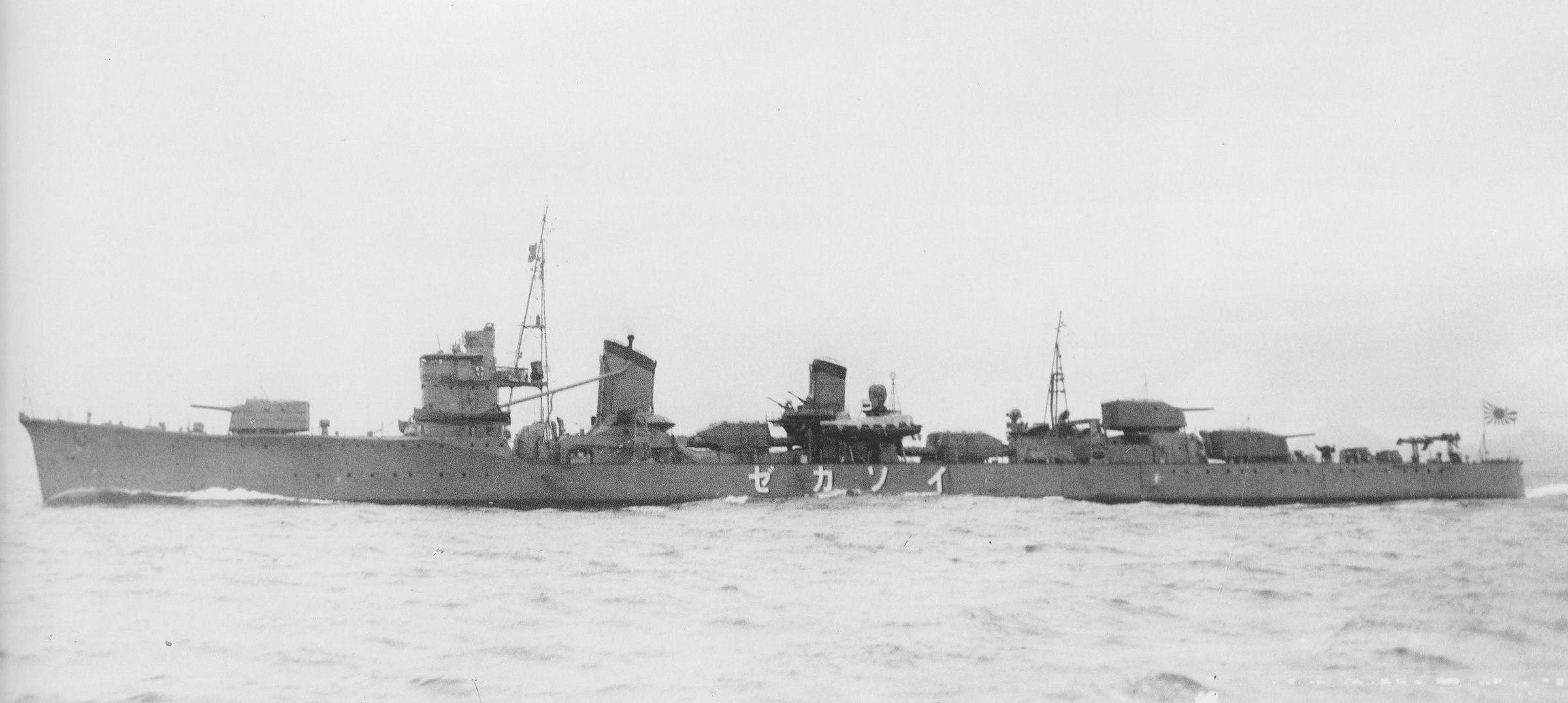
A Japanese destroyer seen broadside, with her name painted on the hull, twin funnels and gun mountings forward and aft.

22 November 1940 · catalogue attribution

Isokaze underway, in a photograph catalogued as 22 November 1940.

Shizuo Fukui / Kure Maritime Museum photo collection, via Wikimedia Commons · Source · Public domain (source statement)

Date, photographer and publication references follow the Commons catalogue: Kure Maritime Museum’s destroyer album, p.99, and Fukui’s 1970 photographic collection, p.200. Those printed volumes have not been independently inspected. This image does not show her April 1945 equipment fit or the Midway rescue. Commons marks it public domain under PD-Japan-oldphoto and PD-1996.

Receiving the carrier’s survivors

When Sōryū was engulfed by fire at Midway, her surviving crew needed somewhere to go. The First Air Fleet’s Japanese battle report describes men driven overboard by fire and an explosion, the recovery of men from the water and treatment of wounded men on the forward deck. It then records their transfer to the destroyers Hamakaze and Isokaze. M14

That passage gives Isokaze a role beyond her place in a formation diagram. A destroyer could become a refuge for the crew of a much larger ship whose own machinery and organisation had broken down. Losing a carrier did not mean that everyone aboard had been lost with her.

The Japanese page names Isokaze as 磯風. An English rendering of the report gives Isonami instead; this profile follows the inspected Japanese original. The passage establishes the receiving ships, but it does not supply a complete passenger list or a verified number rescued by each destroyer.

Back in a force built around a larger ship

Isokaze appears again in the record of Yamato’s final sortie. Commander T. Miyamoto, a Second Fleet staff gunnery officer aboard Yamato, named Isokaze, Hamakaze and Yukikaze together as the 17th Destroyer Division when American investigators interviewed him in October 1945. YT-Y02

He described a ring formation whose screening positions changed with the force’s course. During the air attacks the formation broke apart: Yahagi stopped and was left behind with two destroyers, while Yamato continued with a diminishing escort. His account does not name those two destroyers in that passage, so it cannot by itself establish Isokaze’s precise movements alongside the cruiser.

This is a survivor’s retrospective description, not Isokaze’s bridge log. It places the destroyer in the force and explains the changing problem faced by the screen without providing a minute-by-minute track for each ship.

Disabled, then lost

Asked about other losses, Miyamoto said Isokaze and Kasumi had become uncontrollable and unable to navigate, and were later sunk by the Japanese. He distinguished them from ships sunk during the attacks and expressed uncertainty about Asashimo. YT-Y02

His distinction matters. Damage that ended a ship’s ability to move was not necessarily the same event as her final sinking. But he had also explained that, during the battle’s later stages, he noticed little of what happened aboard the other ships. His answer should therefore remain attributed testimony, not be presented as his eyewitness account of Isokaze’s final moments.

The inspected passages do not settle the exact scuttling time, the weapon used, who gave the final order or the division of survivors among the remaining destroyers. Those details require further ship-level evidence.

One ship across two stories

Isokaze connects the rescue work after Midway with the losses surrounding Yamato. The connection belongs to the ship’s history; it does not imply that her crew remained unchanged between 1942 and 1945.

Read Sōryū for the carrier’s evacuation, or Fuyutsuki for Miyamoto’s own account of being recovered after Yamato sank.

Evidence within reach

Sources for this page

Open a note for the passage, inspection status and limits. Source records link to the available documents.

M14First Air Fleet detailed battle report

Contemporary Japanese command report · archival scan

Passage: JACAR C08030023800 · PDF p.45 / stamped 0047: Sōryū evacuation and the names Hamakaze and Isokaze

The carrier command’s reported assumptions, force organisation and the division of air attack, reconnaissance, support and supply tasks. The opening island strike, request for another attack and changing armament preparations. Hiryū’s counterattack aircraft, remaining strength and later fire emergency. Akagi, Kaga and Sōryū damage and evacuation; opening island-strike allocations.

Checked: Selected Japanese passages on PDF pp.10–11 and 14–15 visually checked for chapter 1. For chapter 4, pp.16–20 visually inspected and compared with M06’s English organisation tables; pp.21–22 inspected for context on 18 October 2026. For Midway Under Attack, PDF pp.29–33 / stamped 0031–0035 visually inspected and selected passages compared with M06; pp.23–26 sampled for context. For Search and Decision, PDF pp.32–33 / stamped 0034–0035 rechecked against M39’s chronological table. PDF pp.34–35 / stamped 0036–0037 visually inspected for The Morning Strikes; p.34 supports command transfer and Hiryū’s continued ability to attack. PDF pp.35–43 rendered and visually inspected for Hiryū Fights Back: pp.35–38 cover counterattack strength, claims and Hiryū’s bombing; pp.42–43 cover fire, propulsion failure and abandonment preparations. Intervening Akagi/Kaga passages inspected for context. PDF p.44 / stamped 0046 visually inspected for the continuation of Hiryū’s evacuation to destroyers. PDF p.18 / stamped 0020 re-rendered and visually inspected for Hiryū counterattack organisation. Ship-profile expansion: PDF pp.17, 39–42 and 44–46 rendered and visually inspected; selected damage passages compared with M06. Cruiser-profile review, 18–19 October 2026: PDF pp.32–33 / stamped 0034–0035 visually rechecked for the successive Tone No.4 reports and decisions. PDF p.45 / stamped 0047 visually rechecked on 21 October 2026 for the Isokaze profile: rescue, treatment and transfer to Hamakaze and Isokaze. The already retained scan was used; a fresh JACAR viewer request returned HTTP 403.

Limits: Working readings, not a certified full translation. The report was compiled after the battle and some tables include actual results, not just pre-battle plans. The English table’s Haruna aircraft type differs from the Japanese image; no type is assigned here. M06 transmits the same report family. Opening narrative compresses later attacks into the same paragraph. Its dates and times are not silently merged with the American chronology; message timing and flight-deck readiness require further records. Initial-contact timing differs between the narrative and M39’s chronological table; no fixed message delay is inferred. Predicted aircraft readiness is not a completed launch. Japanese counterattack target identities and claimed damage on these pages are not confirmed outcomes. Evacuation entries are not a complete personnel roll; scuttling orders and final sinking times remain distinct. Exact bomb-hit counts and the compressed Kaga/Sōryū terminal sinking passages do not settle scuttling contributions. Akagi command-transfer times differ within the report; no single minute is adopted. Sōryū evacuation: M14 PDF p.45 / stamped 0047 names Hamakaze and Isokaze (磯風); M06 renders the second as Isonami. The profile follows the original Japanese name.

View full source record →
YT-Y02Miyamoto interrogation: original typescript and diagrams

Original postwar interrogation typescript · digitised microfilm scan

Passage: Original interrogation typescript pp.133-2–133-3 / PDF pp.2–3: formation, scattered screen and reported destroyer losses

The witness’s place aboard Yamato, named destroyer force, changing screen, sinking recollection, reported rescue and distinction between personal memory and information heard afterward. Named Isokaze in the 17th Destroyer Division and reported her disablement and later sinking by Japanese forces.

Checked: Seven images inspected in the initial audit; PDF pp.2–5 visually rechecked on 21 October 2026, especially pp.2–3. Catalogue and retained 7-page scan compared; SHA-256 cc37160a1b2c01a173b408100bb43cc8ec0a5a5c8b800a0bd219e4ce7a2788b9. Original pp.133-2–133-3 / PDF pp.2–3 visually rechecked on 21 October 2026 for Isokaze’s division, changing screen and reported loss. Typescript p.133-2 / PDF p.2 visually rechecked on 21 October 2026 for Yukikaze’s division and the changing screen. Personal account: original typescript pp.133-2–133-3 visually rechecked on 24 October 2026 for duties, memory gap and information heard after rescue.

Limits: Same testimony as YT-Y01, not an independent corroborating witness. The force list spells the name FUYUZUKI; the rescue passage says FUKUZUKI in both this typescript and the published transcription. Identifying the latter with Fuyutsuki is an editorial reading of that inconsistency. Its 41st Destroyer Squadron wording is compared with 41dg in the Japanese order. No rescue total, individual casualty roll or complete destroyer action log is supplied. Recalled timing and damage estimates are not final reconciled measurements. Miyamoto was aboard Yamato, not Isokaze; his later-loss answer does not establish an eyewitness scuttling account, exact time, weapon or individual rescue totals.

View full source record →

Photograph

Enlarged historical photograph

Web copy resized and compressed; original framing retained. Open image file ↗