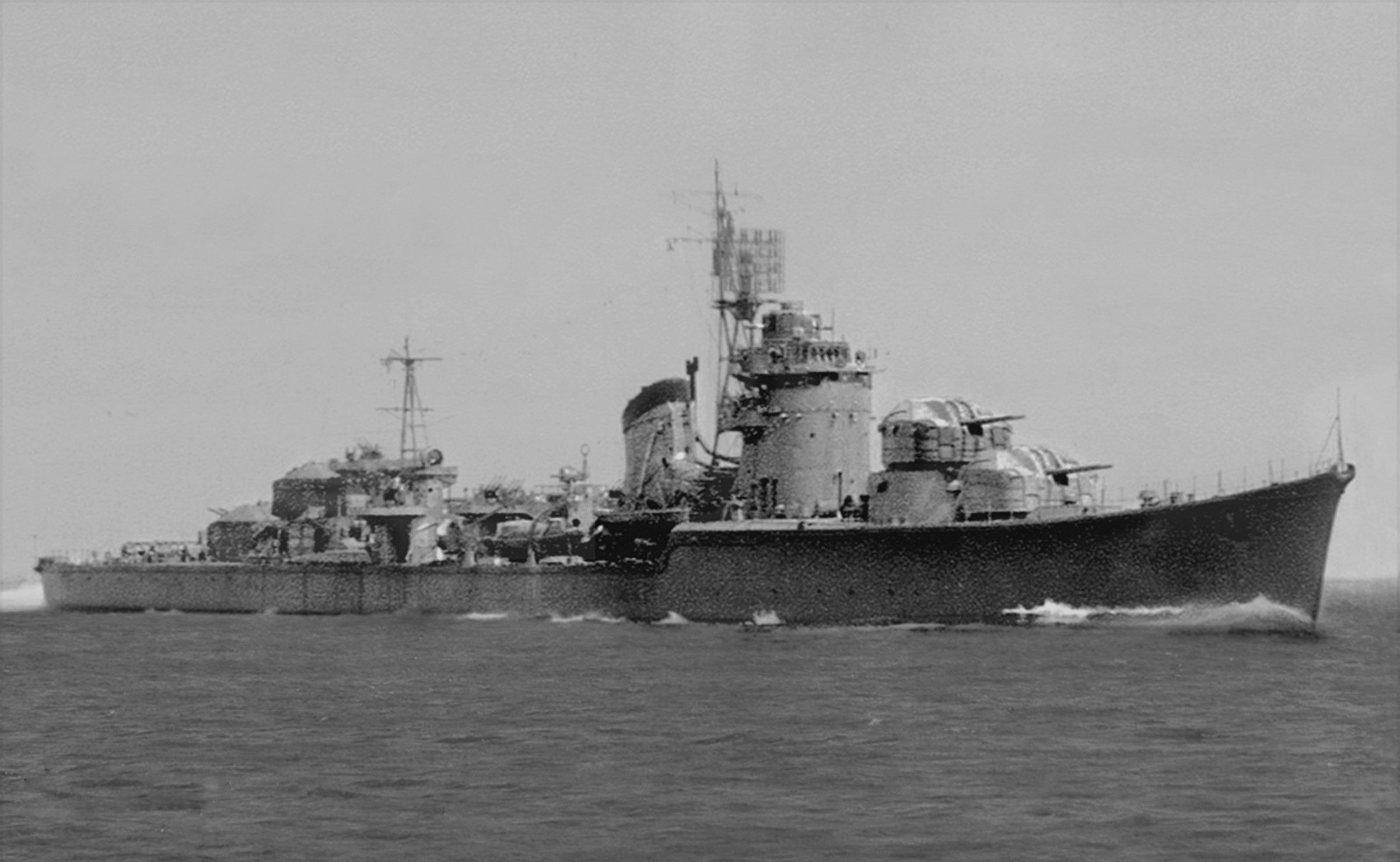


In the force sent towards Okinawa
Fuyutsuki sailed as one of Yamato’s destroyers. Miyamoto’s interrogation places her alongside Suzutsuki in the 41st unit, although the English typescript calls that unit a “Destroyer Squadron”. The Japanese order’s abbreviated organisation table uses 41dg: the 41st Destroyer Division. YT-Y02 YT-Y05
The order provides more than one organisation. In the arrangement for fighting enemy surface forces, the 41st Division is grouped with Yamato, while the remainder of the Second Destroyer Squadron forms another element. That is a prescribed arrangement for a particular kind of battle, not evidence that the ships held those positions throughout the voyage. YT-Y05
Miyamoto described a circular screen whose positions changed with the force’s course. His account offers the view from Yamato; it does not supply Fuyutsuki’s complete track or a timed record of her helm orders. YT-Y02
A man recovered from the water
Miyamoto was aboard Yamato when she sank. He recalled being pulled under, returning to the surface and suffering a blow to the back of his head. His memory then had a gap. He said a destroyer picked him up. YT-Y02
There is a spelling inconsistency worth retaining: the force list names FUYUZUKI, but the rescue passage says FUKUZUKI. This profile reads the latter as a reference to Fuyutsuki, the destroyer in the listed force. That identification is an editorial reading of an inconsistent record; it is not a second, independently checked rescue entry.
The distinction also applies to what happened to Yamato. Miyamoto explicitly attributed some details about her final angle and explosions to what he heard aboard the rescuing ship. Those details should not all be presented as things he personally watched.
Rescue is part of the battle’s outcome
This account establishes a survivor’s reported route out of the disaster. It does not provide Fuyutsuki’s total number rescued, the names of everyone brought aboard, or a medical return. A complete rescue account still needs the destroyer’s own records and comparison with the other surviving ships.
Read The Men and the Record for that wider problem. Fuyutsuki connects the operational story to the people who lived to describe it: the battleship was lost, but the effort to recover men and preserve their experiences continued.