A connected ship profile

Mikuma

The carrier losses did not end the danger. Mikuma’s destruction and the rescue of two of her men extended the battle into its aftermath.

Profile · Evidence and limits

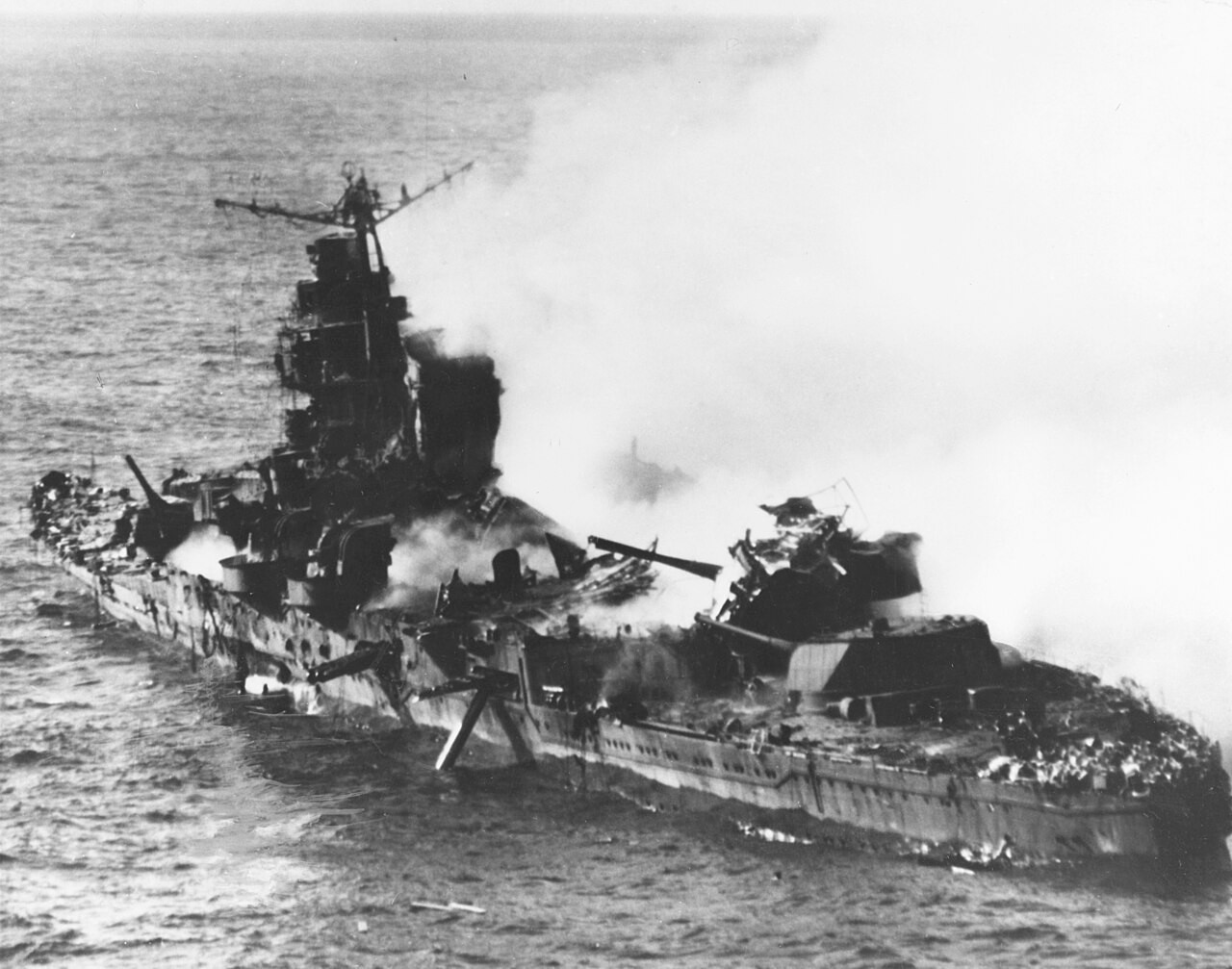
The heavily damaged cruiser Mikuma seen from the air.

6 June 1942

Mikuma after the American carrier strikes. The wrecked superstructure is visible; specific internal damage mechanisms require the written evidence.

U.S. Navy / NHHC, 80-G-414422; photographer credited as A. D. Brick or J. S. Mihalovitch · Source · Public domain (source statement)

The catalogue does not resolve which of the two photographers took this frame.

Exposed during the withdrawal

Mikuma was part of Cruiser Division 7. Japanese officers’ postwar testimony describes the collision with Mogami and the two ships’ slower retirement. Carrier air attacks followed; Mikuma was lost while Mogami survived. M46

The American command report records repeated carrier strikes on 6 June, but overstates their final result by claiming both cruisers sunk. That error matters even when following the ship which really was lost: an accurate outcome does not automatically validate every reported hit or identification leading to it. M01

Two men found at sea

The CINCPAC Gray Book records Trout recovering two Japanese prisoners from wreckage on 9 June. That entry alone does not identify their ship. A subsequent interrogation report names them as Mikuma survivors Kenichi Ishikawa and Katsuichi Yoshida. Read together, the records connect a rescue event to individual men. M19 M45

Ishikawa described a raft initially holding twenty men, with only two remaining when Trout found them. His account gives a survivor’s perspective on exposure and loss after the bombing. It is not a reconciled count of everyone rescued from Mikuma, or of everyone who died aboard her. M45

What the accounts cannot settle

The interrogation includes uncertain aircraft identifications and dates. Those details are not adopted here as a definitive attack sequence. Nor does the postwar testimony settle an individual pilot’s alleged collision with the cruiser. A fuller account requires the ship’s original records, survivor returns and comparison with the American squadron reports.

Continue to The People Left Behind for rescue, captivity and the limits of casualty accounting.

Evidence within reach

Sources for this page

Open a note for the passage, inspection status and limits. Source records link to the available documents.

M46Japanese cruiser officers on the Midway withdrawal

Postwar interrogation · modern transcription

Passage: NAV 66 / USSBS 295, printed pp.270–271: collision, retirement and loss; postwar interrogation transcription

The collision of Mogami and Mikuma and their different eventual fates.

Checked: Relevant questions and answers read on 18 October 2026. Original interrogation pages not inspected. Cruiser-profile review, 18–19 October 2026: Shibata and Nishikawa passages reread through the transcription. An NDL/Commons scan catalogue was located, but no original page inspection is claimed.

Limits: Postwar recollection, not a contemporary damage log. Exact bomb counts, aircraft-crash claims, casualty estimates and fine chronology are not adopted. Shibata was navigator of Suzuya, not aboard Mogami; Nishikawa was Mogami’s gunnery officer. The witnesses’ different positions and later recollection are retained. Original damage records remain outstanding.

View full source record →
M01Nimitz’s Midway action report

Contemporary command report · selected scan pages checked; earlier passages read in transcription

Passage: Printed/PDF pp.20–21, paragraphs 56–61: carrier attacks and uncertain damage assessment

The broad course of the battle and the report’s explicit clock convention. Later pursuit, cruiser attacks and rescue from Yorktown.

Checked: Earlier preparation, timing and attack passages read in modern transcriptions; paragraphs 13–18, 19–25 and 27–36 rechecked on 18 October 2026. For the aftermath chapters, a 28-page scan of serial 01849 was retained and PDF / printed pp.1 and 17–21 rendered and visually inspected. Earlier chapter passages have not all been compared with these images. The report date is taken from the transcription; it is not legible on the inspected first-page image. PDF / printed p.25 visually inspected for fighter assessment, replacement groups and training. Aircraft expansion: PDF / printed pp.6–12, 23 and 25 visually inspected on 18 October 2026; night attack, scout reports, TBF/TBD operations, fighter allocations and equipment assessments. Supporting-ship update: PDF/printed pp.21–22 visually inspected for paragraphs 62–65, including the continuation of paragraph 63. Cruiser-profile review, 18–19 October 2026: PDF / printed pp.20–21 visually rechecked for 6 June attacks and the erroneous two-cruiser sinking claim.

Limits: Preliminary enemy identifications and loss estimates are not final accounting. The report uses Zone plus 12; task-force reports can use a different clock. Both web copies transmit the same report. The apparent 126 B-17 transcription error is not adopted. Early hit claims and a possible fifth carrier are not accepted as established facts. Early warning times differ from M31. The statement implying deliberately spared runways is not adopted; M32 records actual runway damage and repairs. Torpedo hits, early Sōryū damage, additional ships claimed hit and precise deck conditions are not adopted as confirmed facts. Aircraft losses are distinct from personnel losses. Its retrospective sacrifice explanation is not treated as a deliberate attack plan. Its claim that both Mogami and Mikuma sank is rejected; its preliminary personnel total is not a final casualty roll. The scan does not include the separately listed enclosures. Paragraph 74’s claimed fighter exchange ratio is not treated as a verified loss total or controlled performance comparison. Early damage and hit claims on these pages are not adopted as confirmed results. The retrospective sacrifice explanation is not an order for a planned diversion. The reported two hits on Hammann differ from the captain’s account; post-sinking explosion explanations remain tentative. Ships dispatched to assist are not all treated as having arrived.

View full source record →
M19The CINCPAC Gray Book

Contemporary running estimate · digitised loose-page copy

Passage: Gray Book volume 1, PDF p.580 / printed p.574: 9 June entry recording Trout’s recovery of two prisoners

The developing warning, first-contact reporting, incomplete intelligence, searches, competing commitments and carrier recovery after the battle.

Checked: Selected digitised pages inspected, including PDF pp.502, 505, 546, 549–550, 578, 581, 590 and 600. May warning and preparation passages visually checked on 18 October 2026. For First Contacts, PDF pp.575–577 / printed pp.569–571 visually checked; the chapter uses the 2–3 June entries on pp.569–570. PDF pp.579–583 / printed pp.573–577 visually inspected for aftermath context; the people chapter uses printed p.574. Cruiser-profile review, 18–19 October 2026: PDF p.580 / printed p.574 visually rechecked for Trout’s recovery of two prisoners on 9 June.

Limits: Not Nimitz’s personal diary. Early combat claims and estimates reflect the information then available. The entire 874-page volume has not been read. The brief prisoner entry and M45 come from the same headquarters record environment; they are not two independent survivor testimonies. The 9 June entry does not itself identify the prisoners as Mikuma survivors; that identification comes from M45.

View full source record →
M45Interrogation of survivors from Mikuma

Contemporary prisoner-interrogation report · modern transcription

Passage: CINCPAC serial 01753, 21 June 1942, opening identification and paragraphs 2–5: prisoners and Ishikawa’s account; modern transcription

The identity and reported experience of the two men recovered by Trout.

Checked: Transcription read on 18 October 2026. Original page images not inspected. Cruiser-profile review, 18–19 October 2026: opening identifications and paragraphs 2–5 reread through the transcription. Original images remain uninspected.

Limits: The raft narrative is Ishikawa’s reported testimony, not a complete casualty return. Dates and aircraft identifications are uncertain; the interviewer’s assumptions about the witness are not treated as established facts.

View full source record →

Photograph

Enlarged historical photograph

Web copy resized and compressed; original framing retained. Open image file ↗