A connected aircraft profile

Douglas SBD Dauntless

The Dauntless helped win Midway, but its effectiveness depended on finding the target, coordinating the attack and having enough fuel to return.

Profile · Evidence and limits

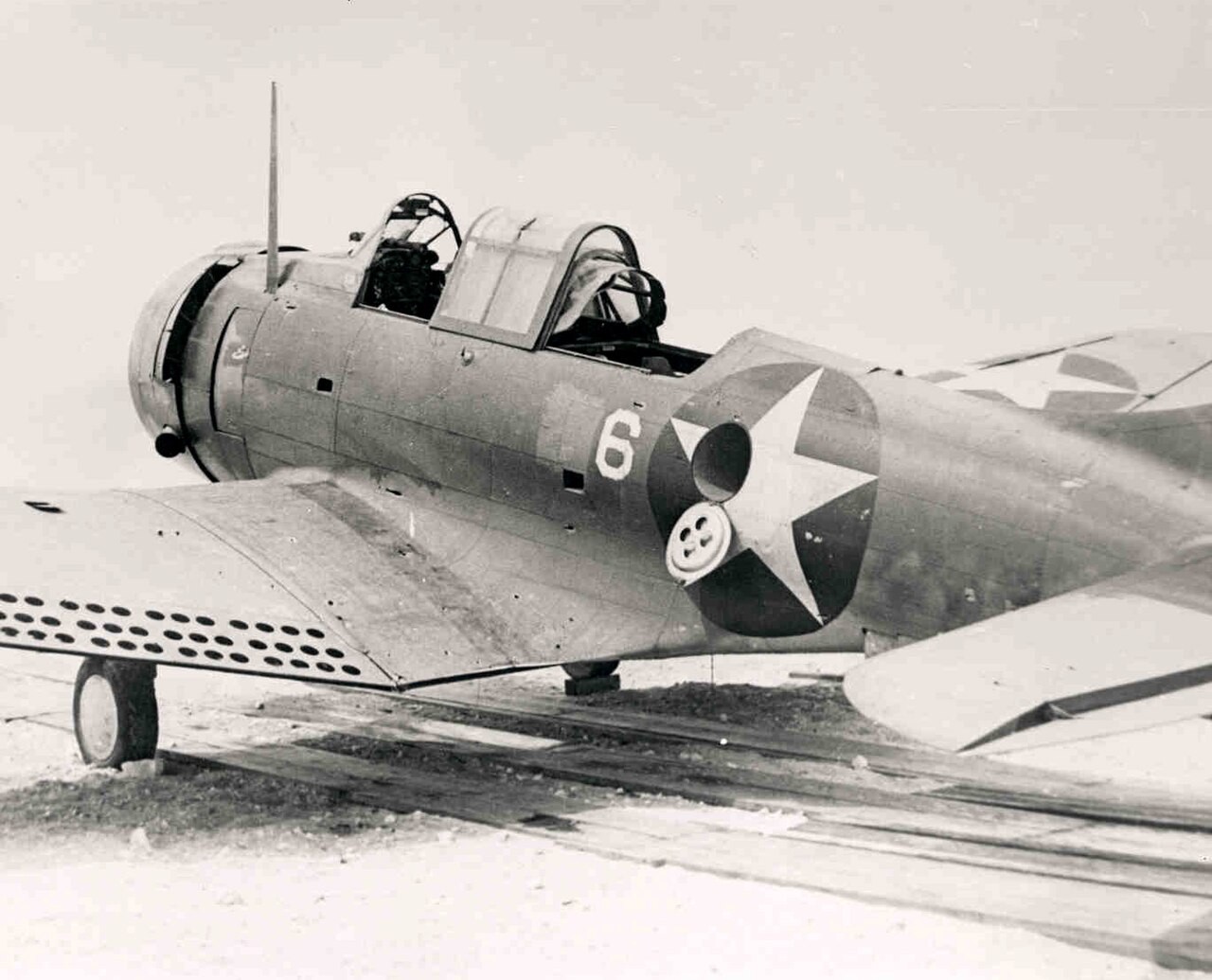
A Douglas SBD-2 Dauntless on the ground at Midway.

4 June 1942

A Marine SBD-2 of VMSB-241 at Midway. The museum identifies it as BuNo 2106, flown by Daniel Iverson with Wallace Reid during the morning attack.

U.S. Navy / National Museum of Naval Aviation, photograph 26994 · Source · Public domain (source statement)

Aircraft identity follows the museum catalogue; the photograph alone does not establish its full damage history.

Two people, several tasks

The SBD carried a pilot and a radioman/gunner. The National WWII Museum’s SBD-3 specification lists a 1,000-horsepower Wright radial engine, two .50-calibre and two .30-calibre machine guns. This is a later museum summary, not an inspection of every aircraft that flew at Midway. M48

The second crewman belonged to the fighting aircraft as much as the pilot did. Enterprise’s squadron rosters name both men, while the return accounts distinguish crews rescued after landing on the water from men still missing. A count of aircraft lost cannot be read as a count of people killed. M17

Which Dauntless?

The contemporary VB-6 report lists both SBD-2 and SBD-3 aircraft. VS-6 lists SBD-3s. It is therefore inaccurate to apply a later SBD-5 specification sheet to the whole Midway force, or to assume that every Dauntless in a squadron was necessarily the same version. M17

The museum aircraft described by M48, BuNo 06508, served in the Guadalcanal campaign and later aboard Enterprise. It is a useful surviving SBD-3, but the museum’s account does not identify it as a Midway participant. M48

Bomb load on a real sortie

On the morning of 4 June, Enterprise’s VB-6 striking aircraft carried a 1,000-pound bomb each. VS-6 and the air-group commander’s aircraft carried a 500-pound bomb with two 100-pound bombs. The squadron record gives us a dated load rather than a theoretical maximum. M17

That difference is useful when comparing aircraft. A maximum payload does not tell us what was carried on a long search, what fuel was needed, or what weapons were available aboard the carrier. The ordnance profile follows the actual entries.

The people and equipment had limits

The VB-6 report describes oxygen difficulties during the approach at altitude and a descent by its commander. It also records confusion over target allocation. Neither problem appears in a table of engine power and bomb capacity, yet both affected the attack. M17

Return was another test. Later missions ended in night landings, including first attempts by some pilots. Successful bombing and successful recovery were separate achievements. M17

Read The Morning Strikes and The People Left Behind to follow the aircraft and their crews through the battle.

Evidence within reach

Sources for this page

Open a note for the passage, inspection status and limits. Source records link to the available documents.

M17Enterprise’s dive-bomber squadron reports

Contemporary squadron reports · third-party hosted scan extract

Passage: PDF pp.2–4, 9 and 13–15: aircraft variants, loads, oxygen, return and crew accounting

Reported bomb loads, oxygen difficulties, target-allocation confusion, fighter opposition, aircraft returns and Stuart Mason’s actions. Afternoon opposition, attacking squadrons and observations of a burning carrier still underway.

Checked: PDF pp.2–4 and 10 rendered and visually inspected on 18 October 2026. Forwarding heading previously inspected; full 15-page research copy retained. PDF p.5 rendered and visually inspected for the afternoon attack and withdrawal. PDF pp.6 and 13–15 rendered and visually inspected for 5–6 June operations and personnel accounting. PDF pp.2 and 9 re-rendered and visually inspected for aircraft variants, in-commission counts and morning loads. Cruiser-profile review, 18–19 October 2026: PDF pp.13–14 visually rechecked; p.13 supplies 5 June context, while p.14 / VS-6 printed p.6 supplies the 6 June afternoon sortie used in the profile.

Limits: VB-6 printed page 3 is absent between printed pp.2 and 4. Carrier identities, hit estimates and aircraft identifications are contemporary claims, not confirmed results. Aircraft returning, crews rescued and crews unaccounted for are distinct report-date categories. Times are not silently combined with the island or Japanese clocks. Not the separate Enterprise ship action report. The roster headed 2 June contains later loss/rescue annotations, not pre-battle knowledge; a missing entry is not proof of the circumstances of death. The 5 June cruiser in the VS-6 narrative is not identified here as Mogami or Mikuma. The 6 June target classifications and hit claims are not individually mapped to confirmed ships.

View full source record →
M48SBD-3 Dauntless: museum aircraft and specifications

Later museum object history and technical summary

Passage: SBD-3 / A-24 specification panel and aircraft BuNo 06508 history; later museum account

Crew roles, engine designation and quoted armament for the SBD-3 summary; the preserved aircraft’s service history.

Checked: Object-history and specification text read on 18 October 2026. Original aircraft handbook and restoration documentation not inspected.

Limits: A modern summary, with rounded dimensions and unspecified conditions for performance figures. Maximum range/load are not adopted as Midway sortie data. The displayed aircraft is not identified here as a Midway participant; SBD-2 and SBD-3 returns remain distinct.

View full source record →

Photograph

Enlarged historical photograph

Web copy resized and compressed; original framing retained. Open image file ↗