A connected ship profile

Mogami

Mogami’s survival is a reminder that damage seen from an attacking aircraft and a ship’s final fate are different kinds of evidence.

Profile · Evidence and limits

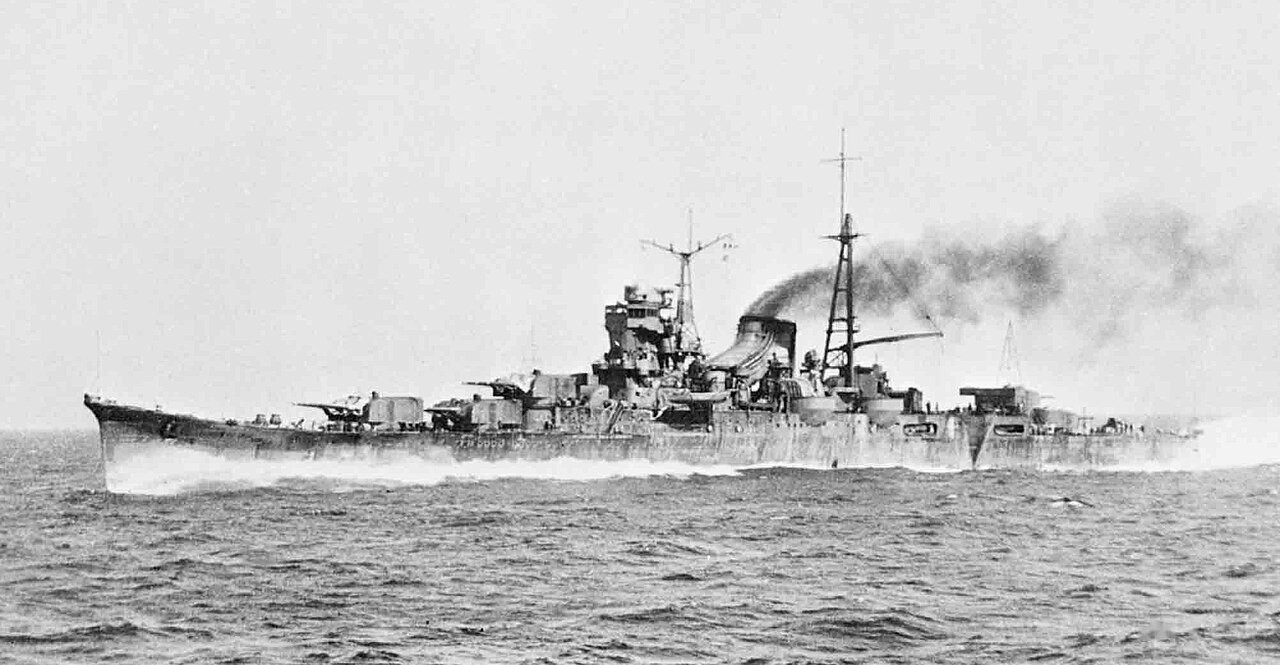
Mogami making speed during trials, with triple forward gun turrets.

20 March 1935

Mogami on trials in her original light-cruiser configuration. Her triple 155 mm turrets were replaced by twin 203 mm turrets before Midway.

Photographer unknown / Ariga’s Warship Photo Gallery, via Wikimedia Commons · Source · Public domain (source statement)

An earlier configuration, not a record of her 1942 fit.

The invasion force’s cruisers

Mogami belonged to Cruiser Division 7, supporting the invasion force. In postwar interrogation, her gunnery officer Nishikawa described an emergency turn after a submarine contact. Mogami collided with Mikuma, badly damaging her own bow. The two cruisers withdrew while Kumano and Suzuya moved ahead. M46

Targets that changed identity

American carrier aircraft attacked the retreating ships on 6 June. Enterprise’s Scouting Squadron Six report shows how uncertain identification remained: its afternoon mission set out for a reported force including battleships, but the squadron described the ships it attacked as cruisers and destroyers. Part of the dive-bomber group searched farther ahead for the reported battleships before returning to attack. M17

The report is evidence of the aircrew’s orders, movements and observations. Its ship classifications and damage claims cannot each be assigned to a confirmed target merely by reading them as a final battle summary.

A sinking claim corrected

Nimitz’s contemporary command report concluded that both Mogami and Mikuma had sunk. Mogami survived. Nishikawa’s later account describes her being bombed but remaining navigable and rejoining the division; Shibata’s testimony traces her subsequent return via Truk to Japan. The early American claim therefore needs an explicit correction, not repetition as an established result. M01 M46

Read Beyond the Carrier Battle for the withdrawal. The Japanese testimony used here is a postwar recollection read through a modern transcription. Original damage records are still needed to settle the detailed hit sequence and provide a dated technical account of the ship.

Evidence within reach

Sources for this page

Open a note for the passage, inspection status and limits. Source records link to the available documents.

M46Japanese cruiser officers on the Midway withdrawal

Postwar interrogation · modern transcription

Passage: NAV 66 / USSBS 295, printed pp.270–271: Shibata and Nishikawa testimony; postwar interrogation transcription

The collision of Mogami and Mikuma and their different eventual fates.

Checked: Relevant questions and answers read on 18 October 2026. Original interrogation pages not inspected. Cruiser-profile review, 18–19 October 2026: Shibata and Nishikawa passages reread through the transcription. An NDL/Commons scan catalogue was located, but no original page inspection is claimed.

Limits: Postwar recollection, not a contemporary damage log. Exact bomb counts, aircraft-crash claims, casualty estimates and fine chronology are not adopted. Shibata was navigator of Suzuya, not aboard Mogami; Nishikawa was Mogami’s gunnery officer. The witnesses’ different positions and later recollection are retained. Original damage records remain outstanding.

View full source record →
M17Enterprise’s dive-bomber squadron reports

Contemporary squadron reports · third-party hosted scan extract

Passage: PDF p.14 / VS-6 printed p.6: afternoon attack on 6 June and uncertain ship identification

Reported bomb loads, oxygen difficulties, target-allocation confusion, fighter opposition, aircraft returns and Stuart Mason’s actions. Afternoon opposition, attacking squadrons and observations of a burning carrier still underway.

Checked: PDF pp.2–4 and 10 rendered and visually inspected on 18 October 2026. Forwarding heading previously inspected; full 15-page research copy retained. PDF p.5 rendered and visually inspected for the afternoon attack and withdrawal. PDF pp.6 and 13–15 rendered and visually inspected for 5–6 June operations and personnel accounting. PDF pp.2 and 9 re-rendered and visually inspected for aircraft variants, in-commission counts and morning loads. Cruiser-profile review, 18–19 October 2026: PDF pp.13–14 visually rechecked; p.13 supplies 5 June context, while p.14 / VS-6 printed p.6 supplies the 6 June afternoon sortie used in the profile.

Limits: VB-6 printed page 3 is absent between printed pp.2 and 4. Carrier identities, hit estimates and aircraft identifications are contemporary claims, not confirmed results. Aircraft returning, crews rescued and crews unaccounted for are distinct report-date categories. Times are not silently combined with the island or Japanese clocks. Not the separate Enterprise ship action report. The roster headed 2 June contains later loss/rescue annotations, not pre-battle knowledge; a missing entry is not proof of the circumstances of death. The 5 June cruiser in the VS-6 narrative is not identified here as Mogami or Mikuma. The 6 June target classifications and hit claims are not individually mapped to confirmed ships.

View full source record →
M01Nimitz’s Midway action report

Contemporary command report · selected scan pages checked; earlier passages read in transcription

Passage: Printed/PDF pp.20–21, paragraphs 56–61: cruiser attacks and erroneous claim that both cruisers sank

The broad course of the battle and the report’s explicit clock convention. Later pursuit, cruiser attacks and rescue from Yorktown.

Checked: Earlier preparation, timing and attack passages read in modern transcriptions; paragraphs 13–18, 19–25 and 27–36 rechecked on 18 October 2026. For the aftermath chapters, a 28-page scan of serial 01849 was retained and PDF / printed pp.1 and 17–21 rendered and visually inspected. Earlier chapter passages have not all been compared with these images. The report date is taken from the transcription; it is not legible on the inspected first-page image. PDF / printed p.25 visually inspected for fighter assessment, replacement groups and training. Aircraft expansion: PDF / printed pp.6–12, 23 and 25 visually inspected on 18 October 2026; night attack, scout reports, TBF/TBD operations, fighter allocations and equipment assessments. Supporting-ship update: PDF/printed pp.21–22 visually inspected for paragraphs 62–65, including the continuation of paragraph 63. Cruiser-profile review, 18–19 October 2026: PDF / printed pp.20–21 visually rechecked for 6 June attacks and the erroneous two-cruiser sinking claim.

Limits: Preliminary enemy identifications and loss estimates are not final accounting. The report uses Zone plus 12; task-force reports can use a different clock. Both web copies transmit the same report. The apparent 126 B-17 transcription error is not adopted. Early hit claims and a possible fifth carrier are not accepted as established facts. Early warning times differ from M31. The statement implying deliberately spared runways is not adopted; M32 records actual runway damage and repairs. Torpedo hits, early Sōryū damage, additional ships claimed hit and precise deck conditions are not adopted as confirmed facts. Aircraft losses are distinct from personnel losses. Its retrospective sacrifice explanation is not treated as a deliberate attack plan. Its claim that both Mogami and Mikuma sank is rejected; its preliminary personnel total is not a final casualty roll. The scan does not include the separately listed enclosures. Paragraph 74’s claimed fighter exchange ratio is not treated as a verified loss total or controlled performance comparison. Early damage and hit claims on these pages are not adopted as confirmed results. The retrospective sacrifice explanation is not an order for a planned diversion. The reported two hits on Hammann differ from the captain’s account; post-sinking explosion explanations remain tentative. Ships dispatched to assist are not all treated as having arrived.

View full source record →

Photograph

Enlarged historical photograph

Web copy resized and compressed; original framing retained. Open image file ↗