A connected ship profile

USS Hornet

Hornet’s first strike failed to arrive as a coordinated force. The loss of her torpedo squadron was devastating, but her flight deck remained available for the battle that followed.

Profile · Evidence and limits

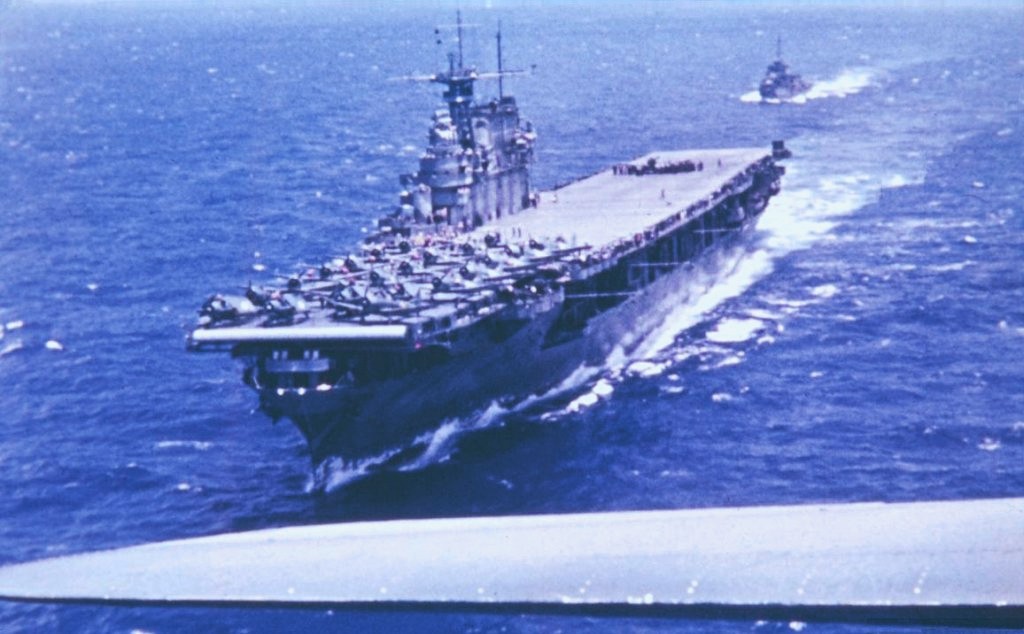
USS Hornet underway at sea.

May 1942

Hornet underway in May, shown in a frame from the U.S. Navy film The Battle of Midway.

U.S. Navy / John Ford film unit, The Battle of Midway · Source · Public domain (source statement)

Film frame; the catalogue supplies the month, not a precise day.

An air group with different jobs

Mitscher’s report lists twenty-seven fighters, thirty-five scout/bombers and fifteen torpedo aircraft after a pre-battle aircraft loss. It allows for temporary repairs. These figures describe a dated air group, not the ship’s maximum capacity. M58

The morning strike included all fifteen torpedo aircraft and thirty-five scout/bombers, accompanied by ten fighters. A larger air group aboard did not mean every aircraft joined that one mission. M58

A strike that came apart

Hornet’s dive bombers did not find the Japanese carriers that morning. Torpedo Eight did, losing all fifteen aircraft in its attack. Nimitz’s command report records the catastrophic aircraft losses across the American torpedo squadrons; it does not turn their scattered arrival into a successful coordinated plan. Claims of torpedo hits are not adopted as confirmed damage. M01

Mitscher’s account records fuel shortages, aircraft returning by different routes and recovery at Midway. George Gay survived the loss of Torpedo Eight’s carrier aircraft; a squadron’s destruction as a fighting formation was not the death of every participant. M58

Still able to launch and recover

Hornet continued flight operations and received aircraft from Yorktown. A crash landing caused a fatal accidental discharge of a fighter’s guns, a reminder that recovery itself could be dangerous. Later searches and strikes required another cycle of fuelling, arming and landing. M58

The carrier’s continuing availability mattered during the pursuit and attacks on Japanese cruisers. Those later operations belong in the assessment alongside the failed morning search. Preliminary American reports repeatedly misidentified targets, so reported battleship attacks are not presented here as established battleship damage. M01

Read The Morning Strikes and Beyond the Carrier Battle. Hornet’s own report remains a transcription pending original-page comparison; its exact flight routes and disputed explanations need further squadron evidence.

Evidence within reach

Sources for this page

Open a note for the passage, inspection status and limits. Source records link to the available documents.

M58Hornet: report of action, 4–6 June 1942

Contemporary carrier report · modern web transcription

Passage: Serial 0018, paragraphs 1, 5–7, 9, 12–17 and 19: aircraft, operations and provisional results; modern transcription

Dated air-group strength, morning strike allocation, fuel and recovery problems, loss of Torpedo Eight’s aircraft, Gay’s survival and continued flight operations.

Checked: Selected web passages read on 18 October 2026. Original report, squadron track charts and listed enclosures not inspected.

Limits: The malformed launch time “090” is not adopted. The report’s Zone plus 10 clock is not silently merged with Nimitz’s Zone plus 12. Target identifications, claimed torpedo hits and battleship damage are not confirmed results. Provisional rescue and casualty figures are not a final roll. The explanation of the morning search requires comparison with squadron records.

View full source record →
M01Nimitz’s Midway action report

Contemporary command report · selected scan pages checked; earlier passages read in transcription

Passage: PDF / printed pp.10–12 and 20: morning strikes, torpedo losses and later cruiser attacks

The broad course of the battle and the report’s explicit clock convention. Later pursuit, cruiser attacks and rescue from Yorktown.

Checked: Earlier preparation, timing and attack passages read in modern transcriptions; paragraphs 13–18, 19–25 and 27–36 rechecked on 18 October 2026. For the aftermath chapters, a 28-page scan of serial 01849 was retained and PDF / printed pp.1 and 17–21 rendered and visually inspected. Earlier chapter passages have not all been compared with these images. The report date is taken from the transcription; it is not legible on the inspected first-page image. PDF / printed p.25 visually inspected for fighter assessment, replacement groups and training. Aircraft expansion: PDF / printed pp.6–12, 23 and 25 visually inspected on 18 October 2026; night attack, scout reports, TBF/TBD operations, fighter allocations and equipment assessments. Supporting-ship update: PDF/printed pp.21–22 visually inspected for paragraphs 62–65, including the continuation of paragraph 63. Cruiser-profile review, 18–19 October 2026: PDF / printed pp.20–21 visually rechecked for 6 June attacks and the erroneous two-cruiser sinking claim.

Limits: Preliminary enemy identifications and loss estimates are not final accounting. The report uses Zone plus 12; task-force reports can use a different clock. Both web copies transmit the same report. The apparent 126 B-17 transcription error is not adopted. Early hit claims and a possible fifth carrier are not accepted as established facts. Early warning times differ from M31. The statement implying deliberately spared runways is not adopted; M32 records actual runway damage and repairs. Torpedo hits, early Sōryū damage, additional ships claimed hit and precise deck conditions are not adopted as confirmed facts. Aircraft losses are distinct from personnel losses. Its retrospective sacrifice explanation is not treated as a deliberate attack plan. Its claim that both Mogami and Mikuma sank is rejected; its preliminary personnel total is not a final casualty roll. The scan does not include the separately listed enclosures. Paragraph 74’s claimed fighter exchange ratio is not treated as a verified loss total or controlled performance comparison. Early damage and hit claims on these pages are not adopted as confirmed results. The retrospective sacrifice explanation is not an order for a planned diversion. The reported two hits on Hammann differ from the captain’s account; post-sinking explosion explanations remain tentative. Ships dispatched to assist are not all treated as having arrived.

View full source record →

Photograph

Enlarged historical photograph

Web copy resized and compressed; original framing retained. Open image file ↗