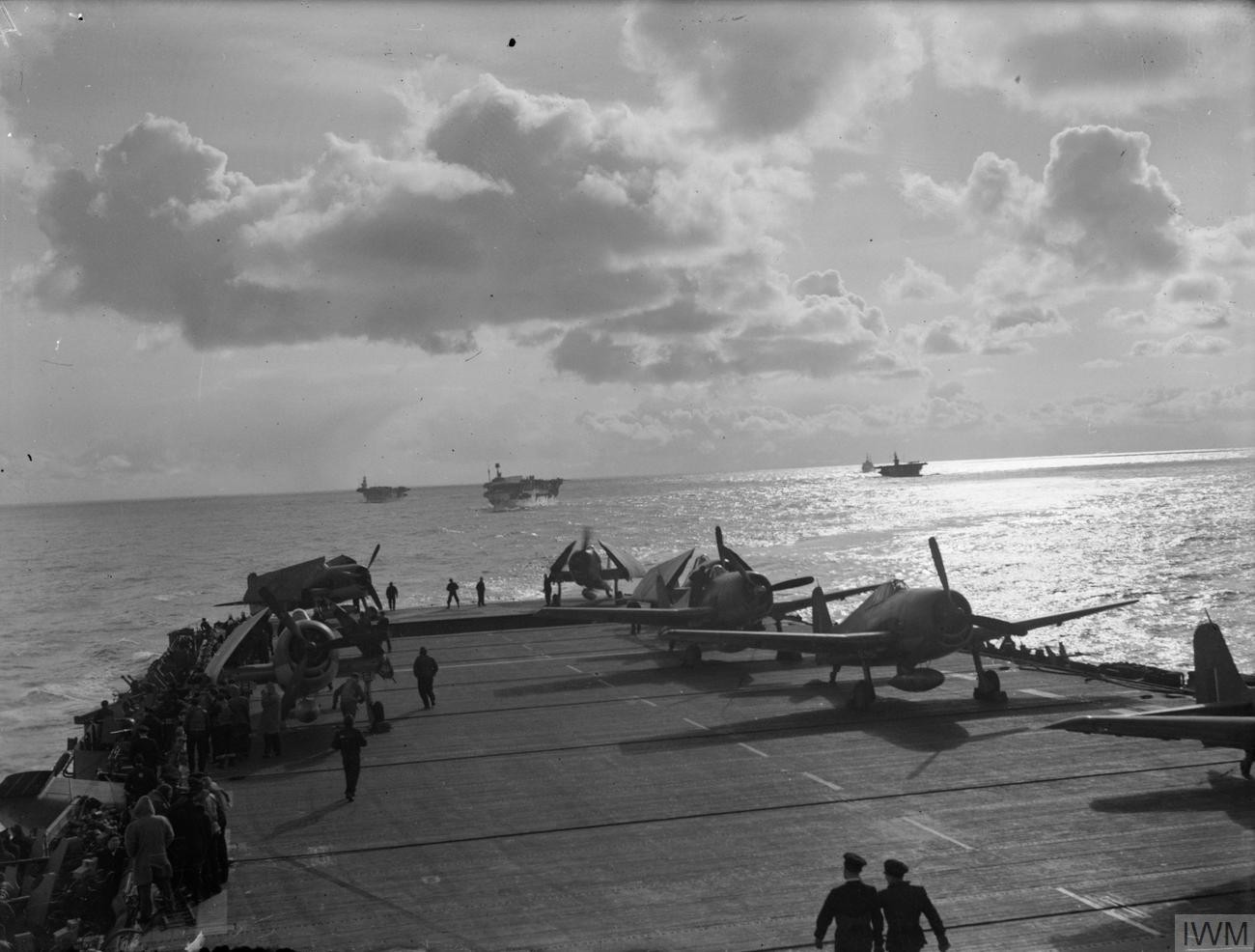


A fighter in two campaigns
The Admiralty’s Tungsten aircraft table lists a single-seat Hellcat armed with six .50-inch guns. In its account of the first attack on Tirpitz, Hellcats and Wildcats descended to fire on gun positions while Corsairs provided cover above. The summary credits this strafing with disrupting the defences; that is the British attacking force’s assessment, not a measurement of every German gun’s performance. YT-T22
One returning Hellcat had a damaged arresting hook and was lost in a water landing. The destroyer Algonquin recovered the pilot. Reaching the fleet did not always mean being able to land back aboard a carrier.
Six aircraft from Bennington
A year later, VF-82’s report for 7 April 1945 records six F6F-5s launching from Bennington to attack the Japanese surface force. Other fighter commitments had already absorbed aircraft. Four of the six carried a 1,000-pound general-purpose bomb; the group included a photographic aircraft. YT-Y23
The report records no enemy aircraft encountered. Instead, the fighters attacked destroyers in three pairs, using guns and bombs. This is evidence for their part in the battle around Yamato, not for six Hellcats bombing Yamato herself.
Seeing an effect and proving damage
Lieutenant Commander E. W. Hessel’s bomb failed to release on his first run. The narrative describes a second release but says the bomb did not explode. Elsewhere it claims a hit aft of amidships on a destroyer and a near miss from another aircraft. These observations do not securely identify an individual Japanese destroyer or establish its final damage. YT-Y23
The crews also judged that strafing reduced defensive fire and helped the bombers and torpedo aircraft. The attack table qualifies the effect as lasting at least during the immediate attack. Temporary suppression should not become a claim that those guns were permanently destroyed.
Returning and watching for survivors
All six aircraft returned; the report lists no damage or personnel casualties for this group. Its account of intense fire therefore describes a danger survived, not an absence of danger. Two pilots also circled survivors of a bomber from another carrier until fuel forced them to leave. They reported that rescue was on the way, but did not establish its completion. YT-Y23
Follow Under Carrier Attack and Tungsten and the Return to Repair for the two operations. The aircraft particulars and bomb loads here belong to their identified records; they are not a single specification assigned to every Hellcat variant.