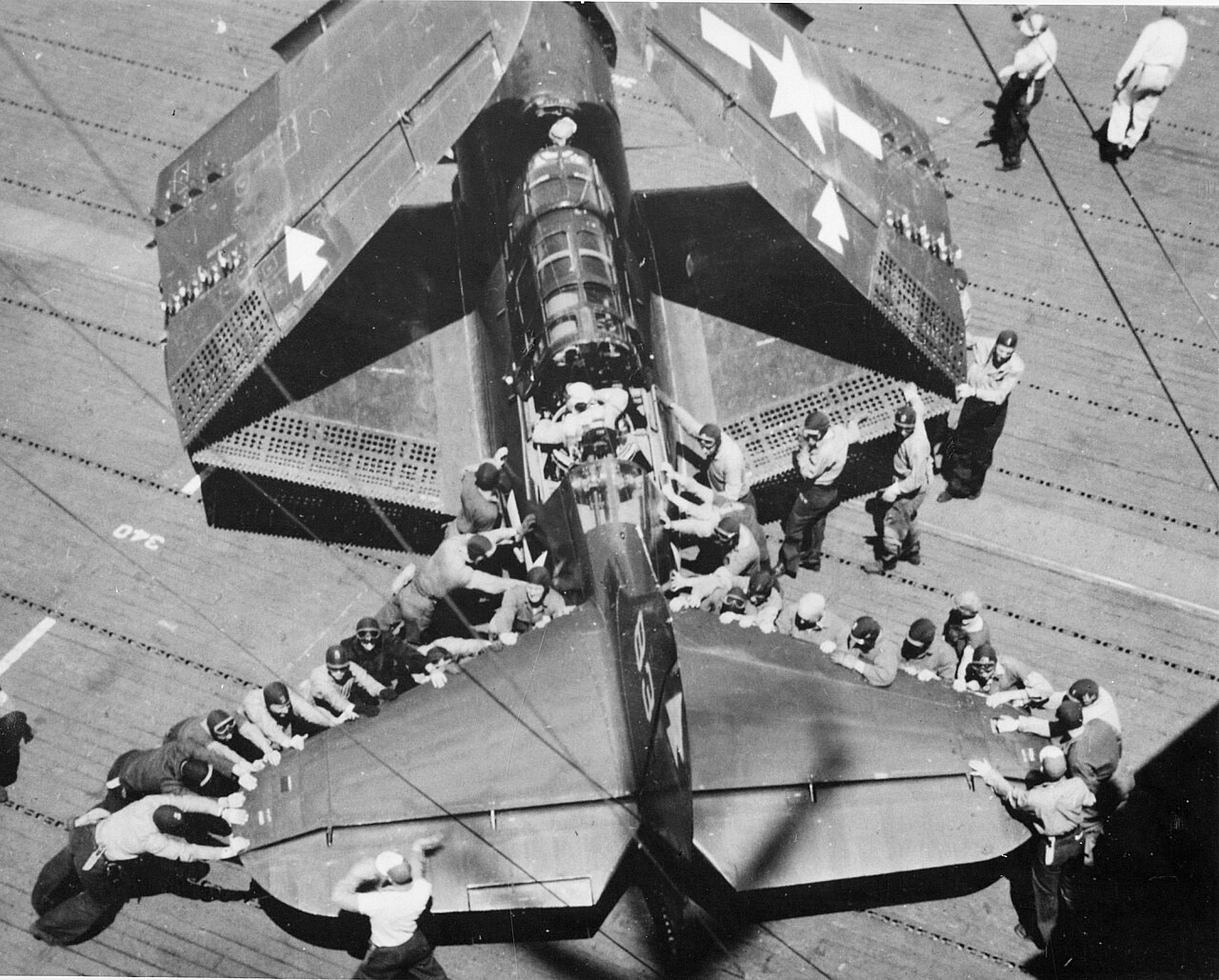


After the Dauntless
The Helldiver was designed to replace earlier carrier scout bombers, including the SBD Dauntless familiar from Midway. Its design combined two seats, folding wings for carrier storage and an internal bomb bay. Serious development and handling problems delayed its introduction. The Smithsonian’s collection history dates its first combat sorties to November 1943. YT-Y19
The same history describes a faster aircraft with greater ordnance capacity than the Dauntless, but one that demanded intensive training. By the later Pacific campaigns, Helldivers formed part of carrier groups alongside fighters and torpedo aircraft. This was a change in the equipment available, not a guarantee that every sortie would succeed.
The aircraft in this strike
VB-82’s own report records eleven Helldivers launched on 7 April 1945, with nine attacking. Its aircraft table lists both SB2C-4 and SB2C-4E variants. This is more specific than the accompanying torpedo squadron’s table, which describes the eleven bombers together as SB2C-4Es. YT-Y20 YT-Y18
The bombing squadron records a normal load of two 1,000-pound semi-armour-piercing AN-M59 bombs, with one aircraft also carrying a 250-pound general-purpose AN-M57. These were different weapons from the Avengers’ Mark 13 torpedoes. YT-Y20
Finding ships beneath cloud
The torpedo squadron’s narrative credits a radar-equipped bombing aircraft with contact at twenty-five miles. VB-82’s own account identifies the crew: Lieutenant Commander Hugh Wood Jr flew the aircraft, and H. H. Reed operated its radar. Their contact helped the formation find the Japanese ships beneath cloud. YT-Y18 YT-Y20
Cloud also shaped the bombing. Four aircraft attacked the battleship; five attacked ships described as cruisers or destroyers. The attack table calls the technique a glide, with releases between 2,500 and 1,000 feet. The narrative explains that where a pilot emerged from cloud affected which ship he could attack. YT-Y20
The aircraft that did not return
Ten aircraft returned. The report lists Ensign Jack Carl Fuller and his gunner Charles Williams Jr as missing, and three other aircraft as damaged but repairable aboard. Its account of parachutes does not identify their occupants. These entries record what the squadron knew when it completed the report. YT-Y20
What the crews could establish
The squadron claimed hits on Yamato, but its own diagram warns that several observers might have seen the same explosion. The camera fitted for damage assessment was aboard the lost aircraft. The claims therefore cannot simply be added together or treated as a complete survey of the battleship’s damage. YT-Y20
Keep the variants separate
The Smithsonian’s preserved aircraft is an SB2C-5, accepted after this battle. Its collection history explains the wider family, but its dimensions and equipment are not used here as an exact specification for Bennington’s SB2C-4 and SB2C-4E aircraft. YT-Y19
Continue with Under Carrier Attack or compare the Avengers in the same formation.