A connected aircraft profile

TBM-3 Avenger

The Avengers carried torpedoes to the Japanese force, but their weapon settings helped determine which ships they attacked.

Profile · Evidence and limits

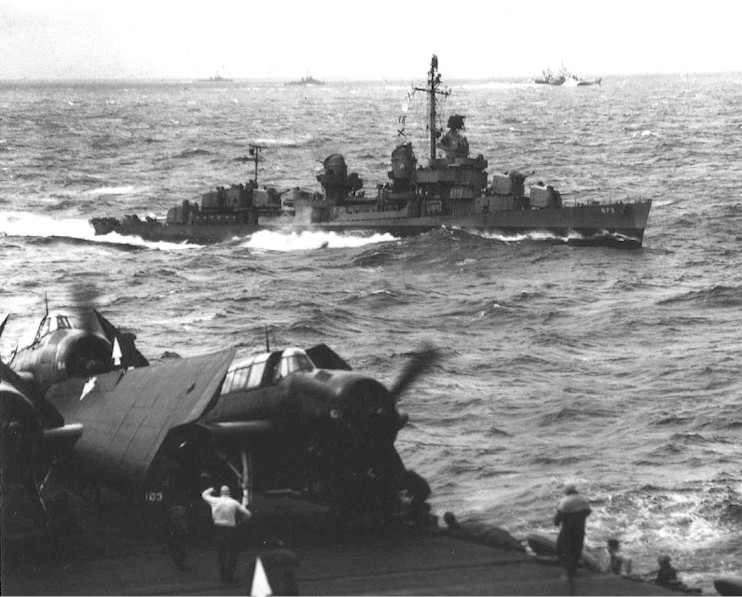
Avenger aircraft in the foreground on a carrier deck, with Harrison alongside at sea.

1945

VT-82 TBM-3 Avengers on Bennington’s deck, with the destroyer Harrison passing nearby.

U.S. Navy, Bennington photographic unit / Naval History and Heritage Command, 80-G-K-5103 · Source · Public domain (source statement)

Catalogue date fields differ within 1945. This photograph is not assigned to the 7 April sortie.

Fuel, weight and a hurried departure

VT-82’s report records ten TBM-3s taking off from Bennington on 7 April 1945. Fourteen aircraft had been armed and their crews briefed, but the urgency of launching left aircraft in the hangar. One of the ten that took off stayed near the carrier because of a fuel-system fault; nine continued to attack. YT-Y18

For the long flight, the squadron fitted additional wing tanks and left most radiomen behind. The report says radiomen remained in aircraft carrying radio-countermeasures equipment; its crew list names pilots, gunners and three radiomen. A normal three-place aircraft did not necessarily fly this mission with all three positions occupied.

This is a later Avenger operation, separate from the six TBF-1s at Midway. Aircraft variant, crew arrangements and tactical circumstances all need their own date.

Why the escorts became the targets

The own-aircraft table records one Mark 13 torpedo per aircraft, set to run at twelve feet. The narrative says the crews judged that setting too shallow for the intended attack beneath Yamato’s heavy belt armour. With most radiomen absent to make the necessary adjustment, the squadron chose escort ships instead. YT-Y18

That is the squadron’s stated reasoning. It demonstrates a connection between the decisions made before launch and the targets available on arrival. It does not establish that every American torpedo unit faced the same restriction.

The report describes releases at 800 feet and attacks on ships identified as cruisers and destroyers. These are details of this operation, not recommended release limits or a verified identification of every target.

Returning through the gunfire

Lieutenant N. A. Wiese’s aircraft was badly damaged, and both he and radioman D. E. Blakely were wounded. The report records all ten aircraft returning, although the damaged machine was subsequently stripped and jettisoned. Getting home did not mean that aircraft or crew had escaped unharmed. YT-Y18

The squadron claimed hits and a sinking, but its target list included two cruisers. The Japanese force record identifies one, Yahagi. The attack narrative preserves the crews’ experience without settling every ship identification or assigning a particular sinking to a particular torpedo. YT-Y05

Follow Under Carrier Attack and the Mark 13 profile for the weapon’s wider history.

A different decision aboard Bunker Hill

Bunker Hill’s VT-84 report provides a comparison with Bennington. It records fourteen TBM-3s launching and thirteen attacking, and describes an approach against Yamato herself. Its formations divided to threaten the battleship from different directions. One aircraft was lost before release; damaged survivors still faced the flight back to the carrier. YT-Y27

The Bunker Hill profile follows that account. It shows why Bennington’s choice of escort targets should not be treated as a limitation shared by every Avenger squadron that day.

Evidence within reach

Sources for this page

Open a note for the passage, inspection status and limits. Source records link to the available documents.

YT-Y27Bunker Hill: VT-84 aircraft action report VT-38

Original aircraft action report · digitised microfilm scan

Passage: Report VT-38, PDF pp.1–6: VT-84 aircraft, attack and return

TBM-3 aircraft, torpedo attack on Yamato, cloud and radar, loss before release, damaged aircraft and return.

Checked: All retained PDF images visually inspected on 21 October 2026; catalogue and unit/report fields compared. SHA-256 dabdc19601fb1037e264f3e45aa6ad306ca0b00648292cbe1d19f66e3fbda0d6.

Limits: VT-38 is the report number; the reporting squadron is VT-84. Six images were inspected; both final images use the sheet 5 form. A special report is referenced but is not separately identified in this copy. Nine hits are an American squadron claim, not independently confirmed allocations. Opening and attack-table aircraft figures are not fully consistent. The narrative supplies individual experiences, not a reconciled Japanese damage assessment or final casualty roll. Ammunition records are marked lost in fire.

View full source record →
YT-Y18VT-82’s attack on the Japanese surface force

Contemporary aircraft action report · scanned archival copy

Passage: Report 35-45, PDF pp.1–6 and 8: aircraft, weapon settings, formation diagram, crew list and narrative

TBM-3 identity; ten launched and nine attacking; Mark 13 torpedoes and twelve-foot depth setting; auxiliary tanks, reduced crews and target selection; damage and return; supporting SB2C-4Es and radar contact.

Checked: All eight PDF images visually inspected on 20 October 2026. Own-aircraft and supporting-aircraft tables, damage table, attack table, formation diagram, crew list, narrative and approval line checked. Public scan downloaded from Wikimedia Commons; Commons catalogue attributes it to NDL USB-06R04:0141–0148 and the NARA USSBS collection.

Limits: An American squadron account, not a Japanese damage survey. Target identifications include two cruisers where the Japanese force record identifies one. Hit and sinking claims are not independently confirmed. The damage sheet is numbered 34-45 while the cover and remaining report sheets read 35-45. Its damage table and narrative differ on gun calibre and injury severity; no exact calibre or medical grading is adopted. The eleven SB2C-4Es are supporting aircraft, not an own-squadron bombing or loss return. The ASH-equipped VB is not identified by individual aircraft or crew. Reported times retain the form’s zone convention.

View full source record →
YT-Y05Second Destroyer Squadron orders and battle records, part 3

Contemporary orders and reports · Japanese archival facsimile

Passage: C08030103200, images 75–76: Japanese force tables identifying Yahagi and eight destroyers

Mission west of Okinawa, departure force and ordered fuel transfers.

Checked: Selected archive page images inspected; the 92-image file is retained for research. Images 75–76 rechecked on 21 October 2026 for the first/second organisations and 41dg grouping with Yamato in a surface engagement.

Limits: Selected working readings, not full translation. Orders do not prove execution or delivery. Complete beaching instructions and final fuel inventory remain unverified.

View full source record →

Photograph

Enlarged historical photograph

Web copy resized and compressed; original framing retained. Open image file ↗