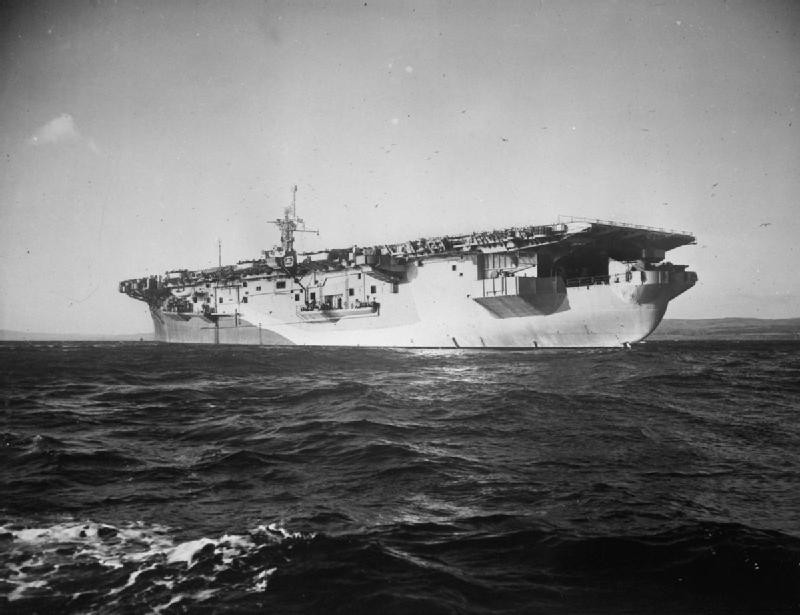


A smaller carrier in a larger operation
The Admiralty’s Tungsten summary lists Emperor among the escort carriers, under Acting Captain T. J. N. Hilken, with twenty Hellcats and two 4-inch guns. Those figures describe the ship in the operation’s roster. They are not a complete account of her armament and aircraft throughout the war. YT-T22
The plan brought several kinds of carrier together. Victorious and Furious supplied the Barracuda bombers. Emperor, Searcher and Pursuer supplied close fighter support, while Victorious also provided Corsairs. Other aircraft remained responsible for protecting the fleet. Destroyers, cruisers and oilers helped the force reach and operate in northern waters.
Two groups of Hellcats
The flying programme called for Emperor to launch ten fighters with the first strike and prepare ten more for the second. The personnel roster names ten Hellcat pilots under each strike: Lieutenant Commander S. J. Hall heads Emperor’s first list, and Lieutenant Commander S. G. Orr the second. This connects the carrier’s twenty listed aircraft to two distinct groups of men. YT-T22
The programme is a plan for launching, preparing and recovering aircraft, not a minute-by-minute record proving that every movement occurred at its scheduled time. Its value is in showing what the ship’s flight deck had to make possible while the attacking groups were away.
Fighting close to Tirpitz
The battle summary describes Hellcats and Wildcats descending to fire on German gun positions during the first attack, with Corsairs covering above. The fighters’ task was to make the bombers’ approach less dangerous. The British account credits their fire with disrupting the defences, but that assessment should be read alongside German records when judging the damage to individual positions. YT-T22
Emperor’s contribution therefore belongs inside the story of the bombing attack, even though her aircraft were fighters. Read the Hellcat profile for the aircraft and Tirpitz’s air defences for the weapons facing them.
A pilot brought home without his aircraft
The loss table identifies an Emperor Hellcat flown by Sub-Lieutenant T. H. Hoare of the Royal New Zealand Naval Volunteer Reserve. Enemy fire had damaged its arresting hook. Hoare landed on the water, and the destroyer Algonquin rescued him. YT-T22
A footnote explains that Rear-Admiral Bisset had decided against attempting a landing without the hook on either fleet carrier because of the number of aircraft then in repair. A decision about one damaged fighter depended on the condition and available space of the larger force. The aircraft was lost; the pilot survived.
Follow Tungsten and the Return to Repair for the attack’s consequences. This profile uses the Admiralty’s wartime battle summary and its appendices; Emperor’s complete log and squadron records have not yet been compared with that account.