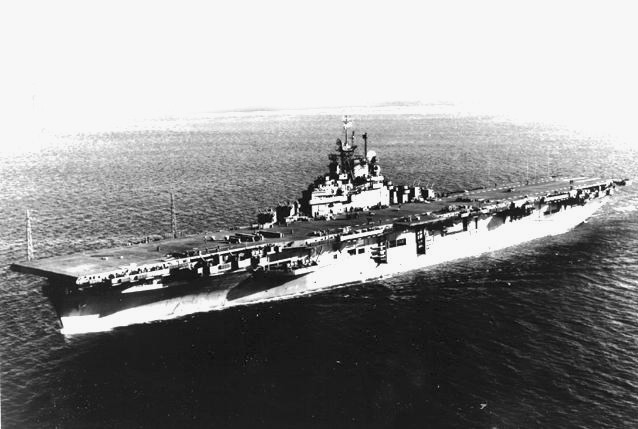


Several kinds of aircraft, one flight deck
On 7 April 1945, Bunker Hill sent aircraft against the Japanese surface force heading towards Okinawa. Two surviving squadron reports give different views of that operation: VF-84’s Corsairs carried bombs and rockets, while VT-84’s Avengers carried torpedoes. Their supporting-aircraft tables also list ten Helldivers and two Hellcats. These are figures for the strike, not the carrier’s entire aircraft complement. YT-Y26 YT-Y27
The reports make the relationship between ship and aircraft tangible. The carrier supplied a place to launch, assemble a mixed force and recover the survivors. What happened between departure and return depended on weather, coordination and each crew’s decisions.
Bombs and rockets through cloud
VF-84’s report lists fifteen F4U-1Ds taking off, each with a 500-pound bomb and eight rockets. Its attack table records fourteen aircraft attacking Yamato, fourteen bombs and 112 rockets, with one hit claimed and the resulting damage unknown. The opening table instead puts fifteen in its attacking column. The profile preserves that difference rather than silently making the entries agree. YT-Y26
The loss sheet records one Corsair destroyed in an operational loss of unknown cause and its pilot missing. The narrative describes an aircraft diving steeply out of cloud and crashing into the sea. This is not recorded as an aircraft shot down by Japanese fire.
Cloud and haze also limited what the returning pilots could establish about the ships below. The narrative’s broader claims of destruction cannot, by themselves, allocate the sinking of a particular ship to this squadron.
Closing on Yamato
VT-84’s cover sheet records fourteen TBM-3s launched and thirteen attacking. Its narrative describes locating the enemy with radar, finding an opening through the cloud and dividing the squadron to approach Yamato from different directions. The intention was to make a turn away from one group expose the ship to another. YT-Y27
The account describes intense gunfire during the final approach. Lieutenant (junior grade) Richard John Walsh’s aircraft was seen burning and crashing before releasing its torpedo. The casualty table lists him and his two crewmen as missing in action. That is the status recorded in this report, not a later reconciliation of their fate.
The attack table claims nine torpedo hits. It is a squadron claim made amid a much larger attack, not nine independently confirmed hits attributable to Bunker Hill. The table also refers to an enclosed special report that is not present as a separately identified document in this six-image copy.
Getting back aboard
Thirteen Avengers are recorded as returning. Several had been hit. Ensign C. E. Webster’s aircraft suffered a fire and undercarriage damage; the narrative says he landed with seven gallons of fuel remaining. Lieutenant (junior grade) D. F. Ray’s crew threw equipment overboard to lighten their damaged aircraft. YT-Y27
Those details restore something a simple list of carriers misses: a successful attack still left crews facing a long flight and a difficult landing. They also explain why aircraft returned and aircraft fit for further service are different measures.
Compare Bennington and her squadrons’ separate choices, or return to Under Carrier Attack.