A connected aircraft profile

Grumman F4F-4 Wildcat

A fighter had to fit aboard a carrier, reach the enemy and bring its pilot home. Improving one part of that task could make another harder.

Profile · Evidence and limits

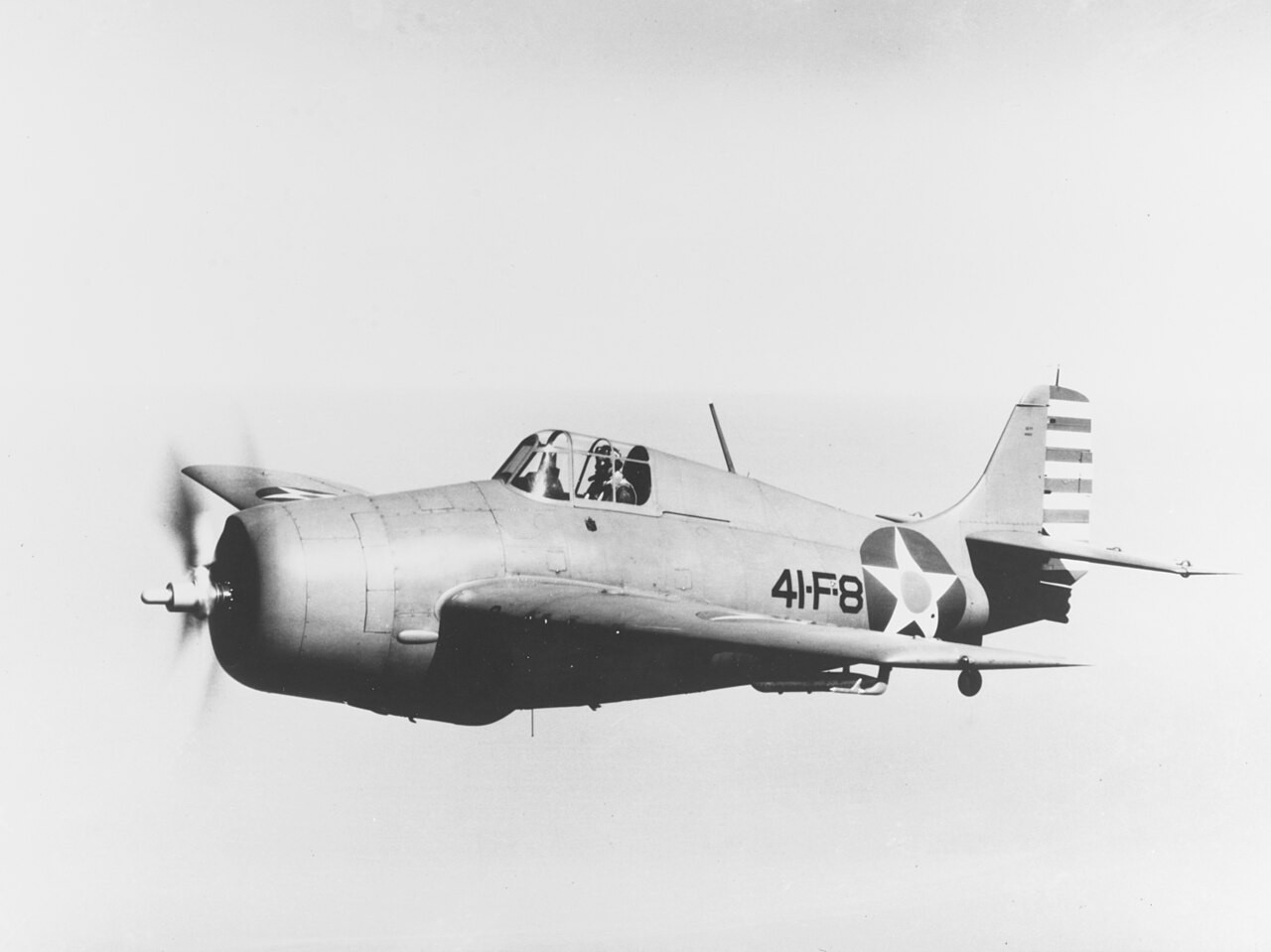
A Grumman F4F-4 Wildcat photographed in flight.

Early 1942

A VF-41 F4F-4 Wildcat in flight. It illustrates the variant discussed here, but this aircraft is not identified as a participant at Midway.

U.S. Navy / NHHC, 80-G-7026 · Source · Public domain (source statement)

Six guns and a place on deck

The Naval History and Heritage Command’s catalogue describes a photograph of an F4F-4 of Fighting Six having its six .50-calibre guns tested aboard Enterprise in April 1942. It is a dated equipment record from before Midway, not a photograph of the battle itself. The catalogue description, rather than the original negative, has been checked here. M49

The F4F-4 also introduced folding wings to the operational Wildcat series. Folding reduced the space occupied by parked aircraft aboard ship. The museum’s account distinguishes it from the fixed-wing F4F-3; later General Motors-built variants must be kept separate too. M50

More compact stowage helped a carrier accommodate fighters. It did not remove the work of moving aircraft, unfolding wings, servicing them and clearing the deck for flight operations.

More barrels was not the only question

Spruance’s post-battle report criticised the ammunition supply for the six guns and suggested reconsidering four guns with more ammunition. This was an operational recommendation, not evidence that Midway’s F4F-4s had already been converted to a four-gun arrangement. M43

The point is a practical one: the number of guns and the time for which they could fire were separate considerations. A heavier battery did not automatically solve every problem encountered in combat.

Protection and performance

Nimitz’s June report judged the F4F-4 inferior to the Japanese Zero in speed, manoeuvrability and climb, while valuing the American aircraft’s armour, armament and protected fuel tanks. That is a contemporary command assessment, not a controlled comparison under identical flight conditions. Its claimed exchange ratio is not adopted here as a verified total. M01

The same page calls for fighter patrols at more than one altitude, larger fighter complements and better training. Aircraft design mattered, but so did where fighters were stationed and whether they could reach an incoming attack in time. M01

The variant matters

This profile does not supply a single top speed or range for all Wildcats. Load, altitude, engine setting and variant must accompany those figures before they can support a fair comparison. The six-gun F4F-4 described here should not be illustrated or specified as a later FM-2 merely because both carry the Wildcat name.

See the fighter defence of Yorktown in Hiryū Fights Back.

A later British connection

Wildcats also took part in the 1944 attack on Tirpitz, including aircraft from HMS Searcher. The Tungsten aircraft table lists Wildcat V and VI with four .50-inch guns each. It does not identify which carrier carried each mark. Those later British aircraft do not change the six-gun F4F-4 specification examined in this Midway profile. YT-T22

Evidence within reach

Sources for this page

Open a note for the passage, inspection status and limits. Source records link to the available documents.

YT-T22Admiralty Battle Summary No. 27: Operation Tungsten

Official wartime operational synthesis · scan of printed edition

Passage: Printed p.14 / PDF p.20: Wildcat V and VI aircraft particulars

Shared Victorious/Furious strike organisation; squadron exchange; aircraft preparation and fleet protection; planned flying programme; Barracuda II and selected bomb loads; conditional expectations for bomb effects. Reported release heights and the two-aircraft reduction in the second strike.

Checked: Title and source-list pages and the cited printed pages visually inspected on 20 October 2026. Full 40-page scan retained with SHA-256; selected page renders retained. Source list identifies Home Fleet report M.056731/44 and carrier reports dated 5 April 1944. Appendix E read as a programme, not an execution log. Printed p.1 and strike observations on pp.6–7 also visually checked for the gun profiles. Printed pp.2, 7 and 14 / PDF pp.8, 13 and 20 rechecked for Hellcat roles, aircraft particulars and the damaged-hook loss. Printed pp.2, 12, 15, 22 and 24 / PDF pp.8, 18, 21, 28 and 30 visually checked on 20 October 2026 for Emperor’s roster, two fighter groups, Hoare’s loss and the flying programme. Printed pp.7, 12, 14–15 and 24 / PDF pp.13, 18, 20–21 and 30 visually checked on 21 October 2026 for Searcher, Fell’s escort role and the Wildcat variants. Printed pp.4, 6, 12, 15 and 24 / PDF pp.10, 12, 18, 21 and 30 visually checked on 21 October 2026 for Pursuer, Graham, Sleigh, the steering incident and Wilkinson’s return footnote. Printed pp.3, 6, 8, 12 and 24 / PDF pp.9, 12, 14, 18 and 30 visually rechecked on 21 October 2026 for Fencer’s fleet protection, aircraft and flying programme. Printed pp.2–5, 9 and 12 / PDF pp.8–11, 15 and 18 visually rechecked on 21 October 2026 for Royalist, Bisset, Eveleigh, force reorganisation and Sheffield. Printed pp.2, 5, 9 and 12 / PDF pp.8, 11, 15 and 18 visually rechecked on 21 October 2026 for Anson, Moore, McCarthy, guns, Force 7 and the decision to cancel the repeat attack.

Limits: An official synthesis compiled from reports, not the signed original reports of Victorious and Furious. Its source list is evidence of the compiler’s sources, not proof we inspected those manuscripts. Aircraft allocation, actual departures, aircraft attacking and fleet-defence aircraft are distinct counts. The bomb-penetration heights are planning expectations, not confirmed damage results. No exact bomb mark, explosive fill or reconstructed complete flight log is assigned. Its armament footnote is a British assessment, not a dated German final-fit return. Its HA/LA label for the 5.9-inch battery is not adopted; the new profiles do not classify those guns as dual-purpose. Strike descriptions preserve the attackers’ viewpoint. The flying programme is a planned schedule; Emperor’s complete log and squadron records have not been independently compared. The aircraft table lists Wildcat V and VI but does not map them to individual carriers; no mark is assigned to every Searcher aircraft from that table. Pursuer’s steering failure is recorded without a precise mechanical diagnosis; the account describes a narrowly avoided incident, not a collision. The aircrew roster is not a complete flying log. The planned four airborne and four standby Wildcats are not a complete execution log. Twenty-five fleet-defence fighters combine Seafires and Wildcats; nine retained Swordfish do not mean nine continuously airborne. Force 2 and Force 8 are successive operational groupings, not interchangeable labels. Seventeen knots is the mixed force’s stated maximum, not Royalist’s individual maximum. Royalist’s eight 5.25-inch guns are operation-list particulars; no bombardment of Tirpitz or complete fighter-control log is established.

View full source record →
M49F4F-4 gun test aboard Enterprise

Contemporary photograph · modern institutional catalogue description

Passage: NHHC photograph catalogue 80-G-16511: VF-6 F4F-4 gun test aboard Enterprise, 10 April 1942

Dated identification of an Enterprise F4F-4 with six .50-calibre guns.

Checked: NHHC catalogue description read in indexed page text on 18 October 2026. High-resolution image and original negative not inspected.

Limits: Caption-level equipment evidence, not a Midway combat photograph or a complete aircraft record. No image reproduced on the website.

View full source record →
M50Wildcat development and folding wings

Later institutional aircraft history

Passage: F4F-3 collection account · F4F-4 folding-wing development; later museum history

The distinction between fixed-wing F4F-3 and folding-wing F4F-4.

Checked: Relevant museum text read in indexed page content on 18 October 2026. Original design and acceptance records not inspected.

Limits: Only the variant distinction is used. Broad production, capacity and performance claims are not used as dated Midway returns; the museum object is an F4F-3.

View full source record →
M01Nimitz’s Midway action report

Contemporary command report · selected scan pages checked; earlier passages read in transcription

Passage: PDF / printed p.25, paragraphs 73–77: fighter assessment, numbers and training

The broad course of the battle and the report’s explicit clock convention. Later pursuit, cruiser attacks and rescue from Yorktown.

Checked: Earlier preparation, timing and attack passages read in modern transcriptions; paragraphs 13–18, 19–25 and 27–36 rechecked on 18 October 2026. For the aftermath chapters, a 28-page scan of serial 01849 was retained and PDF / printed pp.1 and 17–21 rendered and visually inspected. Earlier chapter passages have not all been compared with these images. The report date is taken from the transcription; it is not legible on the inspected first-page image. PDF / printed p.25 visually inspected for fighter assessment, replacement groups and training. Aircraft expansion: PDF / printed pp.6–12, 23 and 25 visually inspected on 18 October 2026; night attack, scout reports, TBF/TBD operations, fighter allocations and equipment assessments. Supporting-ship update: PDF/printed pp.21–22 visually inspected for paragraphs 62–65, including the continuation of paragraph 63. Cruiser-profile review, 18–19 October 2026: PDF / printed pp.20–21 visually rechecked for 6 June attacks and the erroneous two-cruiser sinking claim.

Limits: Preliminary enemy identifications and loss estimates are not final accounting. The report uses Zone plus 12; task-force reports can use a different clock. Both web copies transmit the same report. The apparent 126 B-17 transcription error is not adopted. Early hit claims and a possible fifth carrier are not accepted as established facts. Early warning times differ from M31. The statement implying deliberately spared runways is not adopted; M32 records actual runway damage and repairs. Torpedo hits, early Sōryū damage, additional ships claimed hit and precise deck conditions are not adopted as confirmed facts. Aircraft losses are distinct from personnel losses. Its retrospective sacrifice explanation is not treated as a deliberate attack plan. Its claim that both Mogami and Mikuma sank is rejected; its preliminary personnel total is not a final casualty roll. The scan does not include the separately listed enclosures. Paragraph 74’s claimed fighter exchange ratio is not treated as a verified loss total or controlled performance comparison. Early damage and hit claims on these pages are not adopted as confirmed results. The retrospective sacrifice explanation is not an order for a planned diversion. The reported two hits on Hammann differ from the captain’s account; post-sinking explosion explanations remain tentative. Ships dispatched to assist are not all treated as having arrived.

View full source record →
M43Task Force 16 action report

Contemporary command report · modern web transcription

Passage: Paragraph 9(k): six-gun ammunition and performance criticism; modern transcription

The decision to launch, expected Japanese movement, the time required to launch and Spruance’s incomplete knowledge of carrier strength.

Checked: Heading and selected operational passages read in HyperWar and Midway 1942 transcriptions on 18 October 2026. Original page images not inspected. Later movement, search and fuel passages reread in the HyperWar transcription for Beyond the Carrier Battle. Paragraphs 4(a), 4(f), 9(k) and 9(m) reread for aircraft operation and fighter-equipment profiles.

Limits: Both web copies transmit the same report. Uses Zone plus 10, two hours ahead of Midway’s Zone plus 12. Expectations of Japanese movement are not observed tracks; retrospective statements about Japanese flight decks and a seaplane tender are not adopted as established facts.

View full source record →

Photograph

Enlarged historical photograph

Web copy resized and compressed; original framing retained. Open image file ↗