A connected ship profile

HMS Furious

Furious had two tasks on 3 April 1944: send bombers towards Tirpitz, and keep fighters available over the carriers that would recover them.

Profile · Evidence and limits

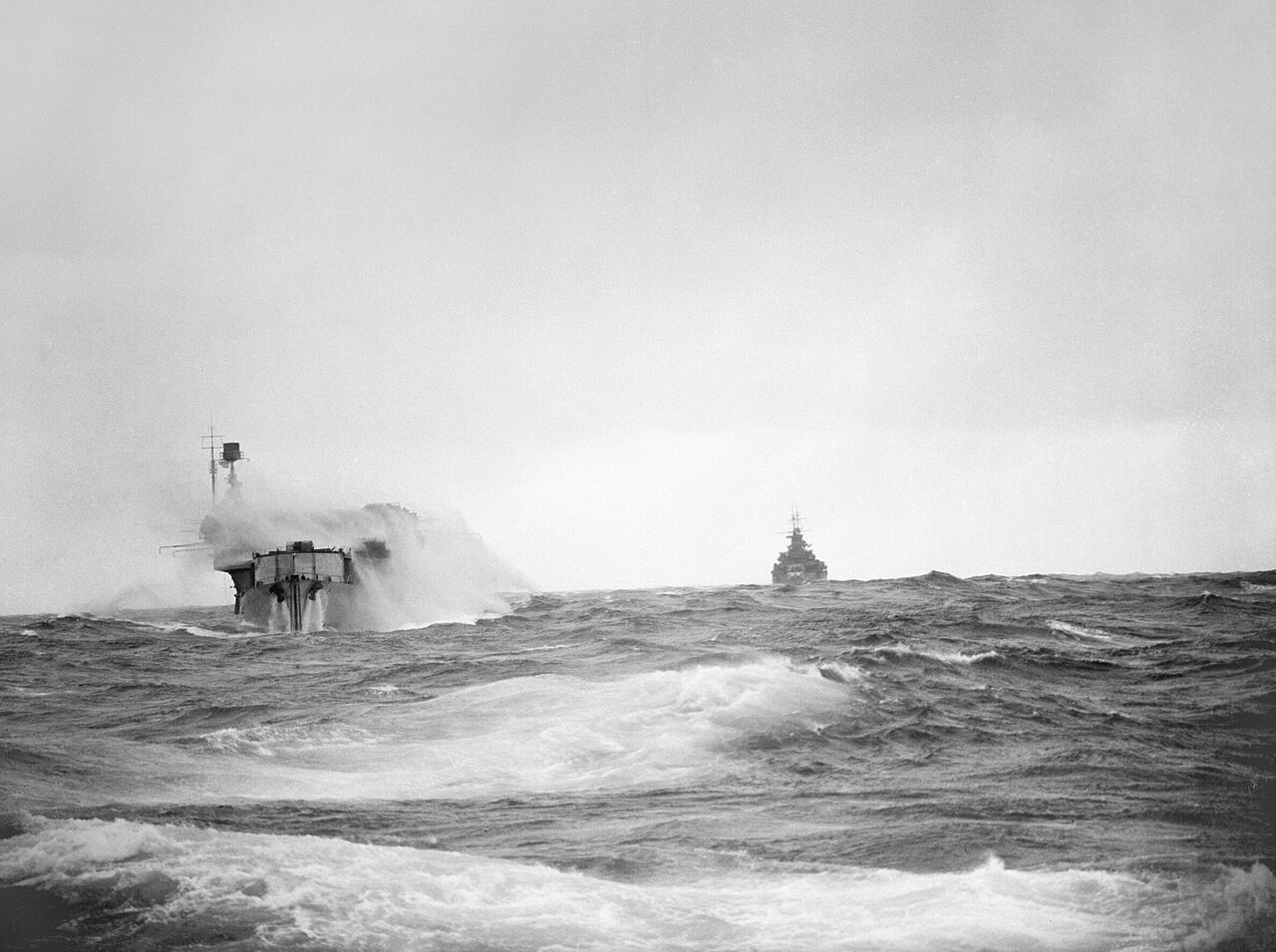
Furious meets a large wave, seen from another ship in rough seas.

Second World War

Furious pitches into heavy seas off northern Norway, with spray breaking over the flight deck.

F. A. Hudson, Royal Navy official photographer / Imperial War Museums, A 23043 · Source · Public domain (source statement)

The catalogue does not supply an exact day; this is not presented as a photograph of Tungsten’s launch.

Half of a coordinated operation

The plan for Tungsten brought Furious and Victorious together to deliver two successive bombing attacks. Each strike was to contain nine Barracudas from Furious and twelve from Victorious. Aircraft from the two decks would assemble into a single formation before setting off for the fjord. YT-T22

The first strike was assigned to No. 8 Wing, associated with Furious; the second to No. 52 Wing, associated with Victorious. The Admiralty summary explains that squadrons had been exchanged between carriers to preserve the trained wings. The organisation in the air therefore differed from a simple division by launching ship.

Lieutenant-Commander R. Baker-Faulkner of Furious commanded the first strike. Other officers directed its Corsairs and the Hellcats and Wildcats supplied by escort carriers. Several ships and aircraft types had to keep to a common timetable. YT-T22

Preparing for a particular target

The force rehearsed against a representation of Tirpitz’s anchorage at Loch Eriboll, including smoke and anti-aircraft positions. A dress rehearsal followed on 28 March. Crews were practising the approach to a defended ship in a fjord, where terrain, cloud and smoke could interfere with identification and the bombing run. YT-T22

That preparation connected the flight decks to the target. A carrier’s value depended on being able to deliver a coordinated force, not simply on the number of aircraft it could carry.

Guarding the decks

Furious’s Seafires also contributed to fleet defence. Appendix E’s flying programme sets out successive fighter launches and recoveries alongside the Barracuda strikes; Fencer supplied Wildcats for protection as well. Aircraft committed to guarding the carriers were distinct from those sent to Tirpitz. YT-T22

The programme is a plan, not a minute-by-minute record of everything that happened. Read alongside the summary’s attack narrative, it shows the practical problem: launch the second strike, recover the first, and keep protection overhead throughout.

Continue to Tungsten and the Return to Repair for the effect on Tirpitz, or compare the bombs selected for the raid.

Evidence within reach

Sources for this page

Open a note for the passage, inspection status and limits. Source records link to the available documents.

YT-T22Admiralty Battle Summary No. 27: Operation Tungsten

Official wartime operational synthesis · scan of printed edition

Passage: Printed pp.2–3, 6 and 24 / PDF pp.8–9, 12 and 30: wing organisation, command and flying programme

Shared Victorious/Furious strike organisation; squadron exchange; aircraft preparation and fleet protection; planned flying programme; Barracuda II and selected bomb loads; conditional expectations for bomb effects. Reported release heights and the two-aircraft reduction in the second strike.

Checked: Title and source-list pages and the cited printed pages visually inspected on 20 October 2026. Full 40-page scan retained with SHA-256; selected page renders retained. Source list identifies Home Fleet report M.056731/44 and carrier reports dated 5 April 1944. Appendix E read as a programme, not an execution log. Printed p.1 and strike observations on pp.6–7 also visually checked for the gun profiles. Printed pp.2, 7 and 14 / PDF pp.8, 13 and 20 rechecked for Hellcat roles, aircraft particulars and the damaged-hook loss. Printed pp.2, 12, 15, 22 and 24 / PDF pp.8, 18, 21, 28 and 30 visually checked on 20 October 2026 for Emperor’s roster, two fighter groups, Hoare’s loss and the flying programme. Printed pp.7, 12, 14–15 and 24 / PDF pp.13, 18, 20–21 and 30 visually checked on 21 October 2026 for Searcher, Fell’s escort role and the Wildcat variants. Printed pp.4, 6, 12, 15 and 24 / PDF pp.10, 12, 18, 21 and 30 visually checked on 21 October 2026 for Pursuer, Graham, Sleigh, the steering incident and Wilkinson’s return footnote. Printed pp.3, 6, 8, 12 and 24 / PDF pp.9, 12, 14, 18 and 30 visually rechecked on 21 October 2026 for Fencer’s fleet protection, aircraft and flying programme. Printed pp.2–5, 9 and 12 / PDF pp.8–11, 15 and 18 visually rechecked on 21 October 2026 for Royalist, Bisset, Eveleigh, force reorganisation and Sheffield. Printed pp.2, 5, 9 and 12 / PDF pp.8, 11, 15 and 18 visually rechecked on 21 October 2026 for Anson, Moore, McCarthy, guns, Force 7 and the decision to cancel the repeat attack.

Limits: An official synthesis compiled from reports, not the signed original reports of Victorious and Furious. Its source list is evidence of the compiler’s sources, not proof we inspected those manuscripts. Aircraft allocation, actual departures, aircraft attacking and fleet-defence aircraft are distinct counts. The bomb-penetration heights are planning expectations, not confirmed damage results. No exact bomb mark, explosive fill or reconstructed complete flight log is assigned. Its armament footnote is a British assessment, not a dated German final-fit return. Its HA/LA label for the 5.9-inch battery is not adopted; the new profiles do not classify those guns as dual-purpose. Strike descriptions preserve the attackers’ viewpoint. The flying programme is a planned schedule; Emperor’s complete log and squadron records have not been independently compared. The aircraft table lists Wildcat V and VI but does not map them to individual carriers; no mark is assigned to every Searcher aircraft from that table. Pursuer’s steering failure is recorded without a precise mechanical diagnosis; the account describes a narrowly avoided incident, not a collision. The aircrew roster is not a complete flying log. The planned four airborne and four standby Wildcats are not a complete execution log. Twenty-five fleet-defence fighters combine Seafires and Wildcats; nine retained Swordfish do not mean nine continuously airborne. Force 2 and Force 8 are successive operational groupings, not interchangeable labels. Seventeen knots is the mixed force’s stated maximum, not Royalist’s individual maximum. Royalist’s eight 5.25-inch guns are operation-list particulars; no bombardment of Tirpitz or complete fighter-control log is established.

View full source record →

Photograph

Enlarged historical photograph

Web copy resized and compressed; original framing retained. Open image file ↗