A connected ship profile

HMS Victorious

Victorious connects the two battleship stories. In 1941 she sent a small, newly embarked force into a difficult night attack. Three years later she helped organise a much larger strike against a defended anchorage.

Profile · Evidence and limits

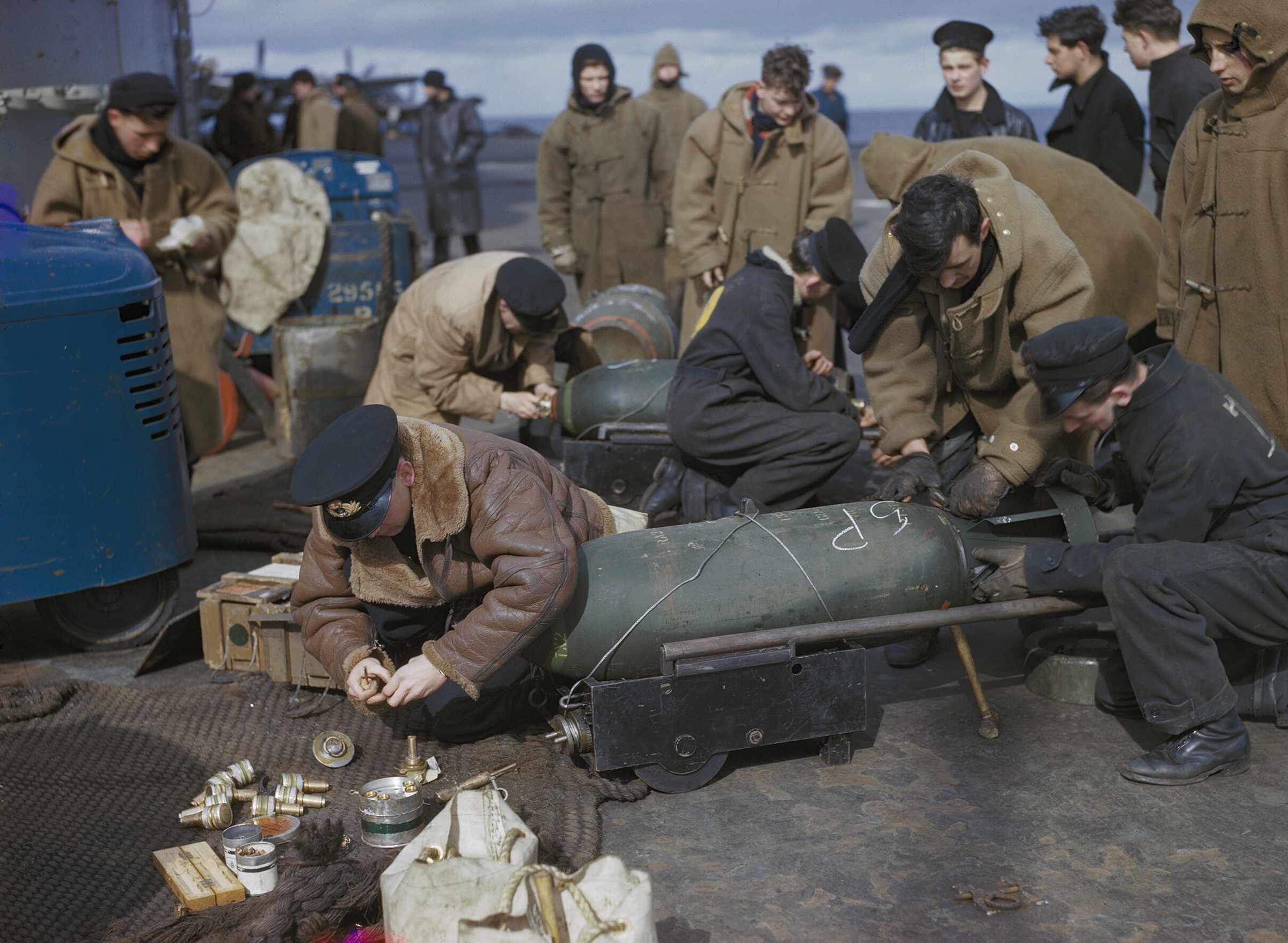
Men work around bombs and equipment on Victorious’s flight deck in a colour photograph.

Before Operation Tungsten · April 1944

Fleet Air Arm personnel prepare bombs on Victorious before the attack on Tirpitz.

Royal Navy official photographer / Imperial War Museums, TR 1812 · Source · Public domain (source statement)

An archive colour photograph, not a modern colourisation. The caption identifies preparation before Tungsten, not a particular aircraft’s eventual hit.

A new carrier in the chase

Victorious had only just commissioned when Tovey called on her to help stop Bismarck. His despatch records nine operational Swordfish and six Fulmars aboard, with little time available for working up. On 24 May he detached the carrier with cruisers because reducing the enemy’s speed mattered more urgently than retaining her aircraft for the next morning’s search. B11

Nine Swordfish took off that evening. Eight attacked; the ninth lost contact in cloud. Airborne radar helped locate the target, but the crews also needed redirection from Norfolk. The attack was an achievement of navigation and coordination as well as flying.

The despatch reports at least one torpedo hit. Its later Admiralty footnote qualifies Tovey’s original assessment of the result: the immediate, principal cause of the eventual interception was the rudder damage inflicted by Ark Royal’s aircraft on 26 May. Victorious’s attack belongs earlier in a pursuit that was still unresolved. B11

Two carriers, shared strikes

For Operation Tungsten, the Admiralty battle summary describes two planned strikes of twenty-one Barracudas, each drawing twelve aircraft from Victorious and nine from Furious. Squadrons had exchanged carriers so that each trained wing could operate together. A strike’s association with one carrier’s wing does not mean that every aircraft launched from that ship. YT-T22

Victorious also supplied Corsair escort fighters. Her deck programme had to accommodate two aircraft types and four bomb types while preparing successive strikes. The summary describes the difficulty of carrying more aircraft than she had been designed to operate, including aircraft exposed to spray, sleet and freezing conditions on deck.

The work behind the launch

Before dawn on 3 April, second-strike aircraft were moved into the warmer hangar while the first strike was arranged on deck. Maintenance, fuelling and aircraft handling made the flying programme possible. The carrier’s contribution began well before the aircraft reached Tirpitz. YT-T22

Follow her from The Pursuit to Tungsten and the Return to Repair. These are two episodes in her service, with different aircraft, targets and tactical problems.

Evidence within reach

Sources for this page

Open a note for the passage, inspection status and limits. Source records link to the available documents.

B11Tovey’s despatch

Contemporary command report · later official printed edition

Passage: Gazette p.4853 / PDF p.7, paragraphs 32–39 and Admiralty footnote

Discovery, the decision to shadow after Hood’s loss, fuel and interception constraints, Victorious’s attack and later operational pressures. Loss of radar contact, search choices and the misleading radio-bearing plot aboard King George V. Rescue and the reported reason for breaking it off.

Checked: Selected official printed pages inspected. Paragraphs 3–15 on pp.4847–4849 visually checked for chapter 4 on 18 October 2026; earlier checks include pp.4855–4857. For The Pursuit, PDF pp.4–8 / printed pp.4850–4854 visually checked, including paragraphs 19–44 and Admiralty footnotes. For Contact Lost, PDF pp.8–9 / printed pp.4854–4855 visually checked, paragraphs 44–54 and the Prinz Eugen footnote. For Contact Regained, PDF p.10 / Gazette p.4856 visually checked, especially paragraphs 59–63. For The Final Battle, PDF pp.11–13 / Gazette pp.4857–4859 visually checked, paragraphs 70–87. Paragraph 87 on PDF p.13 rechecked for Rescue and Remembrance. Ship-profile expansion: PDF pp.4–5 and 12–13 visually rechecked for Prince of Wales and King George V. Supporting-ship update: PDF p.13 / Gazette p.4859 visually rechecked for Dorsetshire’s gunfire, torpedo attack and rescue, paragraphs 84–87. Cruiser-profile review, 18–19 October 2026: PDF pp.3, 5, 8 and 13 / Gazette pp.4849, 4851, 4854 and 4859 visually rechecked for Suffolk and Norfolk.

Limits: A retrospective commander’s account, not the signed manuscript or a complete inventory of British naval strength. Disagreements with the web transcription remain recorded in the research audit. Later Admiralty footnotes correct the interception forecast and qualify Tovey’s assessment of the first torpedo hit; these are distinct editorial voices. Overconfidence is Tovey’s retrospective judgement. The Admiralty footnote corrects his inference that Prinz Eugen remained present; a possible Walrus sighting is a counterfactual, not a certainty. Position-error estimates are Tovey’s retrospective assessment; finding Bismarck did not itself secure an interception. Night torpedo-hit claims are not independently confirmed. External observations of gun suppression and sinking do not establish the internal damage sequence or settle the contribution of scuttling. The submarine sighting is explicitly uncertain. Rescue totals differ from B24 and the later B26 roll; the speculative Canarias rescue is not adopted. Suffolk’s initial discovery was visual; radar sustained contact. Norfolk’s report reached Tovey first. Norfolk’s limited forward radar coverage is not treated as equivalent to Suffolk’s; no radar model or full dated fit is assigned.

View full source record →
YT-T22Admiralty Battle Summary No. 27: Operation Tungsten

Official wartime operational synthesis · scan of printed edition

Passage: Printed pp.2–3, 5–6 and 24 / PDF pp.8–9, 11–12 and 30: preparation, shared strikes and flying programme

Shared Victorious/Furious strike organisation; squadron exchange; aircraft preparation and fleet protection; planned flying programme; Barracuda II and selected bomb loads; conditional expectations for bomb effects. Reported release heights and the two-aircraft reduction in the second strike.

Checked: Title and source-list pages and the cited printed pages visually inspected on 20 October 2026. Full 40-page scan retained with SHA-256; selected page renders retained. Source list identifies Home Fleet report M.056731/44 and carrier reports dated 5 April 1944. Appendix E read as a programme, not an execution log. Printed p.1 and strike observations on pp.6–7 also visually checked for the gun profiles. Printed pp.2, 7 and 14 / PDF pp.8, 13 and 20 rechecked for Hellcat roles, aircraft particulars and the damaged-hook loss. Printed pp.2, 12, 15, 22 and 24 / PDF pp.8, 18, 21, 28 and 30 visually checked on 20 October 2026 for Emperor’s roster, two fighter groups, Hoare’s loss and the flying programme. Printed pp.7, 12, 14–15 and 24 / PDF pp.13, 18, 20–21 and 30 visually checked on 21 October 2026 for Searcher, Fell’s escort role and the Wildcat variants. Printed pp.4, 6, 12, 15 and 24 / PDF pp.10, 12, 18, 21 and 30 visually checked on 21 October 2026 for Pursuer, Graham, Sleigh, the steering incident and Wilkinson’s return footnote. Printed pp.3, 6, 8, 12 and 24 / PDF pp.9, 12, 14, 18 and 30 visually rechecked on 21 October 2026 for Fencer’s fleet protection, aircraft and flying programme. Printed pp.2–5, 9 and 12 / PDF pp.8–11, 15 and 18 visually rechecked on 21 October 2026 for Royalist, Bisset, Eveleigh, force reorganisation and Sheffield. Printed pp.2, 5, 9 and 12 / PDF pp.8, 11, 15 and 18 visually rechecked on 21 October 2026 for Anson, Moore, McCarthy, guns, Force 7 and the decision to cancel the repeat attack.

Limits: An official synthesis compiled from reports, not the signed original reports of Victorious and Furious. Its source list is evidence of the compiler’s sources, not proof we inspected those manuscripts. Aircraft allocation, actual departures, aircraft attacking and fleet-defence aircraft are distinct counts. The bomb-penetration heights are planning expectations, not confirmed damage results. No exact bomb mark, explosive fill or reconstructed complete flight log is assigned. Its armament footnote is a British assessment, not a dated German final-fit return. Its HA/LA label for the 5.9-inch battery is not adopted; the new profiles do not classify those guns as dual-purpose. Strike descriptions preserve the attackers’ viewpoint. The flying programme is a planned schedule; Emperor’s complete log and squadron records have not been independently compared. The aircraft table lists Wildcat V and VI but does not map them to individual carriers; no mark is assigned to every Searcher aircraft from that table. Pursuer’s steering failure is recorded without a precise mechanical diagnosis; the account describes a narrowly avoided incident, not a collision. The aircrew roster is not a complete flying log. The planned four airborne and four standby Wildcats are not a complete execution log. Twenty-five fleet-defence fighters combine Seafires and Wildcats; nine retained Swordfish do not mean nine continuously airborne. Force 2 and Force 8 are successive operational groupings, not interchangeable labels. Seventeen knots is the mixed force’s stated maximum, not Royalist’s individual maximum. Royalist’s eight 5.25-inch guns are operation-list particulars; no bombardment of Tirpitz or complete fighter-control log is established.

View full source record →

Photograph

Enlarged historical photograph

Web copy resized and compressed; original framing retained. Open image file ↗