A connected aircraft profile

Douglas TBD Devastator

The Devastator’s crews faced more than an ageing aircraft. They had to find the enemy, survive the approach and bring a torpedo within reach of a moving ship.

Profile · Evidence and limits

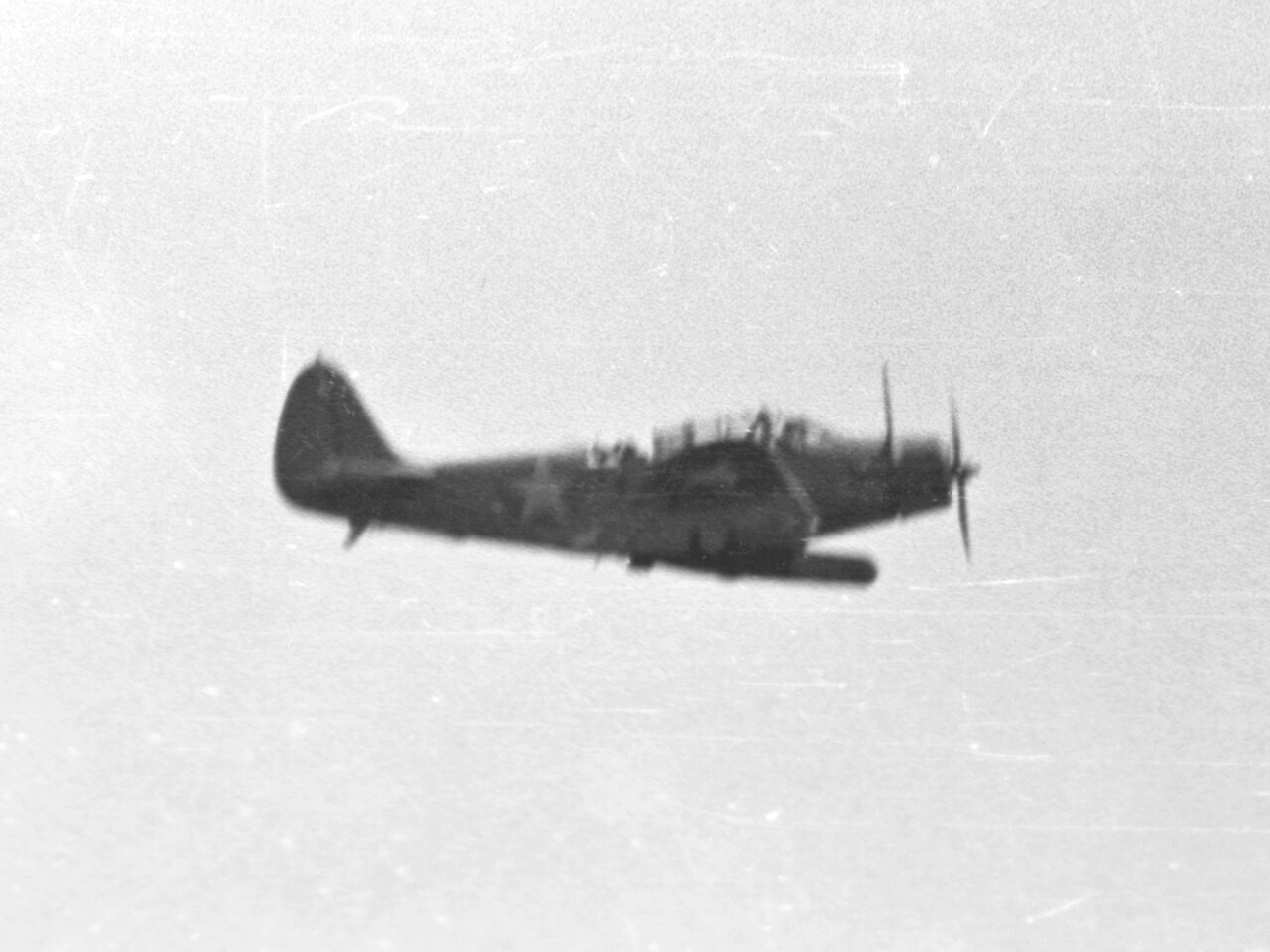
A TBD Devastator in flight with a torpedo beneath its fuselage.

4 June 1942

A TBD-1 Devastator carrying a torpedo during the morning of the battle. The naval catalogue considers a VT-3 identification probable, rather than certain.

U.S. Navy / NHHC, 80-G-21668 · Source · Public domain (source statement)

An aircraft built for carrier work

The Devastator had been an important step forward when it entered service in 1937: an all-metal monoplane with an enclosed cockpit and hydraulically folding wings. Its design accommodated a pilot, bombardier and gunner. That describes the aircraft’s provision for crew, not proof that three people flew in every Midway torpedo sortie. M56

At Midway, the carrier torpedo squadrons still flew TBDs. Hornet’s VT-8 also had a separate detachment operating new TBFs from the island. The two groups belonged to the same squadron but attacked from different bases in different aircraft. M54

The approach was part of the weapon

Nimitz’s report describes separated formations and failed fighter support for the Hornet and Enterprise torpedo groups. It also records the six fighters accompanying Yorktown’s strike. The attacks should not all be compressed into a single, identical experience. M01

Finding a target was only the beginning. The aircraft had to reach a release position while fighters and ships fired at it; the torpedo then had to run correctly and reach the target. A failed attack does not, by itself, tell us which part of that chain failed. The torpedo profile keeps the aircraft and weapon questions separate.

What commanders concluded

Nimitz judged the TBD “fatally inadequate” after the battle. Spruance recommended replacement by the TBF. These are contemporary assessments, reflecting a devastating operational experience. They are not evidence that a newer aircraft could have dispensed with fighter protection: Nimitz explicitly said it could not. M01 M43

The report also interpreted the torpedo squadrons’ losses as helping the dive bombers succeed. That retrospective explanation should not be turned into a claim that their crews had been deliberately sent on a sacrificial diversion. M01

Read The Morning Strikes for the attacks, and The People Left Behind for the distinction between an aircraft loss and the fate of its crew.

Evidence within reach

Sources for this page

Open a note for the passage, inspection status and limits. Source records link to the available documents.

M56TBD Devastator — manufacturer historical snapshot

Manufacturer retrospective · indexed PDF text

Passage: TBD Devastator historical snapshot, printed p.156: design and folding wings; indexed text

1937 service entry; enclosed cockpit, three design crew positions and hydraulic wing folding.

Checked: Indexed text of the historical snapshot read. PDF page image and original Douglas manuals not inspected.

Limits: Used only for the selected design-history facts. Published speed and range are not adopted without operating conditions and independent technical checking; battle-loss arithmetic and cruiser-attack claims are excluded.

View full source record →
M01Nimitz’s Midway action report

Contemporary command report · selected scan pages checked; earlier passages read in transcription

Passage: PDF / printed pp.10–12 and 25: separate formations, fighter protection, losses and equipment assessment

The broad course of the battle and the report’s explicit clock convention. Later pursuit, cruiser attacks and rescue from Yorktown.

Checked: Earlier preparation, timing and attack passages read in modern transcriptions; paragraphs 13–18, 19–25 and 27–36 rechecked on 18 October 2026. For the aftermath chapters, a 28-page scan of serial 01849 was retained and PDF / printed pp.1 and 17–21 rendered and visually inspected. Earlier chapter passages have not all been compared with these images. The report date is taken from the transcription; it is not legible on the inspected first-page image. PDF / printed p.25 visually inspected for fighter assessment, replacement groups and training. Aircraft expansion: PDF / printed pp.6–12, 23 and 25 visually inspected on 18 October 2026; night attack, scout reports, TBF/TBD operations, fighter allocations and equipment assessments. Supporting-ship update: PDF/printed pp.21–22 visually inspected for paragraphs 62–65, including the continuation of paragraph 63. Cruiser-profile review, 18–19 October 2026: PDF / printed pp.20–21 visually rechecked for 6 June attacks and the erroneous two-cruiser sinking claim.

Limits: Preliminary enemy identifications and loss estimates are not final accounting. The report uses Zone plus 12; task-force reports can use a different clock. Both web copies transmit the same report. The apparent 126 B-17 transcription error is not adopted. Early hit claims and a possible fifth carrier are not accepted as established facts. Early warning times differ from M31. The statement implying deliberately spared runways is not adopted; M32 records actual runway damage and repairs. Torpedo hits, early Sōryū damage, additional ships claimed hit and precise deck conditions are not adopted as confirmed facts. Aircraft losses are distinct from personnel losses. Its retrospective sacrifice explanation is not treated as a deliberate attack plan. Its claim that both Mogami and Mikuma sank is rejected; its preliminary personnel total is not a final casualty roll. The scan does not include the separately listed enclosures. Paragraph 74’s claimed fighter exchange ratio is not treated as a verified loss total or controlled performance comparison. Early damage and hit claims on these pages are not adopted as confirmed results. The retrospective sacrifice explanation is not an order for a planned diversion. The reported two hits on Hammann differ from the captain’s account; post-sinking explosion explanations remain tentative. Ships dispatched to assist are not all treated as having arrived.

View full source record →
M43Task Force 16 action report

Contemporary command report · modern web transcription

Passage: Paragraph 9(l): recommendation to replace TBD aircraft with TBFs; modern transcription

The decision to launch, expected Japanese movement, the time required to launch and Spruance’s incomplete knowledge of carrier strength.

Checked: Heading and selected operational passages read in HyperWar and Midway 1942 transcriptions on 18 October 2026. Original page images not inspected. Later movement, search and fuel passages reread in the HyperWar transcription for Beyond the Carrier Battle. Paragraphs 4(a), 4(f), 9(k) and 9(m) reread for aircraft operation and fighter-equipment profiles.

Limits: Both web copies transmit the same report. Uses Zone plus 10, two hours ahead of Midway’s Zone plus 12. Expectations of Japanese movement are not observed tracks; retrospective statements about Japanese flight decks and a seaplane tender are not adopted as established facts.

View full source record →
M54VT-8’s TBF detachment at Midway

Later official historical essay · indexed text

Passage: VT-8 carrier and island detachments; indexed later history

Distinction between carrier TBD and island TBF detachments; TBF-1 identification and individual returning-crew fates.

Checked: Selected indexed passages read. Direct page retrieval failed; contemporary individual crew reports not inspected.

Limits: Later interpretation, not an original action report. Its proposed causal chain through Nautilus and Arashi is not adopted. Conflicting aircraft serial renderings, the date of the Avenger name, exact damage totals and total casualty arithmetic are excluded.

View full source record →

Photograph

Enlarged historical photograph

Web copy resized and compressed; original framing retained. Open image file ↗