A connected aircraft profile

Nakajima B5N2 Kate

Calling the Kate a torpedo bomber tells only part of its story. Its crew also navigated, observed and delivered bombs.

Profile · Evidence and limits

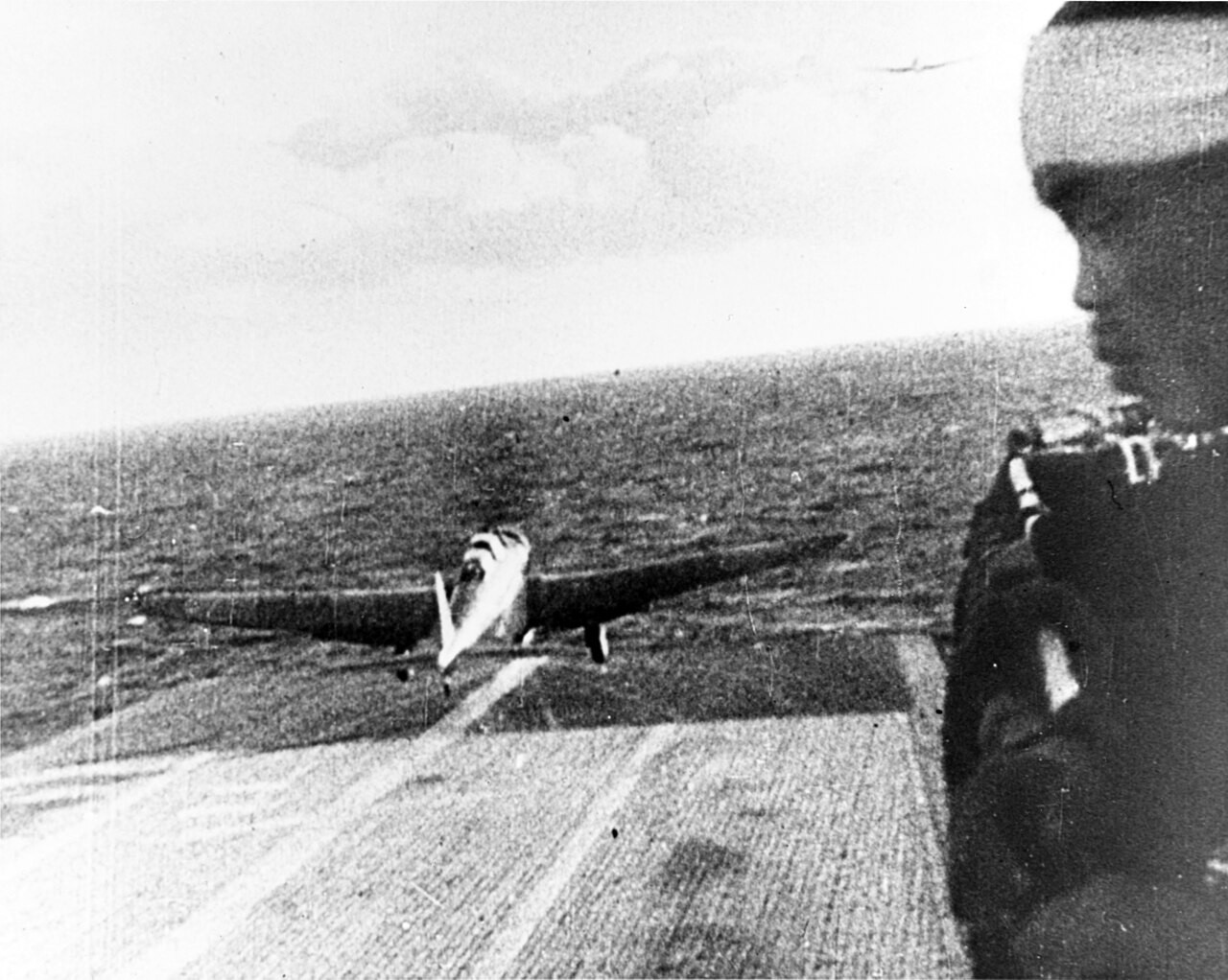
A Nakajima B5N2 taking off from a Japanese carrier.

7 December 1941

A B5N2 launches from Shōkaku for the Pearl Harbor operation, as identified in the catalogue. The film frame illustrates the aircraft in carrier service before Midway.

Japanese naval film / U.S. National Archives, 80-G-182249 · Source · Public domain (source statement)

Captured Japanese film held in a U.S. collection; not a U.S.-authored photograph.

Three people in one aircraft

The pilot, observer and radio operator/gunner sat in line under a long canopy. The observer’s work included navigation: getting a strike across open water and home again was part of delivering the weapon. The senior crewman could command the aircraft without being its pilot. M53

The B5N2 used a Sakae 11 engine, rated in the museum account at 1,000 horsepower for takeoff. A single flexible 7.7 mm Type 92 gun defended the rear. There was no forward-firing gun, and the aircraft lacked armour and self-sealing fuel tanks. Its ability to carry a substantial weapon did not make it a fighter. M53

A weapon chosen for the mission

The Type 97 carrier attack aircraft could carry bombs or a torpedo. The B5N2 version served in the Midway force. The familiar name Kate should therefore not lead us to imagine a torpedo beneath every aircraft on every sortie. M53 M52

Hiryū’s second counterattack gives a precise example. The Japanese organisation table lists nine attack aircraft from Hiryū and one from Akagi, supported by six fighters. It notes that the Akagi aircraft did not release its torpedo. M14

The expenditure table records nine Type 91 modification 3 aerial torpedoes. Ten aircraft assigned and nine torpedoes expended are compatible counts, describing different things. Neither figure is a count of confirmed hits. M41

Damage below the waterline

Yorktown’s technical report records two aerial-torpedo hits on her port side. Flooding, loss of power and a severe list made this a different emergency from repairing holes in the flight deck. M18

The carrier remained afloat after the air attacks. Her later loss involved a submarine attack during salvage efforts, so the Kate’s role should be described as helping disable Yorktown, rather than sinking her outright. M18 Follow both stages in Hiryū Fights Back and Beyond the Carrier Battle.

Evidence within reach

Sources for this page

Open a note for the passage, inspection status and limits. Source records link to the available documents.

M53Nakajima B5N2 Kate — aircraft and crew

Later museum technical and historical account

Passage: The Aircraft, Crew Roles and Defensive Limitations: B5N2 roles, engine and gun

Crew roles, navigation, bomb/torpedo capability, Sakae 11 takeoff power and defensive gun.

Checked: Selected web passages read, including specification distinctions and cited references.

Limits: Later synthesis drawing on published histories and recollections, not an original Midway technical return. Pearl Harbor loads, procedures and anecdotes are not transferred to Midway. Detailed performance tables not adopted.

View full source record →
M52Hornet (CV-8) — official ship history

Retrospective official history · indexed text

Passage: Opening 4 June passage identifies B5N2 aircraft at Midway; indexed text

A6M2, D3A1 and B5N2 identification at Midway; Catalina torpedo hit on Akebono Maru.

Checked: Selected indexed passages read. Direct page retrieval failed; underlying war diaries and photographs not inspected for these claims.

Limits: Later synthesis, distinct from contemporary reports. Used for limited aircraft identification and the named oiler hit, not as independent confirmation of every reported time, loss or tactical interpretation.

View full source record →
M14First Air Fleet detailed battle report

Contemporary Japanese command report · archival scan

Passage: PDF p.18 / stamped 0020: second counterattack organisation and unreleased Akagi torpedo

The carrier command’s reported assumptions, force organisation and the division of air attack, reconnaissance, support and supply tasks. The opening island strike, request for another attack and changing armament preparations. Hiryū’s counterattack aircraft, remaining strength and later fire emergency. Akagi, Kaga and Sōryū damage and evacuation; opening island-strike allocations.

Checked: Selected Japanese passages on PDF pp.10–11 and 14–15 visually checked for chapter 1. For chapter 4, pp.16–20 visually inspected and compared with M06’s English organisation tables; pp.21–22 inspected for context on 18 October 2026. For Midway Under Attack, PDF pp.29–33 / stamped 0031–0035 visually inspected and selected passages compared with M06; pp.23–26 sampled for context. For Search and Decision, PDF pp.32–33 / stamped 0034–0035 rechecked against M39’s chronological table. PDF pp.34–35 / stamped 0036–0037 visually inspected for The Morning Strikes; p.34 supports command transfer and Hiryū’s continued ability to attack. PDF pp.35–43 rendered and visually inspected for Hiryū Fights Back: pp.35–38 cover counterattack strength, claims and Hiryū’s bombing; pp.42–43 cover fire, propulsion failure and abandonment preparations. Intervening Akagi/Kaga passages inspected for context. PDF p.44 / stamped 0046 visually inspected for the continuation of Hiryū’s evacuation to destroyers. PDF p.18 / stamped 0020 re-rendered and visually inspected for Hiryū counterattack organisation. Ship-profile expansion: PDF pp.17, 39–42 and 44–46 rendered and visually inspected; selected damage passages compared with M06. Cruiser-profile review, 18–19 October 2026: PDF pp.32–33 / stamped 0034–0035 visually rechecked for the successive Tone No.4 reports and decisions. PDF p.45 / stamped 0047 visually rechecked on 21 October 2026 for the Isokaze profile: rescue, treatment and transfer to Hamakaze and Isokaze. The already retained scan was used; a fresh JACAR viewer request returned HTTP 403.

Limits: Working readings, not a certified full translation. The report was compiled after the battle and some tables include actual results, not just pre-battle plans. The English table’s Haruna aircraft type differs from the Japanese image; no type is assigned here. M06 transmits the same report family. Opening narrative compresses later attacks into the same paragraph. Its dates and times are not silently merged with the American chronology; message timing and flight-deck readiness require further records. Initial-contact timing differs between the narrative and M39’s chronological table; no fixed message delay is inferred. Predicted aircraft readiness is not a completed launch. Japanese counterattack target identities and claimed damage on these pages are not confirmed outcomes. Evacuation entries are not a complete personnel roll; scuttling orders and final sinking times remain distinct. Exact bomb-hit counts and the compressed Kaga/Sōryū terminal sinking passages do not settle scuttling contributions. Akagi command-transfer times differ within the report; no single minute is adopted. Sōryū evacuation: M14 PDF p.45 / stamped 0047 names Hamakaze and Isokaze (磯風); M06 renders the second as Isonami. The profile follows the original Japanese name.

View full source record →
M41First Air Fleet report: Hiryū’s weapon expenditure

Contemporary Japanese command report · archival scan, part 4

Passage: PDF p.3 / stamped 0158: Hiryū attack aircraft and Type 91 modification 3 expenditure

Recorded bomb categories, torpedo modification and expenditure in Hiryū’s two counterattacks.

Checked: Retained Japanese pages 1 and 3 re-rendered and visually inspected on 18 October 2026; selected fields only. Full 58-page research copy retained from 17 October.

Limits: Working readings, not a certified complete translation. Same report family as M14/M06. Expenditure is not magazine stock, hit count or a complete technical specification. Enemy identifications and damage claims are not accepted uncritically. Japanese report dates are not silently merged with American local dates.

View full source record →
M18Yorktown’s damage report

Technical report · third-party scan extract

Passage: PDF pp.5–6 / printed pp.2–3: Yorktown aerial-torpedo damage and later submarine attack

The sequence of damage, recovery, interrupted salvage and loss of Yorktown. Fuel precautions, flight-deck repair, boiler recovery, loss of power and abandonment.

Checked: PDF pages 4 and 17 visually inspected; other text selectively examined. PDF pp.4–5 rendered and visually rechecked on 18 October 2026 for Hiryū Fights Back. PDF p.6 / printed p.3 visually inspected for towing, salvage, the submarine attack and final loss. Supporting-ship update: PDF p.6 visually rechecked for Vireo’s tow and Hammann’s salvage assistance.

Limits: Relies on officers’ reconstructed recollections after records were lost. Cover publication date and complete plate set are absent from the retained extract. Draws on the captain’s submissions, so is not independent corroboration of M04. Its 1645 torpedo-hit time differs from M04’s approximately 1620, and its 23-degree abandonment list differs from M04’s 26 degrees. The paragraph 10 elapsed-time arithmetic is inconsistent; no exact repair duration is inferred from it. The post-Hammann underwater explosion is tentatively attributed to depth charges, whereas M44 leaves the cause unresolved. The smaller list after the later attack did not mean improved overall buoyancy.

View full source record →

Photograph

Enlarged historical photograph

Web copy resized and compressed; original framing retained. Open image file ↗