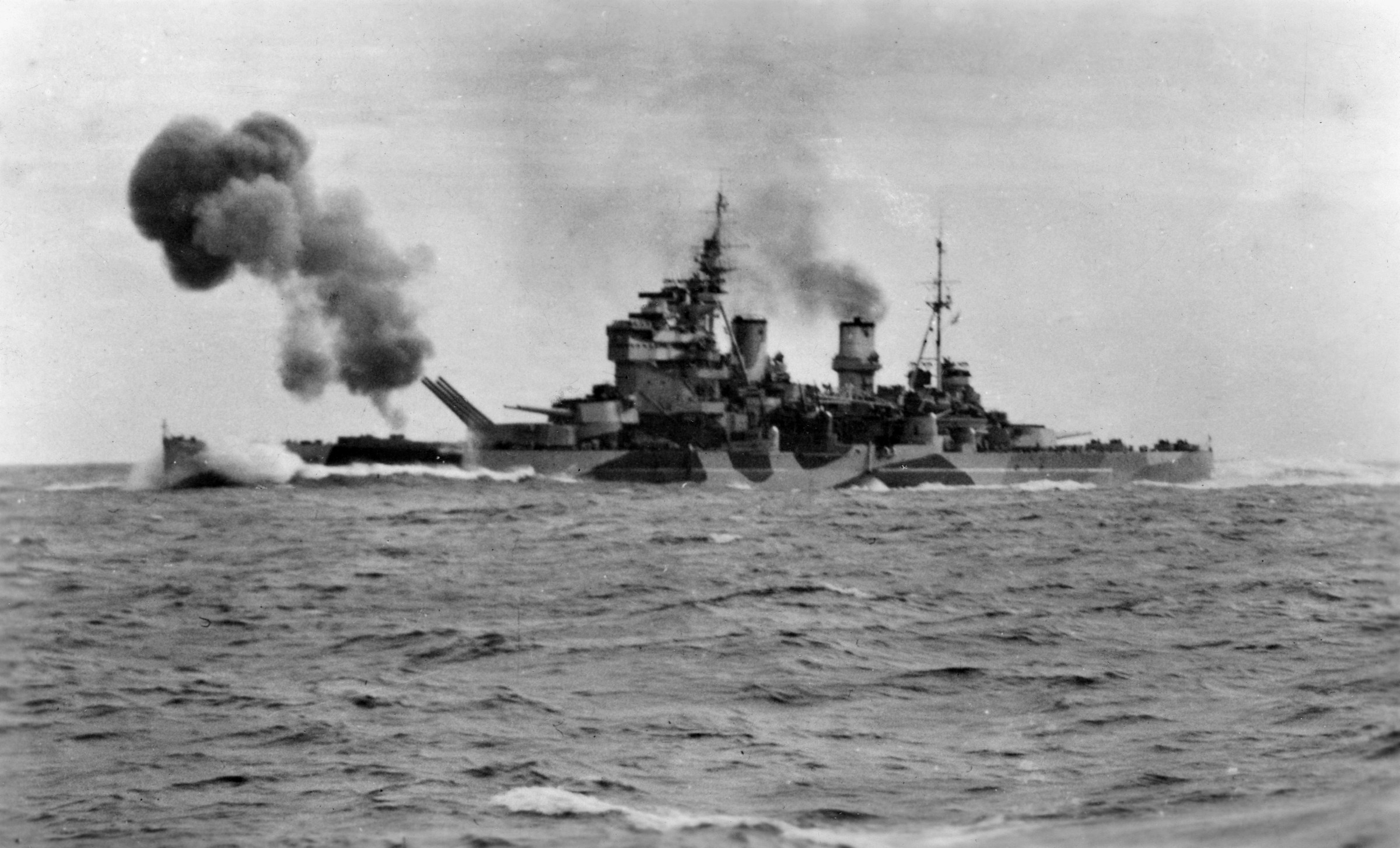


A battleship carrying the commander
The Admiralty’s Tungsten ship list identifies Anson as Vice-Admiral Sir Henry R. Moore’s flagship. It names Captain E. D. B. McCarthy as her commanding officer and records ten 14-inch guns and sixteen 5.25-inch high-angle/low-angle guns. Those particulars belong to the operation’s own list. YT-T22
Moore was second-in-command of the Home Fleet. His responsibilities extended beyond the ship beneath his flag: he had to bring the attacking forces together, get the carriers to their launching position and decide what to do once their aircraft returned.
The distinction explains Anson’s place in this story. The weapons that struck Tirpitz were carried by aircraft. Anson provided the flagship from which the operation was conducted; the inspected account does not describe her firing her main battery at the German battleship.
Convoy cover and a rendezvous
Tungsten was coordinated with the passage of the Arctic convoy JW 58. In the original passage organisation, Anson belonged to Force 1 with Duke of York, Victorious, Belfast and six destroyers, covering the convoy. Duke of York carried the Commander-in-Chief; Anson carried Moore. A second force under Rear-Admiral Bisset was to join them before the attack. YT-T22
The forces met on 2 April. At 1620, the Commander-in-Chief in Duke of York parted company with two destroyers. Moore continued towards the flying-off position with the Tungsten forces. The Admiralty summary records Anson at the head of Force 7 with Victorious, Furious, Jamaica, Belfast and six destroyers. Royalist, Bisset’s flagship, headed Force 8 with the escort carriers. YT-T22
The two flagships therefore served different levels of command within the same operation. Anson’s connection with Royalist helps make sense of a fleet whose organisation changed between the passage north and the air attack itself.
Whether to strike again
After the attacks on 3 April, Moore initially intended to repeat the operation the following morning. Destroyer refuelling began urgently, even though it temporarily reduced the force’s protection against submarines. Keeping the option of another strike open had a cost for the ships supporting the carriers. YT-T22
The decision then changed. The Admiralty account says Moore received reports of serious damage to Tirpitz and of the aircrews’ fatigue. He cancelled further operations and ordered the forces, including the fleet oilers, back to base.
This was a decision made from the reports available at sea. The damage assessment helps explain why Moore withdrew; it is not itself a final survey of Tirpitz’s condition. The Tungsten chapter follows the separate question of what the attack actually did to her readiness.
Bringing the force home
Forces 7 and 8 turned for home on the evening of 3 April and entered Scapa Flow on 6 April. Searcher, slowed by a defect, followed with an escort; the oilers also returned separately. The operation’s end still required managing ships with different speeds and needs. YT-T22
Anson’s contribution is easiest to understand through those decisions. Her flagship role connected the convoy cover, the carrier attack, destroyer fuel, aircrew endurance and the return passage. The battleship’s large guns were only one part of what she brought to the operation.