A connected ship profile

HMS Royalist

Royalist carried the admiral responsible for the escort carriers. Her part in Tungsten was bound up with getting a mixed force to the right place, together and in time.

Profile · Evidence and limits

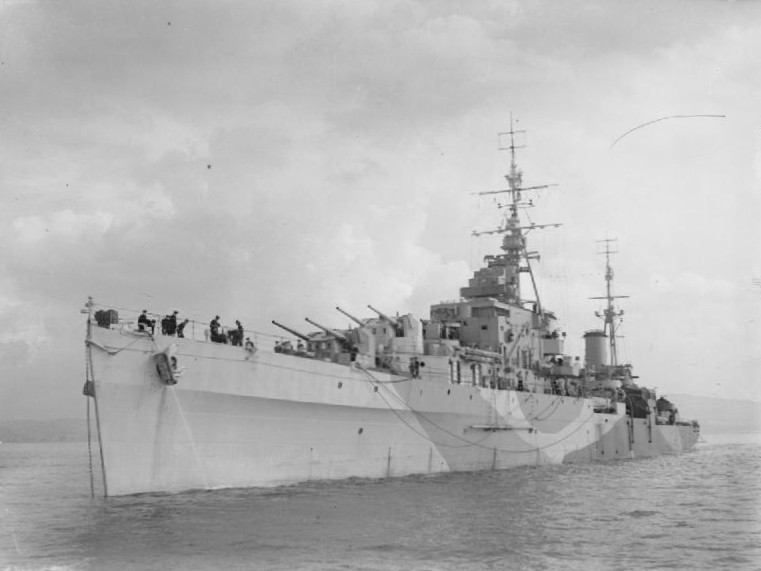
A cruiser at anchor viewed from ahead and to one side, showing the forward twin gun mountings and bridge.

3 September 1943 · catalogue attribution

HMS Royalist at anchor at Greenock in an official Royal Navy photograph catalogued as 3 September 1943.

S. J. Beadell, Royal Navy official photographer / Imperial War Museums, A 19015 · Source · Public domain (source statement)

Identification, date and credit checked against the Commons reproduction of IWM A 19015. The IWM catalogue request was inaccessible in this pass. This is not a photograph of the April 1944 operation. Commons marks the official photograph public domain under PD-UKGov.

An admiral and a captain

The Admiralty’s ship list for Tungsten names Royalist as the flagship of Rear-Admiral A. W. La T. Bisset, Rear-Admiral, Escort Carriers. It separately names Captain M. H. Eveleigh as the cruiser’s commanding officer and lists eight 5.25-inch guns. YT-T22

Those entries describe different responsibilities: Bisset commanded a force, while Eveleigh commanded the ship carrying him. Calling Royalist a flagship should not turn her into the headquarters of every part of the operation. Vice-Admiral Moore, flying his flag in Anson, conducted the attack on Tirpitz after the Commander-in-Chief parted company.

Bringing the carriers together

For the passage north, Bisset commanded Force 2. It included Royalist, four escort carriers, Furious, other cruisers, destroyers and two fleet oilers. This group sailed from Scapa on 30 March and was to join the force that had been covering the Arctic convoy JW 58. YT-T22

On 1 April, favourable weather helped prompt the decision to bring Tungsten forward by a day. The rendezvous changed too. The Admiralty account says Bisset’s force then had to proceed at its maximum speed of seventeen knots, while the oilers were detached with an escort to a separate fuelling position.

Seventeen knots describes this mixed force’s movement. It is not Royalist’s individual maximum speed. The passage illustrates how the timing of a carrier operation could be governed by slower ships and the need to keep fuel available for the destroyers.

A turn in a snowstorm

The following morning, Pursuer’s steering gear broke down. Bisset turned his force towards her to avoid becoming too widely separated in poor visibility. A snowstorm then hid the ships from one another, with Pursuer and the approaching force on opposite courses. YT-T22

The account quotes Bisset on the difficulty of getting the order to turn back through to all the ships by short-range wireless. Visibility cleared in time to avoid a serious incident. It was a near collision, not a recorded collision or proof that Royalist herself had lost steering.

The episode shows the practical demands behind the word command. A decision aboard a flagship still had to reach the other ships quickly enough for them to act together.

A force within the operation

After the forces joined, Royalist headed Force 8 with Emperor, Searcher, Fencer, Pursuer, Sheffield and six destroyers. Anson headed Force 7, which included the two fleet carriers. These were the operational groupings recorded for Tungsten, distinct from the passage organisation. YT-T22

The summary says the two carrier forces remained in visual signalling touch during flying operations and the passage. It also records Bisset’s praise for the escort carriers’ engine-room departments, which had spent much of the operation maintaining their ships’ full speed with little margin for keeping station.

Royalist’s guns were part of the force’s armament, but the attack on Tirpitz was delivered by aircraft. The inspected account does not establish that Royalist bombarded the battleship or provide a complete record of individual fighter-control instructions from her operations spaces.

Follow Tungsten and the Return to Repair, then compare the striking fighters from Pursuer with the fleet protection supplied by Fencer.

Evidence within reach

Sources for this page

Open a note for the passage, inspection status and limits. Source records link to the available documents.

YT-T22Admiralty Battle Summary No. 27: Operation Tungsten

Official wartime operational synthesis · scan of printed edition

Passage: Printed pp.2–5, 9 and 12 / PDF pp.8–11, 15 and 18: command, passage, force organisation, return and ship list

Shared Victorious/Furious strike organisation; squadron exchange; aircraft preparation and fleet protection; planned flying programme; Barracuda II and selected bomb loads; conditional expectations for bomb effects. Reported release heights and the two-aircraft reduction in the second strike.

Checked: Title and source-list pages and the cited printed pages visually inspected on 20 October 2026. Full 40-page scan retained with SHA-256; selected page renders retained. Source list identifies Home Fleet report M.056731/44 and carrier reports dated 5 April 1944. Appendix E read as a programme, not an execution log. Printed p.1 and strike observations on pp.6–7 also visually checked for the gun profiles. Printed pp.2, 7 and 14 / PDF pp.8, 13 and 20 rechecked for Hellcat roles, aircraft particulars and the damaged-hook loss. Printed pp.2, 12, 15, 22 and 24 / PDF pp.8, 18, 21, 28 and 30 visually checked on 20 October 2026 for Emperor’s roster, two fighter groups, Hoare’s loss and the flying programme. Printed pp.7, 12, 14–15 and 24 / PDF pp.13, 18, 20–21 and 30 visually checked on 21 October 2026 for Searcher, Fell’s escort role and the Wildcat variants. Printed pp.4, 6, 12, 15 and 24 / PDF pp.10, 12, 18, 21 and 30 visually checked on 21 October 2026 for Pursuer, Graham, Sleigh, the steering incident and Wilkinson’s return footnote. Printed pp.3, 6, 8, 12 and 24 / PDF pp.9, 12, 14, 18 and 30 visually rechecked on 21 October 2026 for Fencer’s fleet protection, aircraft and flying programme. Printed pp.2–5, 9 and 12 / PDF pp.8–11, 15 and 18 visually rechecked on 21 October 2026 for Royalist, Bisset, Eveleigh, force reorganisation and Sheffield. Printed pp.2, 5, 9 and 12 / PDF pp.8, 11, 15 and 18 visually rechecked on 21 October 2026 for Anson, Moore, McCarthy, guns, Force 7 and the decision to cancel the repeat attack.

Limits: An official synthesis compiled from reports, not the signed original reports of Victorious and Furious. Its source list is evidence of the compiler’s sources, not proof we inspected those manuscripts. Aircraft allocation, actual departures, aircraft attacking and fleet-defence aircraft are distinct counts. The bomb-penetration heights are planning expectations, not confirmed damage results. No exact bomb mark, explosive fill or reconstructed complete flight log is assigned. Its armament footnote is a British assessment, not a dated German final-fit return. Its HA/LA label for the 5.9-inch battery is not adopted; the new profiles do not classify those guns as dual-purpose. Strike descriptions preserve the attackers’ viewpoint. The flying programme is a planned schedule; Emperor’s complete log and squadron records have not been independently compared. The aircraft table lists Wildcat V and VI but does not map them to individual carriers; no mark is assigned to every Searcher aircraft from that table. Pursuer’s steering failure is recorded without a precise mechanical diagnosis; the account describes a narrowly avoided incident, not a collision. The aircrew roster is not a complete flying log. The planned four airborne and four standby Wildcats are not a complete execution log. Twenty-five fleet-defence fighters combine Seafires and Wildcats; nine retained Swordfish do not mean nine continuously airborne. Force 2 and Force 8 are successive operational groupings, not interchangeable labels. Seventeen knots is the mixed force’s stated maximum, not Royalist’s individual maximum. Royalist’s eight 5.25-inch guns are operation-list particulars; no bombardment of Tirpitz or complete fighter-control log is established.

View full source record →

Photograph

Enlarged historical photograph

Web copy resized and compressed; original framing retained. Open image file ↗