A connected ship profile

Kaga

Kaga helped deliver the first blow against Midway. When bombs struck the carrier herself, the emergency spread from steering and command to the survival of the ship’s company.

Profile · Evidence and limits

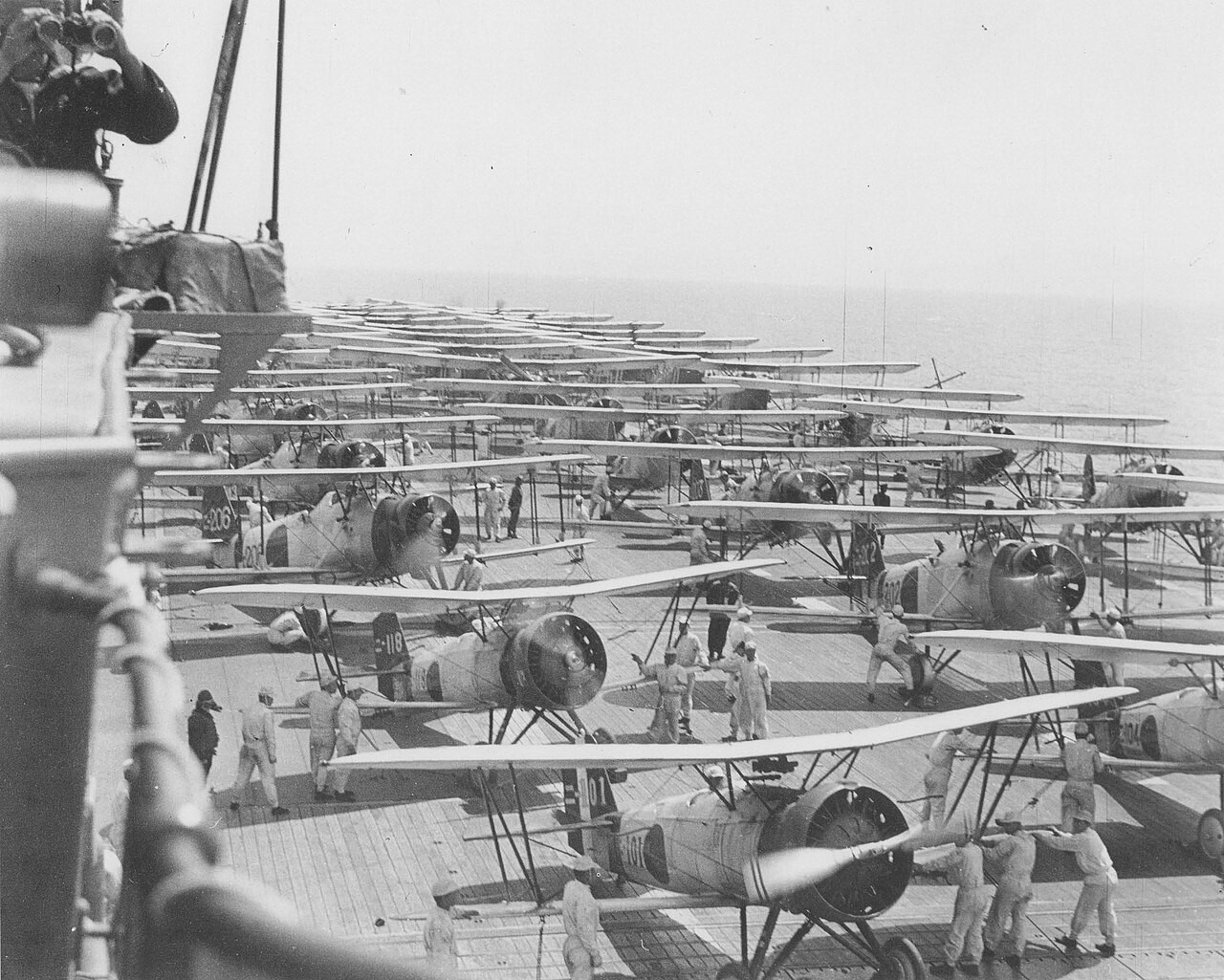
Kaga with biplanes arranged across her flight deck.

11 May 1937

Kaga conducting flight operations with her earlier biplane air group. These aircraft are not the types she carried into Midway five years later.

Shizuo Fukui / Kure Maritime Museum collection · Source · Public domain (source statement)

Aircraft sent against the island

The Japanese attack table assigns eighteen of Kaga’s dive bombers and nine fighters to the opening Midway strike. This contribution formed part of a larger attack assembled from four carriers. Counting that formation does not tell us how many aircraft remained serviceable aboard each ship later in the morning. M14

The distinction becomes particularly important after a carrier is damaged. Aircraft already airborne might survive their parent ship’s loss, but they still needed somewhere to land, fuel and arm.

A battle inside the ship

Kaga’s damage account describes avoiding earlier torpedo attacks before dive bombers appeared overhead. Smoke and shattered glass obscured the bridge; emergency steering was ordered. Further damage destroyed the bridge and killed the captain and those with him. The air officer directed firefighting afterwards. These are the report’s descriptions of what happened within the ship, rather than deductions from American pilots’ hit claims. M14

The account places bomb damage near the forward lift as well as farther aft. The specific number and sequence of hits still require comparison with other evidence. Their consequences are clearer at the operational level: Kaga ceased to be an available flight deck, and her crew faced spreading fires.

A surviving connection to Hiryū

The later organisation table assigns two Kaga fighters to Hiryū’s second counterattack. The remaining Japanese carrier could draw on some aircraft from the disabled ships, but could not replace three lost operating decks merely by accepting their machines. M14

The damage narrative records evacuation to Hagikaze and Maikaze after firefighting failed. It subsequently describes major explosions and sinking. This profile does not use that compressed passage to settle the precise contribution of scuttling or the final sequence of structural failure. M14

Read The Morning Strikes for the attack and The People Left Behind for the wider losses. The original Japanese pages support selected working readings; they are not a complete casualty roll or a certified translation.

Evidence within reach

Sources for this page

Open a note for the passage, inspection status and limits. Source records link to the available documents.

M14First Air Fleet detailed battle report

Contemporary Japanese command report · archival scan

Passage: PDF pp.17–18 and 41–42 / stamped 0019–0020 and 0043–0044: attack organisation, damage and evacuation

The carrier command’s reported assumptions, force organisation and the division of air attack, reconnaissance, support and supply tasks. The opening island strike, request for another attack and changing armament preparations. Hiryū’s counterattack aircraft, remaining strength and later fire emergency. Akagi, Kaga and Sōryū damage and evacuation; opening island-strike allocations.

Checked: Selected Japanese passages on PDF pp.10–11 and 14–15 visually checked for chapter 1. For chapter 4, pp.16–20 visually inspected and compared with M06’s English organisation tables; pp.21–22 inspected for context on 18 October 2026. For Midway Under Attack, PDF pp.29–33 / stamped 0031–0035 visually inspected and selected passages compared with M06; pp.23–26 sampled for context. For Search and Decision, PDF pp.32–33 / stamped 0034–0035 rechecked against M39’s chronological table. PDF pp.34–35 / stamped 0036–0037 visually inspected for The Morning Strikes; p.34 supports command transfer and Hiryū’s continued ability to attack. PDF pp.35–43 rendered and visually inspected for Hiryū Fights Back: pp.35–38 cover counterattack strength, claims and Hiryū’s bombing; pp.42–43 cover fire, propulsion failure and abandonment preparations. Intervening Akagi/Kaga passages inspected for context. PDF p.44 / stamped 0046 visually inspected for the continuation of Hiryū’s evacuation to destroyers. PDF p.18 / stamped 0020 re-rendered and visually inspected for Hiryū counterattack organisation. Ship-profile expansion: PDF pp.17, 39–42 and 44–46 rendered and visually inspected; selected damage passages compared with M06. Cruiser-profile review, 18–19 October 2026: PDF pp.32–33 / stamped 0034–0035 visually rechecked for the successive Tone No.4 reports and decisions. PDF p.45 / stamped 0047 visually rechecked on 21 October 2026 for the Isokaze profile: rescue, treatment and transfer to Hamakaze and Isokaze. The already retained scan was used; a fresh JACAR viewer request returned HTTP 403.

Limits: Working readings, not a certified full translation. The report was compiled after the battle and some tables include actual results, not just pre-battle plans. The English table’s Haruna aircraft type differs from the Japanese image; no type is assigned here. M06 transmits the same report family. Opening narrative compresses later attacks into the same paragraph. Its dates and times are not silently merged with the American chronology; message timing and flight-deck readiness require further records. Initial-contact timing differs between the narrative and M39’s chronological table; no fixed message delay is inferred. Predicted aircraft readiness is not a completed launch. Japanese counterattack target identities and claimed damage on these pages are not confirmed outcomes. Evacuation entries are not a complete personnel roll; scuttling orders and final sinking times remain distinct. Exact bomb-hit counts and the compressed Kaga/Sōryū terminal sinking passages do not settle scuttling contributions. Akagi command-transfer times differ within the report; no single minute is adopted. Sōryū evacuation: M14 PDF p.45 / stamped 0047 names Hamakaze and Isokaze (磯風); M06 renders the second as Isonami. The profile follows the original Japanese name.

View full source record →

Photograph

Enlarged historical photograph

Web copy resized and compressed; original framing retained. Open image file ↗