A connected ship profile

HMS Suffolk

Suffolk helped turn a brief sighting into a pursuit. Her experience also showed why radar contact could never be taken for granted.

Profile · Evidence and limits

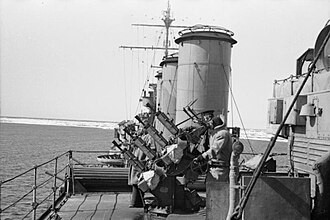
Three sailors at a machine-gun position aboard Suffolk, with ice in the distance.

1941

Men aboard Suffolk on patrol in the Denmark Strait, with ice behind them. Two crew a quadruple Vickers machine-gun mounting while another keeps watch.

R. G. G. Coote / Imperial War Museums, A 4224 · Source · Public domain (source statement)

The catalogue does not tie this frame to the moment Bismarck was sighted.

Eyes before radar

Suffolk’s lookouts first saw Bismarck and Prinz Eugen on 23 May. Tovey’s despatch places the German ships about seven miles away, on the cruiser’s starboard quarter. Suffolk withdrew into mist, increased speed and maintained contact by radar. The initial discovery was visual; radar helped sustain the pursuit. B11

The patrol had been divided between Suffolk near the ice edge and Norfolk farther inshore. That arrangement covered a difficult passage, but seeing the enemy did not ensure that every British commander immediately received the news. Tovey records Norfolk’s signal as the first report to reach his battlefleet; Suffolk’s earlier messages had not reached it. B11

Following a stronger opponent

After Hood’s loss, the cruisers still had to preserve contact. Wake-Walker’s assessment, quoted in the despatch, explained the danger of closing to a range at which their 8-inch guns could be effective. Damage that reduced a cruiser’s speed might also end her ability to shadow Bismarck. Keeping the enemy located had value beyond the damage the cruisers might inflict themselves. B11

The return that did not come

Early on 25 May, Suffolk was following near the limit of her radar’s reach while zigzagging against submarine attack. Contact disappeared on outward legs and had previously returned. When Bismarck turned away during one of those gaps, it did not. Tovey later judged that successful radar shadowing had encouraged overconfidence; that is his retrospective assessment of the episode. B11

Read Contact Lost for the search that followed. The inspected despatch establishes the operational use and limits of radar, but does not provide a complete dated equipment specification for Suffolk.

Evidence within reach

Sources for this page

Open a note for the passage, inspection status and limits. Source records link to the available documents.

B11Tovey’s despatch

Contemporary command report · later official printed edition

Passage: Gazette pp.4849, 4851 and 4854 / PDF pp.3, 5 and 8: first sighting, cruiser tactics and lost radar contact

Discovery, the decision to shadow after Hood’s loss, fuel and interception constraints, Victorious’s attack and later operational pressures. Loss of radar contact, search choices and the misleading radio-bearing plot aboard King George V. Rescue and the reported reason for breaking it off.

Checked: Selected official printed pages inspected. Paragraphs 3–15 on pp.4847–4849 visually checked for chapter 4 on 18 October 2026; earlier checks include pp.4855–4857. For The Pursuit, PDF pp.4–8 / printed pp.4850–4854 visually checked, including paragraphs 19–44 and Admiralty footnotes. For Contact Lost, PDF pp.8–9 / printed pp.4854–4855 visually checked, paragraphs 44–54 and the Prinz Eugen footnote. For Contact Regained, PDF p.10 / Gazette p.4856 visually checked, especially paragraphs 59–63. For The Final Battle, PDF pp.11–13 / Gazette pp.4857–4859 visually checked, paragraphs 70–87. Paragraph 87 on PDF p.13 rechecked for Rescue and Remembrance. Ship-profile expansion: PDF pp.4–5 and 12–13 visually rechecked for Prince of Wales and King George V. Supporting-ship update: PDF p.13 / Gazette p.4859 visually rechecked for Dorsetshire’s gunfire, torpedo attack and rescue, paragraphs 84–87. Cruiser-profile review, 18–19 October 2026: PDF pp.3, 5, 8 and 13 / Gazette pp.4849, 4851, 4854 and 4859 visually rechecked for Suffolk and Norfolk.

Limits: A retrospective commander’s account, not the signed manuscript or a complete inventory of British naval strength. Disagreements with the web transcription remain recorded in the research audit. Later Admiralty footnotes correct the interception forecast and qualify Tovey’s assessment of the first torpedo hit; these are distinct editorial voices. Overconfidence is Tovey’s retrospective judgement. The Admiralty footnote corrects his inference that Prinz Eugen remained present; a possible Walrus sighting is a counterfactual, not a certainty. Position-error estimates are Tovey’s retrospective assessment; finding Bismarck did not itself secure an interception. Night torpedo-hit claims are not independently confirmed. External observations of gun suppression and sinking do not establish the internal damage sequence or settle the contribution of scuttling. The submarine sighting is explicitly uncertain. Rescue totals differ from B24 and the later B26 roll; the speculative Canarias rescue is not adopted. Suffolk’s initial discovery was visual; radar sustained contact. Norfolk’s report reached Tovey first. Norfolk’s limited forward radar coverage is not treated as equivalent to Suffolk’s; no radar model or full dated fit is assigned.

View full source record →

Photograph

Enlarged historical photograph

Web copy resized and compressed; original framing retained. Open image file ↗