A connected ship profile

Prinz Eugen

Prinz Eugen escaped the pursuit of Bismarck. Escape gave her an opportunity to raid, but keeping that opportunity depended on fuel, machinery and secrecy.

Profile · Evidence and limits

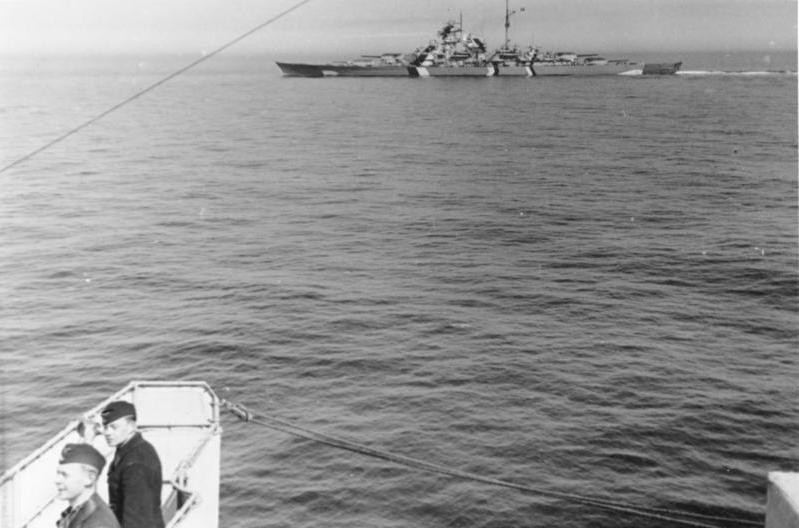
The bridge wing of Prinz Eugen with Bismarck visible in the distance.

May 1941

Prinz Eugen’s bridge wing in the foreground, with Bismarck in the Baltic beyond. The scene shows the ships operating together before the Atlantic battle.

Bundesarchiv, Bild 146-1989-012-03 / Lagemann / CC-BY-SA 3.0 · Source · CC BY-SA 3.0 de · Resized and compressed web copy

The second German ship

Prinz Eugen was a heavy cruiser, armed with eight 8-inch guns. That battery was smaller in calibre than Bismarck’s, but the cruiser was an additional fighting ship with her own commander and tasks. The later American official history supplies this limited armament detail; its other specifications are not assumed to describe her exact May 1941 fit. B31

She was ahead of Bismarck when the British force engaged in the Denmark Strait. Tovey’s despatch records two German ships firing during the action. Their presence complicates any attempt to assign every British hit or observed fire to a particular attacker. B11

A separate raiding mission

The diary’s account of 24 May records orders to break away, refuel and conduct independent operations against merchant shipping. An initial separation attempt did not last; a later instruction sent the ships apart. Brinkmann’s accompanying discussion also shows that he did not possess a complete explanation of Lütjens’ intentions for Bismarck. B25

The ships’ subsequent movements must therefore be reconstructed from their separate records. Prinz Eugen’s commander’s inference about Bismarck’s destination is evidence of what he thought, rather than an order issued aboard the battleship.

Why survival did not mean unrestricted raiding

Later diary passages describe a steam leak, propeller trouble and turbine restrictions. Brinkmann considered speed essential to avoiding stronger enemy forces. With machinery deteriorating and repairs at sea inadequate, he decided to seek a repair port. The diary ends with arrival and docking at Brest on 1 June. B25

This provides a useful comparison when considering a surviving Bismarck: an escaped warship could still impose demands on British forces, yet its ability to attack shipping depended on remaining operational. It does not prove that Bismarck would have followed the cruiser’s exact course or timetable.

The diary used here is a modern bilingual transcription and translation, not a facsimile. See Departure and Discovery and Contact Lost for the wider operation.

Evidence within reach

Sources for this page

Open a note for the passage, inspection status and limits. Source records link to the available documents.

B25Prinz Eugen’s war diary

Contemporary ship’s diary through modern bilingual transcription and translation

Passage: Bilingual edition pp.24–25, 60–62 and 71: separation, machinery restrictions, repair decision and arrival

Separate departure and rendezvous, the encounter with Gotland, the cruiser’s refuelling, and German expectations during the outward passage. Independent raiding orders, machinery restrictions and the decision to seek repairs.

Checked: Edition pp.1 and 3–14 read on 18 October 2026; full 122-page PDF retained as a research copy. Ship-profile expansion: selected bilingual text on pp.24–25, 60–62 and 71 read; no original facsimile inspected.

Limits: Retypeset edition, not original page images. Its introduction identifies Bundesarchiv and NARA T1022 roll 2815 copies, not independently authenticated here. Editorial brackets remain distinct from diary text. Clock changes and inconsistent positions preclude an unqualified combined timeline. Prinz Eugen’s fuel figures are not Bismarck’s. Brinkmann’s estimates of British positions, speed and intentions are his assessments, not verified British dispositions.

View full source record →
B11Tovey’s despatch

Contemporary command report · later official printed edition

Passage: PDF p.4 / Gazette p.4850, paragraphs 16–20: German formation and Denmark Strait action

Discovery, the decision to shadow after Hood’s loss, fuel and interception constraints, Victorious’s attack and later operational pressures. Loss of radar contact, search choices and the misleading radio-bearing plot aboard King George V. Rescue and the reported reason for breaking it off.

Checked: Selected official printed pages inspected. Paragraphs 3–15 on pp.4847–4849 visually checked for chapter 4 on 18 October 2026; earlier checks include pp.4855–4857. For The Pursuit, PDF pp.4–8 / printed pp.4850–4854 visually checked, including paragraphs 19–44 and Admiralty footnotes. For Contact Lost, PDF pp.8–9 / printed pp.4854–4855 visually checked, paragraphs 44–54 and the Prinz Eugen footnote. For Contact Regained, PDF p.10 / Gazette p.4856 visually checked, especially paragraphs 59–63. For The Final Battle, PDF pp.11–13 / Gazette pp.4857–4859 visually checked, paragraphs 70–87. Paragraph 87 on PDF p.13 rechecked for Rescue and Remembrance. Ship-profile expansion: PDF pp.4–5 and 12–13 visually rechecked for Prince of Wales and King George V. Supporting-ship update: PDF p.13 / Gazette p.4859 visually rechecked for Dorsetshire’s gunfire, torpedo attack and rescue, paragraphs 84–87. Cruiser-profile review, 18–19 October 2026: PDF pp.3, 5, 8 and 13 / Gazette pp.4849, 4851, 4854 and 4859 visually rechecked for Suffolk and Norfolk.

Limits: A retrospective commander’s account, not the signed manuscript or a complete inventory of British naval strength. Disagreements with the web transcription remain recorded in the research audit. Later Admiralty footnotes correct the interception forecast and qualify Tovey’s assessment of the first torpedo hit; these are distinct editorial voices. Overconfidence is Tovey’s retrospective judgement. The Admiralty footnote corrects his inference that Prinz Eugen remained present; a possible Walrus sighting is a counterfactual, not a certainty. Position-error estimates are Tovey’s retrospective assessment; finding Bismarck did not itself secure an interception. Night torpedo-hit claims are not independently confirmed. External observations of gun suppression and sinking do not establish the internal damage sequence or settle the contribution of scuttling. The submarine sighting is explicitly uncertain. Rescue totals differ from B24 and the later B26 roll; the speculative Canarias rescue is not adopted. Suffolk’s initial discovery was visual; radar sustained contact. Norfolk’s report reached Tovey first. Norfolk’s limited forward radar coverage is not treated as equivalent to Suffolk’s; no radar model or full dated fit is assigned.

View full source record →
B31Prinz Eugen — official ship history

Retrospective official history · indexed text

Passage: Opening particulars: main battery only; later official history

Limited identification of the cruiser’s main battery.

Checked: Indexed ship particulars read on 18 October 2026; no original armament return inspected.

Limits: The record concerns the ship later designated IX-300. Its displacement, speed, crew and antiaircraft particulars are not adopted as a dated May 1941 fit. Its compressed claim that British aircraft sank Bismarck is not adopted; the final action requires the separate contemporary reports.

View full source record →

Photograph

Enlarged historical photograph

Web copy resized and compressed; original framing retained. Open image file ↗