A connected aircraft profile

Fairey Swordfish

Finding the target was only the beginning. Weather, signals and weapon settings shaped what happened next.

Profile · Evidence and limits

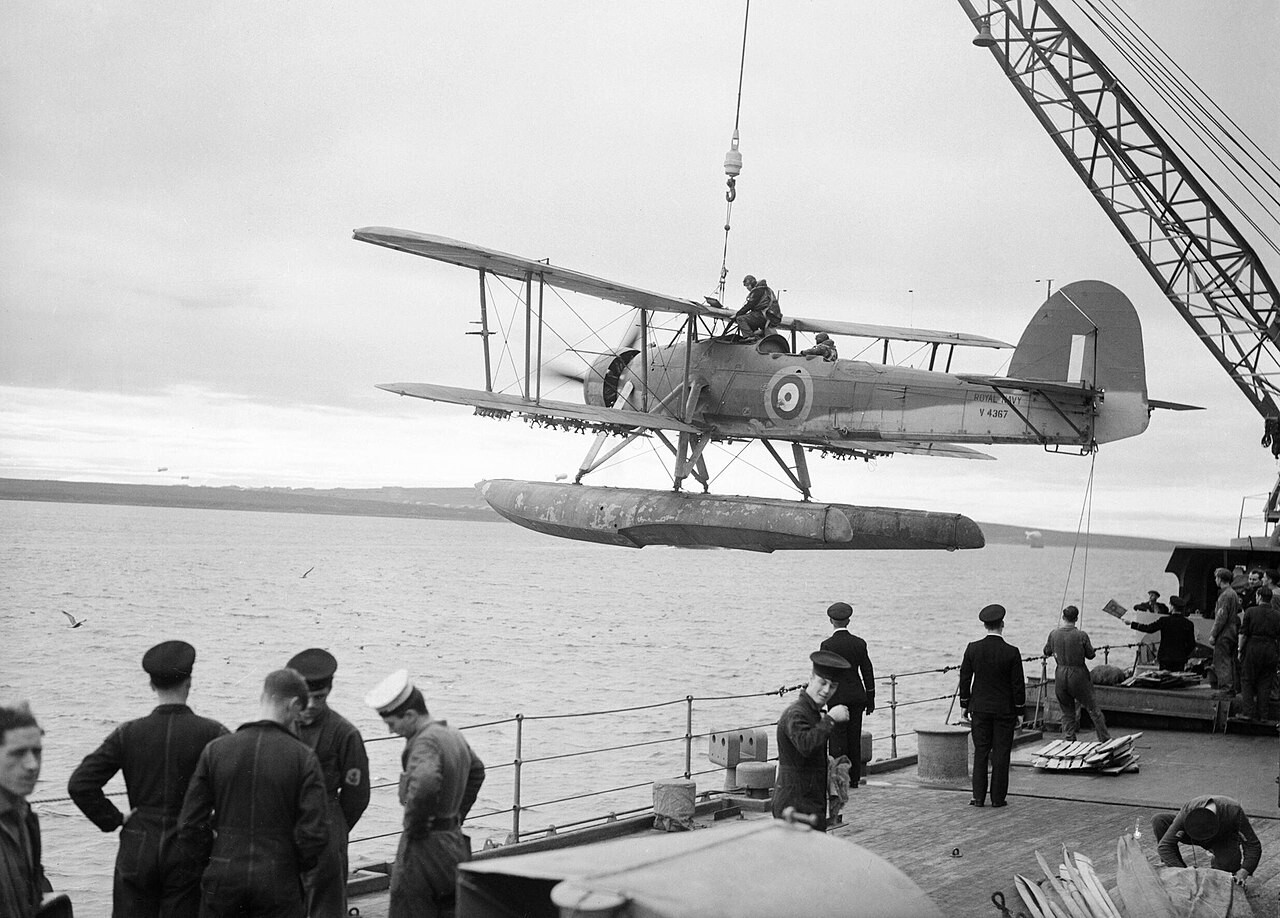
A Swordfish floatplane suspended from a ship’s crane.

October 1941

A float-equipped Swordfish is hoisted aboard the battleship Malaya after reconnaissance. This shows another use of the type; Ark Royal’s torpedo aircraft operated on wheels.

C. H. Parnall / Imperial War Museums, A 5694 · Source · Public domain (source statement)

The aircraft’s float configuration differs from the carrier aircraft used against Bismarck.

An aircraft within an operation

Swordfish from Ark Royal searched, shadowed and attacked during the Bismarck operation. The aircraft’s contribution depended on the carrier, deck crews, available machines, weather and information reaching the aircrews. B04

The two striking forces

The first force mistakenly attacked Sheffield. Somerville’s report records a 30-foot torpedo setting and Duplex pistols. It also describes missing information about the friendly ship and premature torpedo explosions. B04

Before the second strike, contact pistols replaced the earlier configuration and torpedoes were set for 22 feet. Crews were instructed to contact Sheffield before attacking. The changes involved both weapons and identification. B04

Three people in an open aircraft

The Swordfish was a biplane with a standard crew of three: pilot, observer and telegraphist/air gunner. Navy Wings’ general type description gives a wingspan of 45 feet 6 inches and lists forward and rear .303-inch machine guns. These are supporting aircraft details, not proof of a particular machine’s equipment on 26 May. B28

Somerville’s report gives a more immediate glimpse of the crew arrangement. One Swordfish returned with its pilot and air gunner wounded but its observer uninjured. The same passage records icing, cloud and intense antiaircraft fire. Success against Bismarck did not make the aircraft immune to the dangers of the approach. B04

Equipment for finding the target

Long-range tanks were fitted to shadowing aircraft. In the first strike, an aircraft carrying an ASV set—airborne radar for finding surface vessels—located a ship through poor conditions. That ship proved to be Sheffield. Detection and correct identification were separate tasks: equipment could help find a contact without establishing that it was the intended enemy. B04

Performance belongs to conditions

General aircraft specifications are useful, but they do not establish which machines were serviceable or what each carried on a particular sortie. Individual load records and the exact torpedo mark still require separate checking.

Navy Wings’ page includes performance figures and several weapon options across the type’s service. It is a modern operator’s summary, not a 1941 sortie return; its different quoted torpedo weights also need reconciliation. Later rockets, radar fits or anti-submarine loads must not be assigned automatically to the Bismarck attack. B28

Continue with the carrier attacks or examine the torpedo settings.

A later task with Fencer

In April 1944, Swordfish also supported the attack on Tirpitz, serving in anti-submarine patrols while the strike aircraft were away. The Admiralty summary lists nine aboard Fencer and records patrols maintained by aircraft from Fencer and Furious. This was protection for the carrier force, separate from the bombing attack over Tirpitz. Nine aircraft retained for patrol work does not establish that all nine flew continuously. YT-T22

Evidence within reach

Sources for this page

Open a note for the passage, inspection status and limits. Source records link to the available documents.

YT-T22Admiralty Battle Summary No. 27: Operation Tungsten

Official wartime operational synthesis · scan of printed edition

Passage: Printed pp.8 and 12 / PDF pp.14 and 18: fleet patrols and Fencer aircraft list

Shared Victorious/Furious strike organisation; squadron exchange; aircraft preparation and fleet protection; planned flying programme; Barracuda II and selected bomb loads; conditional expectations for bomb effects. Reported release heights and the two-aircraft reduction in the second strike.

Checked: Title and source-list pages and the cited printed pages visually inspected on 20 October 2026. Full 40-page scan retained with SHA-256; selected page renders retained. Source list identifies Home Fleet report M.056731/44 and carrier reports dated 5 April 1944. Appendix E read as a programme, not an execution log. Printed p.1 and strike observations on pp.6–7 also visually checked for the gun profiles. Printed pp.2, 7 and 14 / PDF pp.8, 13 and 20 rechecked for Hellcat roles, aircraft particulars and the damaged-hook loss. Printed pp.2, 12, 15, 22 and 24 / PDF pp.8, 18, 21, 28 and 30 visually checked on 20 October 2026 for Emperor’s roster, two fighter groups, Hoare’s loss and the flying programme. Printed pp.7, 12, 14–15 and 24 / PDF pp.13, 18, 20–21 and 30 visually checked on 21 October 2026 for Searcher, Fell’s escort role and the Wildcat variants. Printed pp.4, 6, 12, 15 and 24 / PDF pp.10, 12, 18, 21 and 30 visually checked on 21 October 2026 for Pursuer, Graham, Sleigh, the steering incident and Wilkinson’s return footnote. Printed pp.3, 6, 8, 12 and 24 / PDF pp.9, 12, 14, 18 and 30 visually rechecked on 21 October 2026 for Fencer’s fleet protection, aircraft and flying programme. Printed pp.2–5, 9 and 12 / PDF pp.8–11, 15 and 18 visually rechecked on 21 October 2026 for Royalist, Bisset, Eveleigh, force reorganisation and Sheffield. Printed pp.2, 5, 9 and 12 / PDF pp.8, 11, 15 and 18 visually rechecked on 21 October 2026 for Anson, Moore, McCarthy, guns, Force 7 and the decision to cancel the repeat attack.

Limits: An official synthesis compiled from reports, not the signed original reports of Victorious and Furious. Its source list is evidence of the compiler’s sources, not proof we inspected those manuscripts. Aircraft allocation, actual departures, aircraft attacking and fleet-defence aircraft are distinct counts. The bomb-penetration heights are planning expectations, not confirmed damage results. No exact bomb mark, explosive fill or reconstructed complete flight log is assigned. Its armament footnote is a British assessment, not a dated German final-fit return. Its HA/LA label for the 5.9-inch battery is not adopted; the new profiles do not classify those guns as dual-purpose. Strike descriptions preserve the attackers’ viewpoint. The flying programme is a planned schedule; Emperor’s complete log and squadron records have not been independently compared. The aircraft table lists Wildcat V and VI but does not map them to individual carriers; no mark is assigned to every Searcher aircraft from that table. Pursuer’s steering failure is recorded without a precise mechanical diagnosis; the account describes a narrowly avoided incident, not a collision. The aircrew roster is not a complete flying log. The planned four airborne and four standby Wildcats are not a complete execution log. Twenty-five fleet-defence fighters combine Seafires and Wildcats; nine retained Swordfish do not mean nine continuously airborne. Force 2 and Force 8 are successive operational groupings, not interchangeable labels. Seventeen knots is the mixed force’s stated maximum, not Royalist’s individual maximum. Royalist’s eight 5.25-inch guns are operation-list particulars; no bombardment of Tirpitz or complete fighter-control log is established.

View full source record →
B04Somerville’s despatch

Contemporary command report · later official printed edition

Passage: Paragraphs 10–15, 21–24 and 30–42, printed pp.4861–4863: search, attacks, weather and recovery

Identification failures, reported torpedo settings and revised instructions for the second striking force. Search conditions, the distinction between sighting and receipt times, the handover to carrier aircraft and limits on Renown’s engagement. Sheffield’s guidance of aircraft, splinter casualties and handover to destroyers; Dorsetshire’s approach from convoy SL 74.

Checked: Selected passages compared visually with the printed edition on 18 October 2026. For Contact Regained, PDF p.15 / Gazette p.4861 visually checked, paragraphs 6–18. For equipment profiles, PDF pp.15–17 / Gazette pp.4861–4863 re-rendered and visually inspected: weather, serviceability, search equipment and crew roles. Catalina profile: PDF p.15 / printed p.4861 rechecked visually for paragraphs 10–15. Supporting-ship update: PDF pp.16–18 / Gazette pp.4862–4864 visually inspected, especially paragraphs 21–24, 30–37, 44 and 50.

Limits: The transcription and printed version transmit the same report. Individual aircraft loads, the exact torpedo mark and confirmed damage require separate records. Report timestamps and receipt times remain distinct; the original Catalina and carrier-aircraft messages have not been compared.

View full source record →
B28Swordfish type details and HS554

Later operator and heritage collection account

Passage: Navy Wings HS554 collection page · crew, dimensions and general armament table; later operator account

Standard crew size, wingspan and general machine-gun arrangement.

Checked: Description and specification fields read on 18 October 2026. Original 1941 aircraft handbook and individual fit records not inspected.

Limits: HS554’s object history and the general type table are distinct. Different torpedo weights appear in the page; they are not harmonised. Later weapon options, radar fits and general performance figures are not assigned to Bismarck sorties.

View full source record →

Photograph

Enlarged historical photograph

Web copy resized and compressed; original framing retained. Open image file ↗