A connected ship profile

HMS Hood

Before she became a national loss, Hood had spent two decades as one of the Royal Navy’s most recognisable ships.

Profile · Evidence and limits

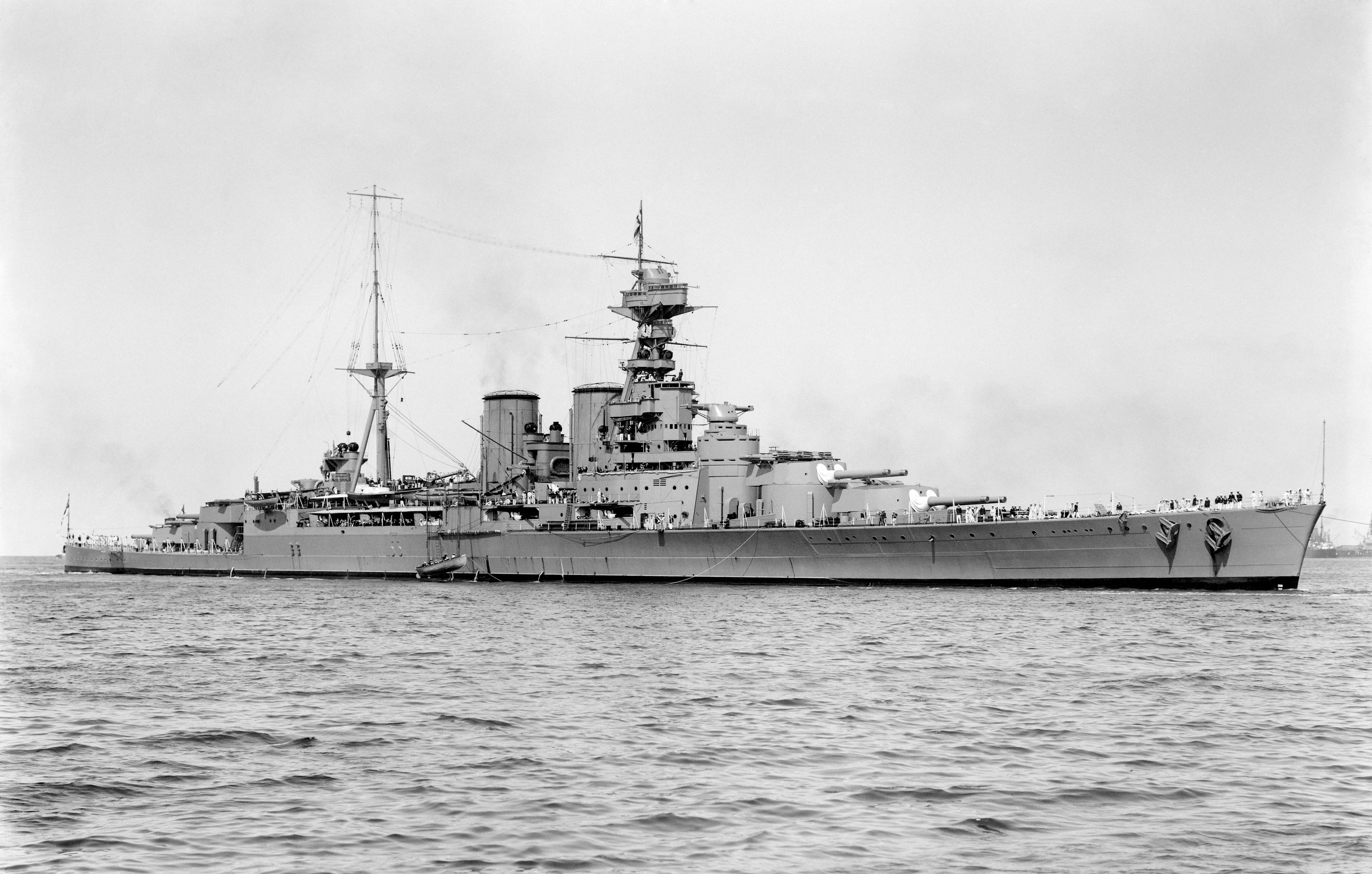
HMS Hood viewed from the side across the water.

17 March 1924

Hood photographed seventeen years before the Denmark Strait battle. Her appearance here should not be read as her complete 1941 equipment fit.

Allan C. Green / State Library Victoria; restoration by Adam Cuerden · Source · Public domain (source statement)

Digitally restored version supplied by Commons; both photographer and restorer credited.

More than her final battle

Hood’s size, heavy guns and public role made her a familiar symbol of British naval power. By 1941, however, her planned major refit had been postponed by war. Reputation and actual condition belong in the same account. B10

This profile connects the ship’s service across stories. It will expand as earlier episodes receive their own research and editorial review.

1920: a ship enters service

Hood was commissioned in 1920 and became a prominent representative of the Royal Navy between the wars. Her earlier service provides a wider setting for the shock of her loss. Detailed interwar chapters remain in preparation. B10

1940: the French fleet

Hood took part in the British attack on the French fleet near Oran. This belongs to a separate account of Mers-el-Kébir, with its own decisions, losses and evidence. That story has not yet been researched in depth for this collection. B10

1941: the Denmark Strait

Hood and Prince of Wales intercepted Bismarck and Prinz Eugen. Hood’s destruction was an immense human loss and changed the risks facing the pursuing British force. Read the chapter on her loss.

The Hood Association records 1,415 dead and three survivors. Individual lives must sit alongside that total. The roll provides a starting point; an independent nominal audit is still outstanding. B07

Why the loss mattered

Tovey’s despatch connects Hood’s loss and damage to Prince of Wales with his willingness to keep King George V in the pursuit as fuel and screening pressures increased. This is evidence of a serious immediate operational effect, rather than proof that Britain had lost overall naval superiority. B11

Further profile work will examine protection, refits, crew experience and dated operating capability. Nominal specifications will not be presented as measured performance in the final action.
Photographs

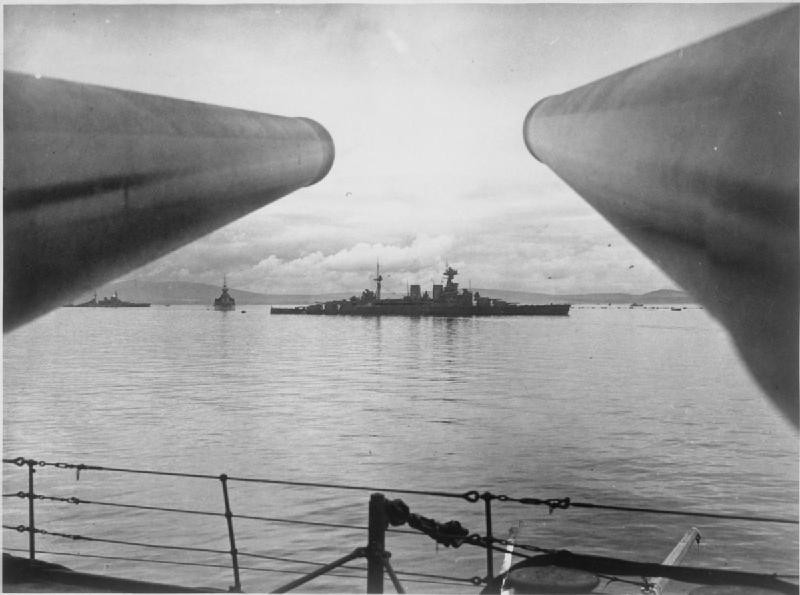
Hood in the distance, framed by two large gun barrels aboard Rodney.

Exact date not established

The IWM catalogue identifies Hood between two of Rodney’s 16-inch guns. The broad catalogue date is not used to assign a particular operation.

R. G. G. Coote / Imperial War Museums, A 111 · Source · Public domain (source statement)

Catalogue gives a broad Second World War date range; no precise date adopted.

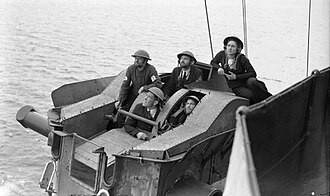
Men aboard Hood looking upwards from an antiaircraft control position.

Exact date not established

Members of Hood’s antiaircraft control team. The photograph brings the people operating the ship into view; the catalogue’s aircraft-destruction claim is not adopted here.

R. G. G. Coote / Imperial War Museums, A 174 · Source · Public domain (source statement)

Catalogue gives a broad Second World War date range; no precise date or aircraft-kill claim adopted.

Evidence within reach

Sources for this page

Open a note for the passage, inspection status and limits. Source records link to the available documents.

B10The loss of the mighty Hood

Modern institutional history

Passage: Introductory commissioning, armament, service and refit passages

Hood’s commissioning, public prominence, eight 15-inch guns and postponed refit.

Checked: Article read; introductory passages rechecked on 17 October 2026.

Limits: Not a ship’s log or dated performance trial. Its precise shell-trajectory and counterfactual assertions are not adopted here.

View full source record →
B07Hood’s memorial roll

Compiled memorial record

Passage: Memorial roll introductory totals

The recorded loss of 1,415 men and a starting point for individual lives.

Checked: Introductory totals and sample entries read; not a complete nominal audit.

Limits: An independent check of the full roll remains outstanding. Biographical details and image permissions require their own review.

View full source record →
B11Tovey’s despatch

Contemporary command report · later official printed edition

Passage: Paragraph 64, printed pp.4856–4857

Discovery, the decision to shadow after Hood’s loss, fuel and interception constraints, Victorious’s attack and later operational pressures. Loss of radar contact, search choices and the misleading radio-bearing plot aboard King George V. Rescue and the reported reason for breaking it off.

Checked: Selected official printed pages inspected. Paragraphs 3–15 on pp.4847–4849 visually checked for chapter 4 on 18 October 2026; earlier checks include pp.4855–4857. For The Pursuit, PDF pp.4–8 / printed pp.4850–4854 visually checked, including paragraphs 19–44 and Admiralty footnotes. For Contact Lost, PDF pp.8–9 / printed pp.4854–4855 visually checked, paragraphs 44–54 and the Prinz Eugen footnote. For Contact Regained, PDF p.10 / Gazette p.4856 visually checked, especially paragraphs 59–63. For The Final Battle, PDF pp.11–13 / Gazette pp.4857–4859 visually checked, paragraphs 70–87. Paragraph 87 on PDF p.13 rechecked for Rescue and Remembrance. Ship-profile expansion: PDF pp.4–5 and 12–13 visually rechecked for Prince of Wales and King George V. Supporting-ship update: PDF p.13 / Gazette p.4859 visually rechecked for Dorsetshire’s gunfire, torpedo attack and rescue, paragraphs 84–87. Cruiser-profile review, 18–19 October 2026: PDF pp.3, 5, 8 and 13 / Gazette pp.4849, 4851, 4854 and 4859 visually rechecked for Suffolk and Norfolk.

Limits: A retrospective commander’s account, not the signed manuscript or a complete inventory of British naval strength. Disagreements with the web transcription remain recorded in the research audit. Later Admiralty footnotes correct the interception forecast and qualify Tovey’s assessment of the first torpedo hit; these are distinct editorial voices. Overconfidence is Tovey’s retrospective judgement. The Admiralty footnote corrects his inference that Prinz Eugen remained present; a possible Walrus sighting is a counterfactual, not a certainty. Position-error estimates are Tovey’s retrospective assessment; finding Bismarck did not itself secure an interception. Night torpedo-hit claims are not independently confirmed. External observations of gun suppression and sinking do not establish the internal damage sequence or settle the contribution of scuttling. The submarine sighting is explicitly uncertain. Rescue totals differ from B24 and the later B26 roll; the speculative Canarias rescue is not adopted. Suffolk’s initial discovery was visual; radar sustained contact. Norfolk’s report reached Tovey first. Norfolk’s limited forward radar coverage is not treated as equivalent to Suffolk’s; no radar model or full dated fit is assigned.

View full source record →

Photograph

Enlarged historical photograph

Web copy resized and compressed; original framing retained. Open image file ↗